
Exchanging small denominations and new banknotes: A shortage of 20,000 VND notes.
As usual, the market for small denominations and new banknotes becomes incredibly active during the Lunar New Year season due to the demand for exchanging old bills for new ones to give as lucky money to children as part of traditional Vietnamese customs and for visiting temples on the first day of the year. The phenomenon of everyone rushing to exchange their old bills for new ones has become an unchangeable "rule."
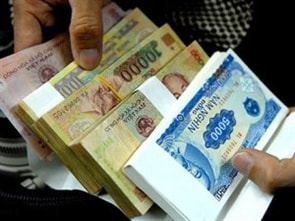
Walk-in customers are rarely given priority by banks when exchanging money for smaller denominations during Tet (Lunar New Year). (Source: Internet)
However, the supply of small denomination banknotes and new currency issued by the State Bank of Vietnam in the last months of the year is limited, so the shortage of small denomination banknotes and new currency persists. Small denomination banknotes, especially those from 5,000 dong and below, suddenly become a "valuable" item during Tet, particularly in large cities.
It's difficult to get small denominations of money at the bank.
Earlier this week, the State Bank of Vietnam's Hanoi branch was bustling with activity as commercial banks in the area flocked there for transactions, most commonly involving exchanging new banknotes and small denominations for both individual and corporate customers.
However, the State Bank of Vietnam's Hanoi branch stated that at the end of the year, the State Bank focuses on disbursing cash to commercial banks to ensure the structure of currency in circulation, meeting only a portion of the public's demand for new banknotes. Therefore, banknotes with denominations of 50,000 VND and below are considered scarcer this year compared to previous years, especially the 20,000 VND denomination.
This is because in previous years, the demand for new 20,000 dong banknotes was high, and the State Bank of Vietnam issued a large quantity. However, after the Lunar New Year, commercial banks returned the money, and the demand for this denomination is generally low throughout the year. Therefore, continuing to print more new banknotes of this denomination would be wasteful.
Many customers complain about being unable to exchange small denominations of money at commercial banks. Ms. Nguyen Thuy Anh, an accountant at an import-export company, said that even though they are a familiar business, this year the bank only allowed them to exchange half of the low-denomination bills (10,000 VND, 20,000 VND) compared to their needs.
Even loyal customers have their credit limits cut, so it's not surprising that banks are turning a blind eye to people's requests for exchanging money for Lunar New Year gifts. According to surveys, major commercial banks such as Vietcombank, BIDV, and Agribank... are not exchanging small denominations or new banknotes for people who need them.
"The bank only exchanges torn or invalid banknotes, not new banknotes of low denominations for Lunar New Year gift-giving," a staff member at the headquarters of Asia Commercial Bank (ACB) stated.
A retail banking director on Tay Son Street in Hanoi said that banks don't have a large supply of new banknotes, so they usually set specific criteria for providing them to customers, prioritizing those with bank accounts and allocating the quantity according to different customer types. This year, banknotes with denominations of 20,000-50,000 dong are quite scarce due to the limited allocation from the State Bank of Vietnam.
An employee at a bank on Thai Ha Street (Hanoi) also reported that new 500 dong and 20,000 dong banknotes are still scarce during the Tet holiday season. Even bank employees are only allowed to exchange a certain amount of 500 dong notes. He said that in previous years he usually helped relatives and friends exchange notes, but this year he couldn't promise anything because there aren't many small denominations like 500 dong, 1,000 dong, and 2,000 dong notes available.
Black market fees remain exorbitant.
In reality, when commercial banks cannot meet the public's demand for new banknotes, a fee-based currency exchange service emerges in the black market. Currently, the internet is flooded with websites offering exchange services for small denominations and new banknotes, with advertisements offering all kinds of denominations, even those that are scarce at commercial banks.
Accordingly, the common exchange fee is 15-25%, sometimes even up to 35-40%. Nguyen Xi and Dinh Le streets (Hanoi) have long been famous for their money exchange services. According to our reporter's observations, on just a short stretch of road from Dinh Le to Nguyen Xi, there are more than a dozen women "lying in wait" to offer money exchange services. For denominations such as 10,000, 20,000, 50,000, and 100,000 VND polymer banknotes, unused and in full series, the exchange rate is 10 for 9. For rarer denominations, such as 10,000 VND red paper banknotes or 2 USD bills, the exchange fee is quite high; for 10,000 VND, the rate is 13 for 10, and if you buy in bulk, it will be reduced to 12-12.5 for 10.
According to Ms. Le Thi Cham, a money changer on this street, if you exchange a "decent" amount, regardless of the time of day or night, just call 15 minutes in advance and someone will deliver the money to your door. She also stated that the service will operate until the 30th of Tet (Lunar New Year's Eve), but the closer it gets to Tet, the higher the fees will be.
On the stalls outside Huong Pagoda and many other temples, small denominations of money and "ghost money" (money used in funeral rituals) are sold together. Here, people don't specify how many 500-dong notes you'll get for 100,000 dong; the price is already set at 70,000 dong per bundle (100 notes) for 500 dong notes, 120,000 dong per bundle for 1,000 dong notes, and so on. Even the seemingly unusable 200-dong notes are the most expensive in these places, considered rare, at 30,000 dong per bundle.
After failing to get money exchanged from acquaintances, Ms. Vu Thi Dinh from Tay Ho, Hanoi, had to resort to exchanging small denominations at Phu Tay Ho temple. “My relatives in the countryside are the only ones in Hanoi, so my aunts and uncles called to ask me to exchange some small bills for New Year's gifts and temple visits, but for over a week I’ve been trying everywhere and haven’t been able to. Now I have to accept the high fees; without them, I have no way to get back home.”
"I thought I'd saved up some money to spend on Tet (Lunar New Year) when I go back home, but I didn't expect to have to pay such high fees. From next year onwards, I'll have to ask my relatives for money as soon as I hear from them," Ms. Dinh lamented.
Another popular method for exchanging small denominations of money is through online services. According to Zinzon, the exchange fee for 500 dong notes (for amounts over 100,000 dong) is 25%, while for 1,000 dong notes it's 16%. Meanwhile, an individual named Anh Tuan advertises a "soft" exchange fee: for 5,000 dong and 10,000 dong notes, the fee is only 10% for amounts of 3 million dong or more. Customers are responsible for transportation costs if delivery is required.
This year, lucky money envelopes based on birth years are also fetching exorbitant prices. Currently, some individuals offering money exchange services for Tet (Lunar New Year) have released collections of lucky money envelopes with denominations of 50,000 VND and 2 USD, each featuring a birth year, at unbelievable prices. A 50,000 VND note with a serial number ending in 1945-1994 is being offered at 120,000 VND/note; a 2 USD note with a serial number ending in 1970-2000 is priced at 250,000 VND/note, nearly six times the bank's exchange rate.
According to (Vietnam+)


