
In Kẻ Gám, everyone knows Mr. Phan Văn Lạng – an Outstanding Artist of traditional Vietnamese opera (tuồng). Mr. Lạng recounts that, as a child, he followed his father to the village square and temple grounds to watch opera. His father also performed opera, so the sounds of the drums, the rhythm of the two-stringed fiddle, and the myriad faces of the opera characters naturally seeped into his blood. Like many farmers in Kẻ Gám village, Mr. Lạng doesn't know exactly when opera arrived in this land, only that this traditional art form has persistently followed the people who migrated here for work, and has taken root and remained firmly rooted to this day.

“Traditional opera is very unique; those who see it for the first time are immediately captivated and want to perform it right away. And those who are captivated and deeply immersed in it can't tear themselves away,” Mr. Lang said. Then he enthusiastically recounted his twenties, which he called his “golden age,” when he could perform classic plays such as Trung Trac – Trung Nhi, Luu Binh – Duong Le… In his younger days, he was passionate about performing, and even in his old age, his passion for opera hasn't faded. He spends his days and nights passing on his knowledge and teaching the younger generation.
The plays that Mr. Lang choreographed and taught to the Kẻ Gám village's traditional opera troupe were highly appreciated by the villagers and opera enthusiasts. Mr. Dang Van Huy, the head of the Kẻ Gám traditional opera club, said: "Mr. Lang played a significant role in guiding the Kẻ Gám opera actors. He had a good singing voice and knew most of the ancient stories by heart. In particular, he had a talent for staging ancient stories, even if the scripts were incomplete. He also had an easy-to-understand way of communicating, especially regarding physical movements, and his passion created a strong appeal for the younger generation."

Mr. Dang Van Huy is also one of the traditional opera (tuong) artisans of Ke Gam village, with over 40 years in the profession. His father, Dang Van Huong, was an artisan specializing in playing the role of the male lead wearing a conical hat, and was once selected by the Central Traditional Opera Theatre. Like other generations of traditional opera practitioners, Mr. Huy inherited the "tuong gene" from his father early on, and from a young age, he was captivated by the sounds of drums, two-stringed fiddles, clappers, and the body language and movements of the generals and soldiers in traditional opera stories.
Back then, the "actors" in village-level traditional theater were quite young; he was only in his twenties when he took on leading roles, specializing in playing generals. He performed with such grace and skill that whenever he appeared on stage, the villagers and people from surrounding areas would cheer and shout, laughing and crying along with each scene. "We were so happy to be doing traditional theater; we forgot to eat and sleep, practicing every night, rain or shine," Mr. Huy recounted about theater, a bright light shining in his eyes.
Among those of the same age as Mr. Huy is Mr. Le Khac Tai, now 70 years old. Since his youth, he has specialized in playing the role of the "black actor" – portraying generals of the enemy or loyalists. His generation lived and breathed traditional theater; they may not have had enough to eat or wear, but whenever they heard the drums of the theater, they eagerly went to rehearsals.

“Back then, being assigned to the traditional opera troupe was an honor for the whole family. We packed our lunches and eagerly went to practice. There were nights with drizzling rain and biting winds, but we still cycled from 5 PM until 11 PM before lighting torches and heading home,” Mr. Tai recalled with undisguised pride. He recalled countless memories of those days, both happy and sad, such as suddenly forgetting the script on stage, the prompter behind the curtain shouting too loudly, causing the audience to burst into laughter, or insufficient costumes—some lacking jackets, others lacking boots… The opera stages back then were mostly hastily constructed with bamboo on a high mound in the fields. Yet, as soon as the torches were lit and the drums beat, people from all over the region flocked in like a festival. Mr. Tai said that 40 years of following traditional opera meant 40 years living in that bustling atmosphere, and his enthusiasm and passion for the art form never waned.
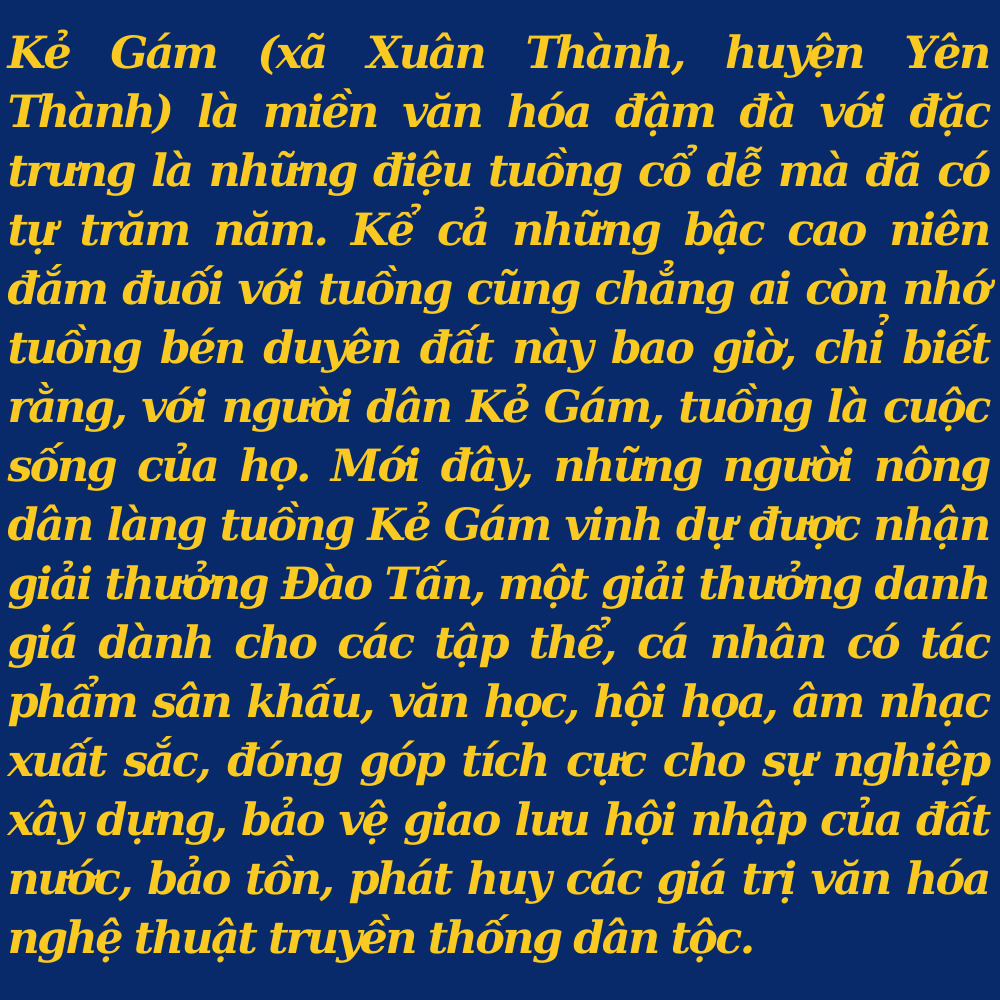
These days, in the village of Kẻ Gám, alongside the hustle and bustle of the harvest season, there's the excitement of hearing stories about the honest farmers of the village receiving the Đào Tấn Award in Hanoi. Ms. Hoàng Thị Dung – who specializes in playing leading male and female roles – still overjoyed, shared: “We are extremely happy and proud to stand on the podium to receive the award. The Kẻ Gám traditional theater now not only has awards in the hearts of the people but is also recognized by the State with a prestigious award.”
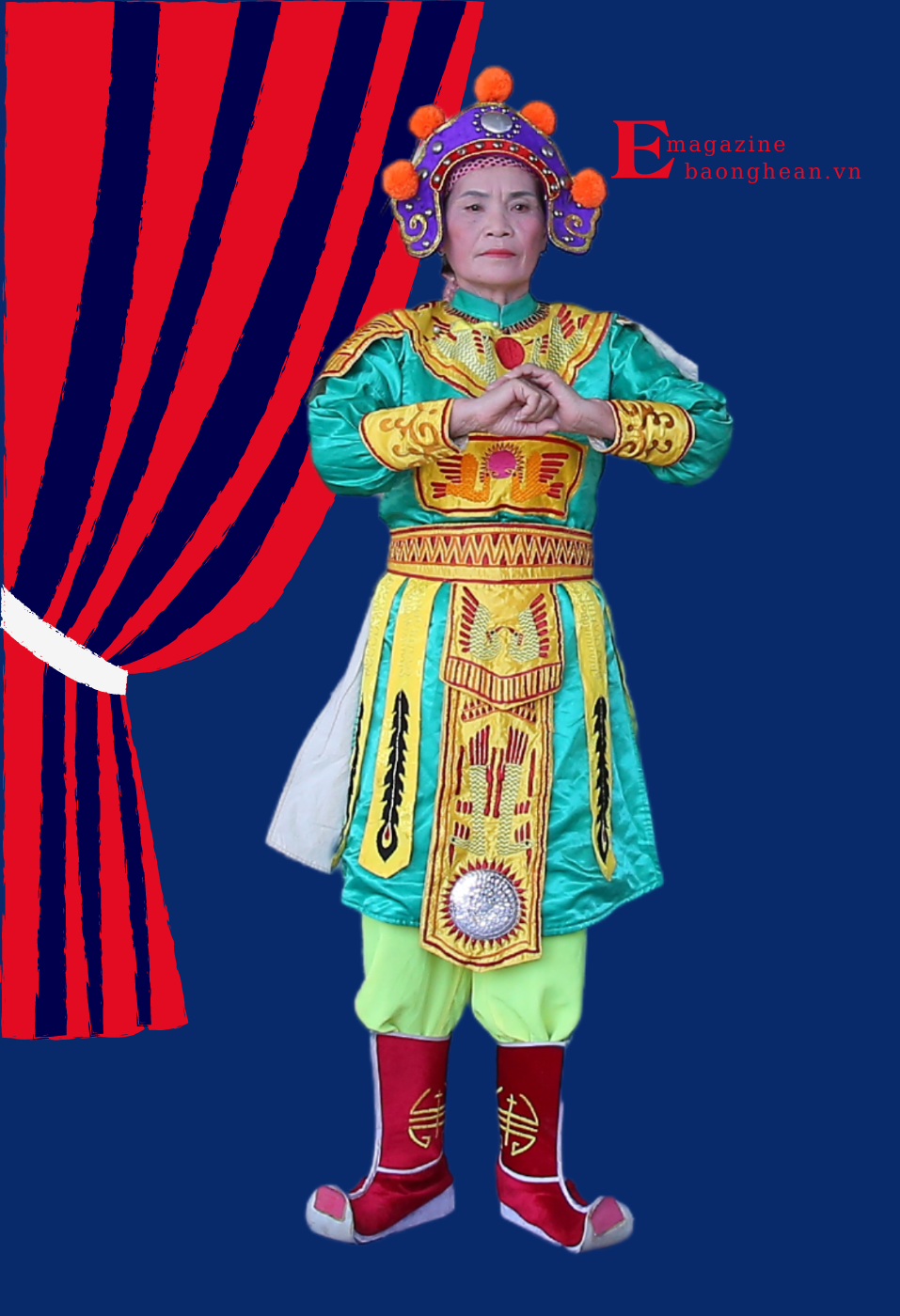
Ms. Dung recounted that during the awards ceremony, her performance of an excerpt from the play My Chau - Trong Thuy caused a sensation in the audience. People marveled at the smoothness of a peasant's performance in the play, and were surprised and wondered where these peasants learned to sing and act so well. Then, at the reception, she was asked to perform again, much to the emotion of many actors and audience members present that day.
Speaking about the award named after the founder of Vietnamese traditional opera, Mr. Dang Van Huy – Chairman of the Ke Gam Traditional Opera Club – expressed: "After many years of dedication and passion for traditional opera, we receive this award with immense joy. This award gives us even more motivation to continue spreading and passing on the tradition, helping traditional opera to live on and flow forever in the heart of Ke Gam."
Traditional Vietnamese opera in Kẻ Gám village is not only a source of spiritual nourishment but also a cultural brand of this region. "Anyone, from the elderly to young children, young people to senior citizens, can sing opera," said Mr. Đặng Văn Huy. That's a general assessment of the movement, but the number of people who truly understand and perform opera well is not large. To perform well, besides talent, one needs a certain charm and charisma to play the role. Some people are "stuck" with one type of character, finding it difficult to switch to another. Those who love opera know that there are four main types of characters: general, female lead, old man, and male lead. Each type requires a specific actor, expressing charm and embodying the role through physical characteristics, facial expressions, eye contact, dialogue, smile, and even just a simple gesture. Therefore, alongside the joy of recognition, those who love Kẻ Gám opera still have many concerns as the actors' careers in the village are dwindling. The Kẻ Gám theater troupe now has 17 members, the youngest of whom is already… 50!

According to Mr. Huy, the traditional opera of Ke Gam village no longer features the sharp and witty characters of the venerable Phan Lang, Dang Huong, and Phan Long… The old opera troupe also had very skilled musicians; just the sound of the trumpet, flute, drums, and two-stringed fiddle would create a lively atmosphere. Today, although the musical instruments still exist, the musicians who played as well as before are gone. Therefore, the greatest concern of those who love traditional opera in Ke Gam village is how to train a younger generation to succeed them, passionate about opera like their predecessors. “If we talk about love among the younger generation, it only exists in terms of participation, attending and supporting. Wherever there is opera, there are packed audiences of all ages, men and women. But…” – Mr. Nguyen Khac Tai left the sentence unfinished. That “but…” is the concern for transmission, the hope that the sound of opera will continue to resonate, because deep within every person in Ke Gam, opera is an integral part of the village culture, and it must not fade away…