

Sacred Nine-Room Temple
The Nine-Chambered Temple, Past and Present
Before the 18th century, the Nine-Room Temple was built on the summit of Pú Chò Nhàng (over 350 meters high), northwest of Mường Tôn (more than 2 km from Khoẳng-Châu Kim village). During a festival, while bathing the buffalo at Bắng Cọc, on the section of the Nậm Giải river flowing through Khoẳng village, dark clouds gathered and a strong wind blew. A dragon came and swept away Mường Tôn's white female buffalo. The Mường chief considered this a bad omen and ordered the people to kill the buffalo and perform a ritual to ask the heavens, Buddha, and ancestors for permission to build the temple in a different location. Afterwards, a white-necked crow came and picked up a piece of buffalo bone from the old temple (Pú Chò Nhàng), flew back, and dropped it on a small hill south of Mường Tôn called Pú Pỏm.
In the early 20th century, in the second year of Emperor Bảo Đại's reign (1927), the then-prefect of Quỳ Châu, Sầm Văn Hiên, ordered the people of the villages to harvest ironwood and gather it at the riverbank of Piếng Pần village (now part of Châu Thắng district, Quỳ Châu province). Afterwards, skilled craftsmen from the villages came to carve and sculpt the basic parts, transporting them by river upstream to Tà Tạo wharf, and carrying them to the summit of Pú Pỏm to build the temple. Following this, large festivals were held annually. According to veteran educator Lô Khánh Xuyên, former head of the district's Education Department, during that period, each festival was an opportunity for the people to express their reverence for their ancestors, but also a chance to compete in unique folk games: "What could be more fun than the 'tập xạp' and 'vít luống' (bamboo pole jumping and throwing the ball)?" The sounds of drums and gongs during the ceremonies, and the cheers of the festival crowd, lasted for several days. But before that, during the six-day ceremony, no drums or gongs were allowed to be played. When the prohibition ended, everyone would burst into joyful cheers, signaling the return of the village spirits. This tradition was maintained for many years, until 1972, due to the historical circumstances of that period, the corrugated iron roof of the temple was removed and used to roof a cooperative store, and the frame gradually deteriorated, leaving only the weathered foundation.
Responding to the spiritual needs of the people and to revive a major and unique festival of the Thai ethnic group in the western region, the People's Committee of Que Phong district decided to begin the construction and renovation of the Nine-Room Temple at the end of 2003. In June 2006, the first festival will begin, following the last festival held more than 30 years ago. Now, on the site of the old temple, a new temple, strongly resembling the traditional stilt houses of the Thai people, has been erected in the spacious and open Pu Pom hamlet. The entire structure of the temple, with its staircases and the patterns along the railings, evokes a sense of familiarity and closeness for the people. In front of the main entrance, facing the temple, are nine white buffaloes (Quai Me Hao) made of cement, lying prostrate. The interior of the temple uses modern materials but retains the main layout of the stilt house. The altars and ritual objects are simple but dignified. In front of the temple lies the vast, sprawling fields of Chau Kim commune, with the Nam Giai river winding around from the foot of Pu Cho Nhang peak. The temple is nestled against Ten Cang mountain, and further behind lies the immense, distant, and majestic San Noc Yeng mountain range. Mr. Ha Dinh Quy, a resident of Pieng Chao village who is temporarily in charge of the temple, told us that: Around the end of the lunar month, the ancestors often "return" to watch their descendants rebuild the temple. Late at night, the sounds of fire-blowing and horse hooves, sometimes faint, sometimes clear, echo around the temple. It's as if the ancestors are happy because their descendants still remember them...
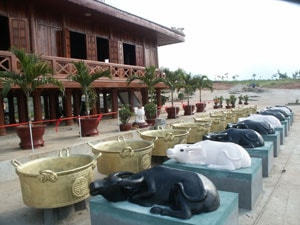 |
Nine-Chamber Temple. |
The festival is dazzling.
Traditionally, each festival included an indispensable offering: a buffalo that had not been used for plowing and had no physical defects. In addition, each village would offer nine piglets, 90 small chickens, and 90 portions of grilled river fish. Nowadays, to be more appropriate, the offerings are not as complete as before, but all the details, however small, necessary for the festival are still ensured.
On the appointed day, the village chief gathers the elders, officials, and young men from the nine villages to bring offerings. The offerings, brought by the young men of each village, include fish, chicken, pork, wine, and buffalo. The procession is led by the village chief, followed by the elders, officials, and offerings, then the buffalo bather, the village shaman, the beautiful young women, and finally the festival-goers from each village. The procession winds through the hamlets, villages, streams, and ravines, all heading towards the temple. Upon arrival, each village divides its offerings and places them in the designated area for its village. There, nine bamboo trays, nine reed platforms, and three wooden trays (except for Muong Ton, which has five wooden trays) are already prepared. The platforms are arranged in four tiers. In the center of each platform is a jar of rice wine with nine bamboo straws already inserted.
The Thai people believe that the road to Muong Pha (Heavenly Realm), the dwelling place of the Heavenly King and Tao Lo Y, has many checkpoints, and at each checkpoint, they must offer a sacrifice to the guardian deity. Therefore, on the first day, they only offer fish, chicken, and pork. On the second day, they perform the "Hap Quai" ceremony (the buffalo sacrifice ceremony) before slaughtering the buffalo. At this ceremony, the head shaman leads the village chief, the village elder, and other elders carrying torches around the village's buffalo three times to show their agreement to offer the buffalo. Then, the village elder takes the buffalo down to bathe at the Ta Tao riverbank with nine symbolic splashes of water and leads it in a different direction to the temple. After the buffalo is tied to the "lac quai" (buffalo tethering post), in front of which is a banyan tree belonging to each village, the village elder swings a knife and symbolically cuts the buffalo's neck. The slaughtered buffalo meat is then placed on the highest platform of the offering area. The shaman continued performing the "Hắp Quái" ritual until the third day. After the ceremony, the meat was prepared on the spot and divided equally among everyone to enjoy. Any leftover meat was either left behind or thrown into the stream; no one was allowed to take any home.
The solemn ceremony concluded, ushering in the lively and joyful activities of the festival. A crossbow shooting competition took place, with nine young men from each village competing. The target was 20 paces away. Prizes included hand-woven brocade fabric, a silver cigarette box, and a leather betel nut box. Other competitions such as tug-of-war, traditional wrestling, bamboo pole dancing, circle dancing, and throwing the ball also attracted many young men and women. But most noteworthy were the romantic songs and performances in various forms such as xuoi, lam, and nhuon. These songs not only wished the village chief long life and peace and happiness for the nine villages and ten hamlets, but also served as love songs and courtship songs. This activity was not limited to the temple area but extended to neighboring villages and continued until the mountains and forests awakened to a new day. The lyrics of the "hắp bảo khéo" (love songs sung by young men and women) are simple yet deeply lyrical: "I wish to catch the dew at the Buffalo Temple so that the reeds can be carried by the wind / I wish to be husband and wife with the beautiful Mường Nọc people, famous throughout the nine villages." The festival has ended, but those songs still seem to float throughout the nine villages and ten districts, bringing closer Mường Chừn and Mường Quáng, and adding beauty to Mường Chón and Mường Chòng. We will meet again at the Nine-Room Temple festival next year. On June 14th this year, I invite you to join the Nine-Room Temple festival, at the headwaters of the Nậm Giải river in western Nghệ An province.
Related news and articles:
Tran Hai-My Ha