

The issue of restoring and preserving the Van Mieu historical site in Nghe An.
As natives of Nghe An province, knowing that Nghe An has a Confucius Temple in Vinh City and that the province has a plan to restore and renovate it, everyone is excited and proud of the tradition of valuing education and learning in their homeland.
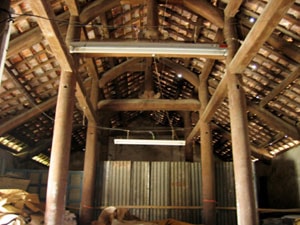
Only the framework of the building remains at the Temple of Literature.
However, how restoration and preservation should be carried out is a question that needs thorough research. It is neither advisable nor possible to build a new cultural structure in a new location and then declare it a historical and cultural monument!
At the Temple of Literature, as far as we know, the only remaining heritage is a building frame, which is now being used as a warehouse by the Nghe An Printing Company. The former Temple of Literature grounds are the area currently occupied by the Nghe An Printing Company and partly by the surrounding residential area. Therefore, the restoration and renovation of the Temple of Literature must begin with this heritage and its grounds; there is no other way.
To accomplish this, a team of scientists and experts in history, culture, and humanities is needed. They will conduct surveys and collect relevant historical documents (photographs, drawings, descriptions) through existing works such as: Bui Duong Lich's Nghe An Ky, Ngo Sy Lien's Dai Viet Su Ky Toan Thu, Le Quy Don's Phu Bien Tap Luc... and gather opinions from contemporary Confucian scholars and historians in the country to develop a scientifically objective economic and technical justification, design, and investment project.
First, we must determine which historical period the monument belongs to. If it is 200 years old, it is certainly from the Nguyen Dynasty; what is the location of the remaining heritage (the building's framework) within the Temple of Literature complex (the Confucius Temple or the House for Literary and Poetry Discussions...), how many structures are there, what is its content, form, architecture, and location within the grounds...?
Based on the survey results, scientists had to design all the structures on the campus grounds according to their original prototypes in order to restore them.
Based on the survey results, we have two options to choose from:
- Firstly, if sufficient evidence and arguments are gathered to determine that this is a historical and cultural relic of national significance and influence, then the recently constructed buildings must be "sacrificed" for restoration and preservation.
- Secondly, if sufficient evidence cannot be gathered and its impact is not very significant, then only the existing heritage (starting from the building's framework) should be restored and a memorial plaque erected. On it, all the historical information that has been collected should be fully recorded.
Some argue that restoring this monument at a location near the old Imperial Examination Hall is the right approach. Linking the Imperial Examination Hall with the Temple of Literature to form a single complex of historical and cultural relics is unscientific!
If deemed necessary, we can restore the Imperial Examination Hall on its original site, following the same survey procedure as described above.
Remember that the locations of old cultural relics were chosen by our ancestors for historical reasons; we should not change history or build new cultural structures based on current conditions.
Nguyen Dinh Vo -123 Herman, Vinh City