From Vinh city, after crossing the Ben Thuy bridge for about 200m, you will reach a fork in the road. Turn left and follow the road along the right bank of the Lam River for about 5km to reach the Tien Dien historical site, where the great poet Nguyen Du, a world cultural figure and author of The Tale of Kieu, rests in eternal peace.
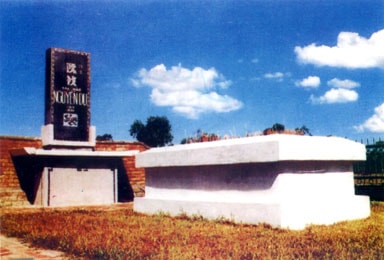 | The tomb of Nguyen Du |
The entire Tien Dien historical site is a collection of many relics: the temple of Nguyen Hue, the temples of Nguyen Nghiem and Nguyen Trong, the tomb of Nguyen Du, Tien Bridge, etc. The Nguyen Du memorial area alone covers about 2 hectares, surrounded by a wall. Entering through the main gate, there is a stone pillar inscribed with the two Chinese characters "Hạ mã" (Dismount), next to it is the guesthouse, followed by the Tư văn house, the memorial stele of Nguyen Quynh, the temple of Nguyen Du, and an exhibition hall displaying artifacts related to his life and career.
The Tư Văn House, made of ironwood and tiled with scale-shaped tiles, is surrounded by walls. It has two chambers, originally the Văn Thánh House of Nghi Xuân district in Xuân Viên, which Nguyễn Nghiễm brought and built here. In 1790, the Tư Văn House was destroyed by fire, and later rebuilt by members of the Nguyễn family and district officials. It serves as a place for cultural and spiritual activities, where family members and close friends gather to offer incense, worship, and compose poetry. Inside the Tư Văn House are five couplets, the most notable of which is:
Etiquette and morality are usually observed in the examination system. The teachings of the moral code are recorded in writing at night. (Etiquette must be diligently studied. Moral principles must always be remembered.)
The memorial stele dedicated to Nguyen Quynh was erected in 1762 by his second son, Nguyen Nghiem. Located in the center of the temple, the stele is built high. At the top is inscribed the words: "Hong Nguyen Tuan Luu" (Great source, strong stream). On either side of the stele are couplets:
Feeling the times, even the sun and moon The legend of the land (When remembering, gaze upon the sun and moon. The teachings will live on with these mountains and rivers.) In front of the stele, there are still a muỗm tree and a bồ lỗ tree planted by Nguyễn Quỳnh for his family to tie up their horses; they are now nearly 300 years old.
The Nguyen Du ancestral temple was built in 1825 on a plot of land in Tien Giap hamlet. Inside, there is an altar built of lime and sand, above which is a horizontal plaque inscribed with the words "Hong Son The Pha" (Genealogy of Hong Son), a gift from Hoang Phu Thai, the Trung Hieu Dai Phu (Great Master Trung Hieu) of the Qing Dynasty, in 1790. In 1940, the Tien Duc Intellectual Development Association moved this temple to its current location within the memorial area. On the altar is a stone tablet with the inscription "Thanh Hien Nguyen Tien Sinh" (Mr. Nguyen of Thanh Hien).
Next to the Nguyen Du temple is an exhibition hall displaying a number of rare documents and artifacts directly related to the life and career of the great poet, such as inkstones, teacups, winecups, coat hangers, a hunting compass, a wooden relief depicting the procession of a doctor returning home in triumph, and copies of The Tale of Kieu printed in over 50 languages.
Among the exhibits is the Mai Hac plate, reflecting Nguyen Du's diplomatic mission to China in 1913. During this trip, Nguyen Du visited a porcelain workshop. The workshop owner, knowing that he was a Vietnamese envoy and also a talented poet, showed him a plate depicting a crane standing beside a plum tree and asked for a poem to inscribe on the plate. Nguyen Du wrote:
Singing and enjoying the peaceful scenery, Mai is an old friend, the crane is an acquaintance. A few hundred meters east of the memorial site is the Nguyen Nghiem Temple, also known as the Temple of the Great King, built in 1742.
Nguyen Du passed away on September 16, 1820, in the capital city of Phu Xuan. His remains were initially buried in An Ninh commune, Quang Dien district, Thua Thien-Hue province. In the summer of the year Giap Than (1824), Nguyen Ngu, Nguyen Du's son, moved his remains to Dong Mai for reburial, later relocating them to Dong Thanh, near the garden where Nguyen Du lived in Tien Dien. Nearly 100 years later, his descendants reburied them in Dong Cung, the location of his current tomb. In 1989, the local authorities renovated the tomb, giving it the majestic and beautiful appearance it has today.
The Tien Dien historical site, where Nguyen Du wrote the Tale of Kieu, has become an attractive cultural tourism destination. Every year, it welcomes thousands of visitors who come to explore and study, reliving the heroic, poetic atmosphere and rich cultural identity of Nghe Tinh province.
|
;)
 baonghean.vn