

The beautiful bond of betel and areca nuts.
A grand, meticulously prepared wedding will have a ceremonial offering filled with hundreds of betel nuts and hundreds of betel leaves; even a small, simply prepared wedding cannot do without a bunch of betel nuts and a handful of betel leaves placed on a plate.
From ancient times to the present day, whether it's a wedding following the customs of Northern, Central, or Southern Vietnam, or even a wedding in the West, a Vietnamese wedding cannot be without a tray of betel nuts and leaves.
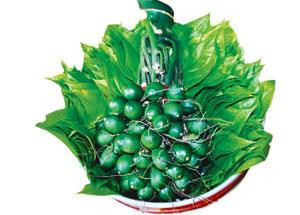 |
Ancient people believed that the betel palm, with its round, sturdy, upright trunk, symbolized a man, while the betel leaf, with its plump, triangular shape spreading horizontally on the ground, symbolized a woman. The betel vine climbing around the betel palm trunk also symbolized enduring love. Chewing betel with a little lime creates a reddish-pink color like blood or lipstick – a color symbolizing fidelity.
Folklore still recounts: "A betel quid symbolizes a couple's union / The betel leaf is the wife, the fresh areca nut is the husband / Green betel, white areca nut, pink lime / Lime mixed with meaning, strong tobacco with destiny..." For a woman, betel and areca nuts are also considered symbols of prestigious hospitality, something she can be proud of for life, allowing her to legitimately teach her children, subordinates, and even future wives. Girls who are asked for marriage with "betel in hand, gifts on their heads" have the right and responsibility to be a virtuous wife and dutiful daughter-in-law.
In the old days, after the engagement ceremony, the bride's family would often divide the betel nuts, tea, and cakes that the groom's family had brought into small packages as gifts for relatives, friends, and neighbors... as a way of announcing that their daughter had found a partner.
 |
Wedding customs are more or less influenced by the lifestyle, thinking, and style of modern people. When preparing for a wedding, most of the worries are focused on the "material" aspects such as booking a restaurant, taking photos, renting a dress, renting a car, printing invitations, etc.
Ms. Bich Ngoc, owner of stall 1113 specializing in betel nuts and leaves from Ba Diem at Ben Thanh Market, whose family has been preparing betel leaves and arranging betel nut bunches for engagement, proposal, and wedding ceremonies for three generations since the 1940s, said: "Nowadays, people mainly perform betel nut ceremonies in a conventional way, because few people eat them, so almost all the offerings for these ceremonies are outsourced to service providers."
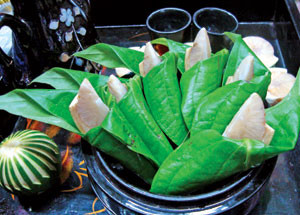
So what constitutes a modern betel nut and areca nut offering that still adheres to tradition? Ms. Bich Ngoc, drawing on her customers' experience and family's sales traditions, explains: since the custom of the groom's family distributing gifts to relatives and neighbors has been abandoned in Saigon, the betel nut and areca nut tray only needs six prepared betel leaves and six betel nuts. Notably, according to Northern tradition, the betel leaves must be shaped like phoenix wings, the leaves must be thick, green, spicy, and the lime used must be white Northern lime, and the tobacco used is typically red-shelled tobacco. According to Southern tradition, the betel leaves are prepared like a steamed rice cake, the leaves are sweet (often Ba Diem betel), and they are used with red lime, tobacco, and red-shelled betel.
If the engagement ceremony is attended by many people, and for the sake of beautiful filming and photography, the betel tray is often accompanied by a ceremonial offering of a bunch of betel nuts and leaves, possibly from several dozen to several hundred – but it must be an even number – in pairs. The calculation of the number of betel nuts and leaves is: 1 betel nut = 2 betel leaves. Additionally, in the North, people following a modern style prefer a bunch of 105 betel nuts, symbolizing "a hundred years of happiness." People in the South choose a bunch of 60 betel nuts, symbolizing "60 years of life."
| According to Vietnamese custom, a wedding must be completed with six ceremonies, known as the Six Ceremonies: 1. Betrothal ceremony: The groom's family sends someone to the bride's family to express their intention to choose their daughter as their daughter-in-law. 2. Inquiry about the name: The groom's family asks a matchmaker to inquire about the girl's full name and date of birth (to see if they are compatible). 3. Bringing the auspicious date: The groom's family informs the bride's family that they have consulted the astrologers and divination, that everything is auspicious, and that they wish to proceed with the wedding ceremony. 4. The betrothal ceremony (Nạp Trưng): The groom's family brings the betrothal gifts to the bride's family for the ancestral worship ceremony and introduction. This ceremony is commonly called the engagement ceremony. 5. Requesting the date: The groom's family asks the bride's family to set a date for the wedding procession. 6. The wedding procession: the ceremony of bringing the bride to the groom's house, which is the wedding ceremony. Many believe that choosing betel nuts in bunches of 60 symbolizes the cycle of "birth – aging – sickness – death – birth – aging," which will help the couple live together until old age, overcoming all the difficulties and hardships of life. |
According to Economics and Urban