
A symbol of my hometown
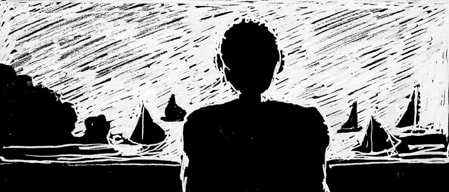
I had the opportunity to accompany writer Nguyen Minh Chau to Lach Van and Lach Quen. It was a quiet sunset, giving way to the sound of the waves...
I had the opportunity to accompany writer Nguyen Minh Chau to Lach Van and Lach Quen. It was a quiet sunset, giving way to the rhythmic, majestic waves lapping against the shore. Wandering along the water's edge for quite a while, he said: "Thinking about it, it's incredibly difficult for people to find food to eat throughout their lives!"
Therefore, in ancient Japan, there was a tradition that when elderly people reached old age, they would choose a beautiful day, wrap a handful of rice in a green banana leaf, find a mountain, climb it, and live there. They vowed to eat all the rice before dying, leaving the food at home for their children and grandchildren. Food changed their lives. How painful!
After Mr. Chau passed away, I had no one left to discuss life with. Returning to Lach Van alone, I absorbed his words, lost in thought about the human condition, living before the waves. Vietnamese people value elders; every village has a village headman. The elderly are more respected than officials. Those in old age who still have the strength and ability to work and earn a living do not want to rely on their children or grandchildren.
 |
During her time boarding at the home of her late father, Mr. Dinh, in Xuan Dinh hamlet, Dien Tien commune, at one or two in the morning, Ms. Luong would get up, boil corn in a pot, pack it into a mortar, make rice cakes, wrap sesame seeds and peanuts, betel nuts and leaves, and put them into a net bag for her father to go out to sea. At three in the afternoon, Mr. Dinh would return, and his daughter would stop mending the nets, carry the fish, shrimp, and crabs to the Dam market to trade for corn and rice for the next day. High tsunamis, towering above the casuarina trees, crashed down, forcing the village of Dong Cac, home to the scholar Cao Xuan Duc, to flee to National Highway 1, but people still managed to make a living, creating a "heavenly and earthly" phenomenon, famous throughout the country...
During the fierce war, I returned to my mother Lich's home in Trang Than, along with the Dien Phuc Party Committee, to fight against the Americans. Even after clearing shrapnel from bombs, with a sagging belly requiring a sling around her neck, my mother still took the buffalo out to the fields, taking advantage of the opportunity to find some wild yams to cook with starfruit, improving the meals for the cadres operating underground. Holding the bowl of soup, tears welled up in my eyes. The low-lying rice paddies of Dien Thai surrounded the foothills of Luong Kien Son mountain.
Floods and storms swept through, each village like an isolated island. According to stories told by the villagers, Mr. Phó Ngà used to carry a plow on his shoulder and a buffalo under his arm, swimming across the river to the fields to plow. When floods surrounded the village, he had to ride his buffalo to beg for fire. But once he got fire, he would cook a pot of mashed potatoes, then ride his buffalo to deliver it to each household. "A morsel when hungry is worth more than a bowl when full." More precious than a pound of gold! In those days, scholars also faced similar circumstances. I remember Professor Nguyễn Trung Hiếu, who taught at Vinh Pedagogical University, selling his ancestral home in Diễn Bình. The teacher and students cycled back to their hometown, arriving well past noon. They could only stop at Sò market to buy a few dozen rice cakes, dipped in a bowl of spicy chili sauce that burned their tongues! Finding something to eat wasn't easy!
Yet, at the beginning of this third millennium, during a conversation with Mr. Cam, the deputy secretary of the district Party committee, he said: "The meals of the people in Dien Thap, my hometown, are now better than those of the rich farmers and landlords of the past..."
Through Mr. Cam's story, I suddenly felt as if yesterday, while driving from Vinh back to the district, I was entering a vast park. Each family was like a fragrant flower. Tiled roofs, corrugated iron roofs, and walls painted in vibrant green and yellow. I thought to myself: With houses like these, it's true that "food is no longer a difficult problem," as my aunts and uncles say whenever I return to the village.
For centuries, invaders from the North plundered our country. The French, Japanese, and American colonialists also invaded our land so that they could have an abundance of food and delicacies! The people of Dien Chau fought against nature and against invaders to survive.
Now that people have food, the challenge is to improve the quality of their meals. My aunt married into a family in Dien Van, the birthplace of the famous Van Phan fish sauce. When she gave birth to her first child, she had to eat rice with freshly squeezed fish sauce, a concentrated, slightly burnt, salty, and bitter sauce. Now, Van Phan fish sauce produces over 13 million liters annually, supplying the entire country with high-quality products.
Poet Tran Huu Thung and I happened to meet Mr. Ngo, a retired fisheries official, who was quietly cultivating Ligusticum chuanxiong, Panax notoginseng, and Korean ginseng on Mo Da mountain, under the protection of King An Duong Vuong of Thuc. That day, our meal included a glass of homemade herbal wine. It remains etched in my memory for decades.
Standing atop Mount Mộ Giạ and looking out at the East Sea, where our ancestors cast their nets and fished for food, the catch has never been as abundant as it is now, reaching 24,900 tons. Simultaneously, aquaculture production has reached 5,000 tons across 2,900 hectares. As a result, there's a plentiful supply of fresh fish and shrimp on our dinner tables every day. The people of Lạch Vạn estuary not only enjoy the scenic beauty of the ancient "Bích Hải Quy Phàm" (Blue Sea Returning to the Plains), but also commemorate the guardian deity of the sea, Sát Hải Đại Vương.
Walking along the Long Cuong shell beach from Mo Da, through Ru Ta, Ru Mua, Dong Tho to Hon Tro, one can look down at the land our ancestors cultivated. Several fields are bustling with activity, striving to achieve yields of 50 to 70 million dong per hectare. The people, including Mr. Dung, Mr. Da, Mr. Pho Nga, and the father and son, including Doctor Ngo Tri Hoa and Imperial Scholar Dang Van Thuy, are astonished. This high-yield area accounts for 60% of the cultivated land. Along with this area are the two small industrial zones of Dien Hong and Dien Thap, acting as two driving forces propelling the Dien Chau economy forward, improving the material quality of life.
Tonight, under the bright full moon, we lay on a fishing boat in Dien Hai, close to the surging waves, with my poet friend Tran Ngoc Canh. Amidst the vast, bright expanse of sky and sea, we couldn't sleep. We thought about Dien Thanh beach, Hon Cau... We thought about the heroic Dien Van medical station. We reminisced about the stories the writer Nguyen Minh Chau told years ago. We felt pity for the many people who were hungry and lacked clothing. More than sixty years after the August Revolution, Dien Chau, along with the rest of the country, has finally eradicated hunger and is reducing poverty.
Each year, 2,300-2,500 students are admitted to universities and colleges. It's encouraging that Hoan Chau College, located in their hometown, will provide a valuable source of skilled labor with access to scientific and technical knowledge. Twelve traditional craft villages (such as Dien Van confectionery, Dien Quang vermicelli, and bear and rhinoceros farms in Dien Lam) all utilize their skilled hands to provide higher quality food for the community.
While talking about the flower growers of Dien Hong, the drum makers of Hoang La, the incense makers in Dien An, and the towns that export to the US and South Korea... contributing to the joy and faith in spiritual life, I suddenly remembered the banner of the scholar who fought against the French - Dr. Nguyen Xuan On, and the steadfast communist Phung Chi Kien. I wanted to think of a symbol for my homeland.
Could it be the majestic Hai Vai mountain on the tranquil Bung River? As suggested at the 1,380th anniversary of the name Dien Chau? Could it be the great sailing ship from Cua Van, majestically sailing across the waves to conquer new heights?!
Cảnh Nguyên