
A patch of wild sunflowers is visible in the distance.
Overcome the pressure
Overcome the pressureIn An Khe, a magnificent landscape unfolded before us. No one would have thought they were standing 800 meters above sea level.Gia Lai province is mostly flat, with vast plains stretching as far as the eye can see, covered in endless rubber and coffee plantations.
Along both sides of National Highway 14, the wild sunflowers bloom in vibrant yellow. It's unclear exactly how captivating the beauty of this flower is, but countless legends are told about it, and writers, poets, and musicians have devoted much effort and ink to its creation.
It's no coincidence that Gia Lai Newspaper chose wild sunflowers as the background for its invitation to the "15th Conference of Party Newspapers in the Central and Central Highlands Regions" with the theme "Local Party Newspapers and the Propaganda Work on Preserving and Promoting Indigenous Identity." Nghe An Newspaper participated with a presentation on "Preserving and Promoting Cultural Values in the Era of National Integration." Lam Dong Newspaper posed the question, "What can be done to preserve and promote indigenous culture?". Binh Thuan Newspaper focused on "Contributing to the Propaganda to Eliminate Outdated Customs," while Phu Yen Newspaper emphasized "Educating the Younger Generation to Preserve and Promote Indigenous Culture"... In general, the presentations from the newspapers all revolved around the concerns of preserving the traditional culture of their ancestors.
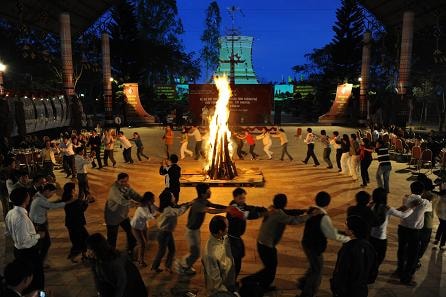 |
Farewell night at the "Conference of Party Newspapers in the Central Region". |
During the conference, the echoes of the International Gong Festival, held from November 12-14, 2009, still lingered in the heart of the highland city. Along the winding, undulating roads, banners promoting the festival adorned the streets, and everywhere we went, we encountered enlarged photographs of people from the Central Highlands ethnic groups playing gongs. Immediately after the festival, a conference on "Preserving and Promoting Gong Culture" was also organized.
It is noteworthy that the local identity here is maintained and preserved with respect and without formality. At the city's intersections, there are reliefs reflecting the rich culture of the Central Highlands. Amidst the massive, modern architectural structures of the developing city, we still encounter traditional local cultural elements, such as communal houses and the houses of the Ede, Gia Rai, and Gie Trieng ethnic groups.
At Dong Xanh Park, about 4 km from Pleiku City, visitors can admire a garden of wooden sculptures reflecting the working life and spirituality of the Ede people, and visit models of communal houses and tools used in daily life and work by ethnic minorities in the Central Highlands.
It feels like in Gia Lai, almost everything is connected to a legend. Even the name Pleiku is like that. The story goes that one day, the father felt unwell and called his two sons together, declaring that he would hold a hunting competition, and whoever won would inherit the land from him. The younger son won. After the father's death, the younger son took over the land and established a village named Pleiku. In the Ede language, "Plei" means village, and "ku" means younger brother. Pleiku therefore means "The Younger Brother's Village".
Not only in Gia Lai, but also in other Central Highlands provinces that our group visited, namely Dak Lak and Lam Dong, the imprint of local identity is strongly evident. In Dak Lak, Trung Nguyen Coffee Company invested in building a Central Highlands museum on a 2-hectare site. The local identity is reflected in the clear annotations in both Vietnamese and the relevant ethnic languages for the exhibited artifacts. This allows visitors not only to access the artifacts but also to learn about a new culture – the culture of the local language. In Lam Dong, XQ Company also dedicated 2 hectares to building a tourist attraction in Da Lat City to introduce visitors to the basic aspects of the cultural and spiritual life of the ethnic groups living in this region.
It is commendable that, despite the rapid development of modern life in the Central Highlands, customs and traditions such as the buffalo sacrifice festival, the new rice harvest festival, the funeral rites, and the carving of tomb statues; musical instruments like the T'rưng, K'rông pút, K'ni, Alal, and gongs; and dances and recitations such as the epic poems of Dam San and Xinh Nha—all distinctive cultural features of the Central Highlands—are still preserved, maintained, and safeguarded.
The issues we heard about in the workshop and what we witnessed firsthand in the Central Highlands remain with us, as we reflect on the issues of preservation and loss of indigenous identity right here in our homeland...
Nguyen Ngoc Duc