

The effectiveness of credit policies
(Baonghean)Over the past period, thanks to the implementation of policies supporting agricultural mechanization by the Government and Nghe An province, thousands of farmers in the province have been able to borrow capital through the Agricultural Bank to purchase machinery and equipment to serve agricultural and rural development, increase crop yields, and expand specialized commodity farming areas.
In the late 1990s, the Nghe An Agricultural Bank began lending to farmers to purchase machinery, gradually mechanizing agriculture. However, lending was only truly intensified when the Provincial People's Committee issued Decision No. 5005/QD-UB.NN on December 12, 1998, regarding the policy of supporting loans for purchasing multi-functional small plows. According to this decision, farmers could borrow 2/3 of the value of a multi-functional small plow and receive interest rate support for 3 years... Subsequent decisions on policies supporting farmers in purchasing mechanization, as well as in 2009, when the Prime Minister issued Decision No. 497/QD-TTg "on supporting interest rates on loans for purchasing machinery, equipment, supplies for agricultural production and building materials for rural housing," further boosted this initiative. The Nghe An Agricultural Bank has implemented capital investment according to the above decisions, directing and guiding local banks to prioritize allocating sufficient capital to meet the credit investment needs for agricultural and rural targets as decided by the province and the Government. At the same time, it regularly checks and promptly resolves difficulties, ensuring that loans are disbursed according to proper procedures and that the correct target groups are eligible for interest rate support loans...
Mr. Phan Duc Tien, Deputy Director of the Provincial Agricultural Bank, said: "In the early years of implementing unsecured loans under the agricultural machinery support policy, the amount of 10 million VND was partially unsecured, causing the bank considerable concern. Furthermore, at that time, farmland was still fragmented into many small plots, limiting investment in machinery for production. A segment of farmers still preferred to cultivate their land themselves to reduce plowing costs, and if they bought machinery and it proved ineffective, it would lead to overdue debts and difficulties in collection... However, with faith in the borrowers' determination to improve their lives and their honest, hardworking nature, the bank boldly granted unsecured loans to the people."
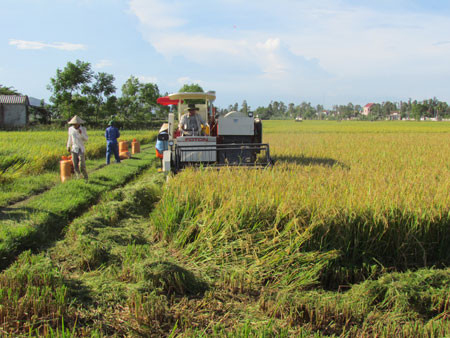
Farmers in Hung Nguyen are using combine harvesters to harvest rice.
Over the past 10 years, the Nghe An Agricultural Bank has lent 190.2 billion VND to farmers for the purchase of agricultural machinery, including 90.2 billion VND disbursed under the Provincial People's Committee's decision. This includes 78.8 billion VND for 6,986 plows; 3.2 billion VND for 144 harvesters; and 9.2 billion VND for 833 tea pickers. As of September 30, 2011, outstanding loans totaled 25.2 billion VND (16.7 billion VND for plows, 3 billion VND for harvesters, and 5.4 billion VND for tea pickers). The Nghe An Department of Finance has promptly subsidized interest payments quarterly, with a total subsidy of 15,070 million VND disbursed from 1999 to June 30, 2011. In addition, implementing Decision 497/QD-TTg and Decision 2213/QD-TTg of the Prime Minister over two years (2009-2010), interest-subsidized loans totaling 100 billion VND were provided, including 84.6 billion VND for the purchase of machinery and equipment for agricultural production and processing, benefiting 1,124 customers. The amount of interest subsidized was 12.5 billion VND. As of June 30, 2011, the outstanding debt was 65 billion VND.
Several localities borrowed heavily to purchase agricultural mechanization equipment, such as: Do Luong district with 190 machines costing over 2.4 billion VND; Nghi Loc with 173 machines costing over 2.1 billion VND; Nam Dan with 198 machines costing over 3.1 billion VND; Yen Thanh with 188 machines costing nearly 3 billion VND; Hung Nguyen with 132 machines costing over 1.8 billion VND; Thanh Chuong with 239 tea harvesting machines costing nearly 2.5 billion VND; Anh Son with 253 tea harvesting machines costing over 2.6 billion VND...
Thanks to access to low-interest loans for investing in machinery to mechanize agriculture, farmers in the province have seen tremendous benefits. Previously, when preparing her family's more than 4 acres of rice fields, Ms. Vo Thi Ngan, from Hamlet 13, Nghi Long Commune, Nghi Loc District, had to mobilize all family members to plow and hoe for several days to complete the land preparation. Since acquiring the plow, the land preparation is completed in just a few hours. The plows deeply and thoroughly, improving the quality of land preparation and effectively addressing the seasonal nature of agricultural production. The cost of mechanized land preparation is lower than manual labor. Simultaneously, the introduction of machinery for land preparation and harvesting reduces labor, saves time, reduces costs, and increases productivity and economic efficiency. According to farmers in Hung Nguyen district who borrowed money to buy multi-functional plows and harvesters, they recovered their investment after only 2-3 seasons of continuous operation. Besides using the machines for their own farming, these households now use them to plow and harvest for other households in the commune, earning a significant income from the machinery.
According to bank data, households purchasing multi-functional plows and harvesters, whether or not they received interest rate subsidies, and whether or not they received price support, have repaid both principal and interest on time, without incurring bad debts. Currently, many farmers still need loans to purchase agricultural machinery. This shows that borrowers have used their loans effectively, contributing to increased income and improved living standards for farmers. Furthermore, through our research, we have observed that farmers are increasingly interested in investing in mechanization for agricultural production. This is considered a crucial factor in large-scale commodity production, increasing labor productivity, and accelerating the industrialization and agricultural modernization of rural areas.
Quynh Lan