
What to do to preserve 3.8 million hectares of rice land? - "Tough" policies
"Businesses wanting to build factories, urban areas, tourist resorts, golf courses, etc., on rice paddy land must go through an auction and pay compensation..."
"Businesses wanting to build factories, urban areas, tourist resorts, golf courses, etc., on rice paddy land must go through an auction and compensate farmers at market value, or even higher than residential land prices." These are the points outlined in the draft Decree on rice paddy land management developed by the Ministry of Agriculture and Rural Development. According to experts, this is a truly strong legal tool to curb the current rampant conversion and encroachment on rice paddy land nationwide.
·Compensation for rice land at market value.
It's not enough to simply plan 3.8 million hectares of rice land and mark red boundaries on cadastral maps down to the commune level to indicate which plots should be preserved for rice cultivation. To truly protect these fertile rice paddies, specific management mechanisms and policies are necessary. Therefore, the Prime Minister has assigned the Ministry of Agriculture and Rural Development to draft a new Decree on rice land management, supplementing Decree 69/2009/ND-CP that has already been issued.
According to the draft, rice land is land suitable for cultivating one or more rice crops per year. The conversion of rice land to other uses is strictly regulated. Specifically, it stipulates that the conversion of rice land to other uses must conform to the approved land use plan. Projects for the construction of transportation infrastructure, electricity, telecommunications, disaster prevention and mitigation works, public works, national defense and security works, etc., should minimize the use of land previously used solely for rice cultivation.
One of the "tough" policies that many people support is the regulation that when converting rice land to other purposes such as industrial zones, urban areas, tourist areas, golf courses, etc., the land use rights must be auctioned at market prices, instead of provincial authorities making decisions to reclaim the land and hand it over to businesses to develop projects, with relatively low compensation rates as before.
Accordingly, after deducting reasonable costs for organizing the auction, 70% of the revenue from land use rights auctions will be used to compensate those whose land is expropriated, and 30% will be collected into the budgets of various levels of government to serve infrastructure development and other socio-economic purposes.
According to Nguyen Tri Ngoc, Director of the Department of Crop Production, the agency tasked with drafting the aforementioned decree, the reason for introducing such "strict" regulations is to limit the practice of businesses establishing projects on rice paddy land.
|
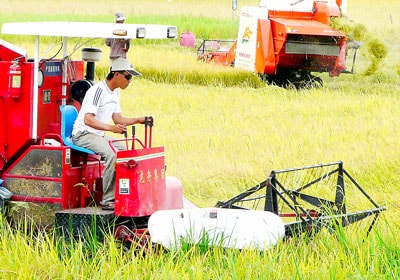
The draft decree on the management of rice land (new) will help farmers feel secure in their production. Photo: CAO PHONG |
·Are businesses fleeing?
According to Dr. Le Duc Thinh, from the Institute for Research on Agricultural and Rural Development Policy and Strategy, in reality, even before the current draft Decree on rice land management, the Government had already issued Decree 69 regulating land use planning, land prices, land acquisition, compensation, support and resettlement, which initially created a turning point in protecting rice land.
Specifically, after the decree was issued and came into effect at the end of 2009, it caused a series of businesses nationwide to hesitate in their ambitions to transform fertile rice-growing areas into urban zones, golf courses, tourist resorts, and industrial parks. Accordingly, the compensation rates for the expropriation of farmers' rice land were significantly increased, by 1.5 to 5 times compared to before.
Therefore, businesses are now complaining that the compensation for rice land is too high, along with the accompanying support payments, which are a real barrier for them. Because of this, many businesses can't withstand the pressure and end up withdrawing. For example, in Bac Ninh province, despite the government's investment attraction policies, according to incomplete statistics from the Department of Planning and Investment of Bac Ninh province, at least 10 businesses have fled the area after Decree 69 was implemented.
Associate Professor Pham Duy Nghia, Head of the Department of Economic Law at Hanoi National University, believes that while regulating compensation prices for rice land at market value may provoke a reaction from businesses, it is clearly an inevitable trend to ensure the rights and fairness of farmers, as well as to protect rice land. Farmers have already suffered many disadvantages when their rice land is confiscated at excessively low prices.
According to Nguyen Tri Ngoc, Director of the Department of Crop Production, after Decree 69 was issued, provincial authorities themselves reacted, arguing that such policies would hinder provinces from attracting investment to increase their budgets and make development difficult. He added that if regulations require businesses to auction off rice-growing land in the future, a similar situation will likely occur. However, we need to find a harmonious balance between immediate economic benefits and long-term sustainable benefits, between the interests of localities and the nation. Especially after recent economic crises, agriculture has clearly played a crucial role in stabilizing the socio-economic situation and combating inflation, further demanding greater investment in agriculture. In the future, when the draft Decree on rice land management (new) is approved by the Government, there will certainly be even stricter policies to protect the 3.8 million hectares of rice nationwide.
|
According to SGGP