

A 17-year-old's dream and a passion for film.
(Baonghean.vn) - In 2011, Vietnamese cinema once again made its mark on the world stage when the feature film "Bi, Don't Be Afraid" won major awards at international film festivals in 2010, such as: the SACD ACID/CCAS Award at the International Critics' Week - Cannes Film Festival, the Special Mention Award at the Vancouver International Film Festival and the London Film Festival, and the New Talent Award at the Hong Kong Asian Film Festival.... The screenwriter and director of this film is Phan Dang Di, a native of Nghe An province... On the occasion of the New Year, a reporter from Baonghean.vn had an interview with him to hear him share about his work, life, and new plans.
PV: Mr. Phan Dang Di, over the past year, the image of the young boy Bi, with dozens of international awards, has caused a stir in the Vietnamese film industry. Bi in the film is an innocent, carefree boy with a pure perspective on life. Readers back home are curious to know what your childhood was like? Do you have many memories of Nghe An province?
Director Phan Đăng Di (PDD):I spent my early childhood years in Nghi Xuan – then part of Nghe Tinh province – before moving to Vinh in 1984 with my family. My memories of this period are very pleasant. My family lived in a thatched-roof teachers' housing complex, next to the school where my mother taught were fields of peanuts, sesame, and watermelons... I was about 5 years old then, and like Bi, I was fascinated by plants and delighted when one day I found a small pickled melon (a type of melon smaller than watermelon used for pickling). I dug a small hole to hide the melon I had found, and I was always worried about how it would fit in the tiny hole if it grew bigger... In winter, migratory birds would fly back and perch on the branches behind the house and swoop down to the fields. Adults would set traps, and children would make fake nests to lure starlings to lay their eggs in them, anxiously waiting. Such things are hard to forget.
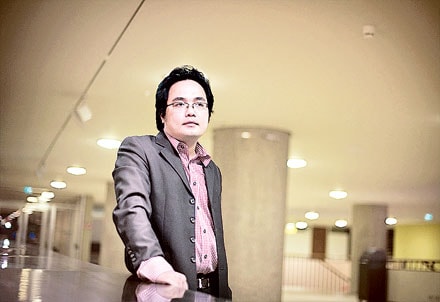
Director Phan Đăng Di at the Asian Film Festival
Interviewer: Why did you choose filmmaking as your main career and become an independent filmmaker?
Director PDD:Even as a child, I always fantasized about the world of the books I read rather than the real world, and I allowed myself to embark on imaginary journeys around the globe.
It was also because of my imagination that I started writing stories and was convinced I would become a writer. Then, during the summer vacation of my 17th year (1993), I happened to watch a TV program about the Cannes Film Festival. That year, Tran Anh Hung – a French director of Vietnamese descent – won the Camera D'or for Best First Film. Chen Kaige (China) with "Farewell My Beloved" and Jane Campion (New Zealand) with "The Piano" won the Palme d'Or, and actress Holly Hunter in that film also won Best Actress. Immediately, these images captivated me, and I decided I had to become a filmmaker without anticipating the difficulties I would face...
It was a spontaneous choice at the age of 17, and it took me exactly 17 years (2010) to get to Cannes with my first film and win an award there. In November of the same year, I met Holly Hunter again, this time as President of the Jury at the International Film Festival.
As for choosing to become an independent filmmaker, it's simply because it suits my own approach and concept of cinema—a rather personal kind of cinema that requires the director to be involved with the film from its very beginnings, to patiently wait for it to grow within them, to be strong enough to give birth to it, and to possess the intellect and inner strength to keep it intact as they envision it. It's a very rigorous birthing process in which the director always has complete control.
PV: In your works like "Lotus," "Drifting," and "Bi, Don't Be Afraid," one can sense the profound depth of the director. As a young filmmaker choosing such a challenging subject matter, going against current audience tastes, aren't you afraid of being considered eccentric?
Director PDD:I'm over 30 now, hardly young anymore, but at least old enough to know what I'm choosing. When it comes to creativity, you still need a "don't be afraid" attitude to succeed. This definitely requires a certain degree of daring and courage, or in other words, a certain stubbornness.
PV: In your opinion, what are the secrets to conquering international film festivals?
Director PDD:There's no secret other than sincerity, imagination, and love. When making films, I always start with love for people, even though people are often flawed and make mistakes; I love the place I live in, even though that place is sometimes chaotic and uncivilized... Perhaps that's why, when I've presented my films abroad, no one has ever told me that my films made them think badly of Vietnam.
That's also why, to date, "Bi, Don't Be Afraid" has been screened at around 60 film festivals and cinematic events in 50 countries, and this coming March, the film will be commercially released in about 100 cinemas in France. However, this is just an isolated phenomenon; the truth is that Vietnamese films...
Interviewer: What do family, parents, and hometown mean to you in your life?
Director PDD:Its meaning has grown over time, and it probably has a somewhat classical feel to it, just like most people.
PV: You often draw inspiration from real-life images and people in the films you've written and directed, such as "Bi, Don't Be Afraid," set in Hanoi, and "Father, Son and..." set in Ho Chi Minh City. Have you ever considered writing a film set in Nghe An province, your birthplace and a region rich in cultural identity?
Director PDD:Currently, I'm focused on a new project scheduled to begin filming in the second half of 2012, so I don't have any other thoughts in mind yet. However, I might film a movie in Nghe An sometime. I often dream about the ancient forests of western Nghe An, where the majestic cliffs and the wild, mysterious landscape beneath the primeval forests of Pu Mat occasionally creep into my imagination...
PV: One last question. Although your family has now moved to Hanoi, do you still often return to your hometown in Nghe An, and does your family still maintain the cultural traditions that people from Nghe An traditionally practice during Tet (Lunar New Year)?
Director PDD:Every year, we return to our hometown to visit the graves of our grandparents and ancestors, then light incense at the family's ancestral temple before heading back to Hanoi to celebrate Tet.
For me, the Nghệ An flavor I remember most during Tet is the huge, very salty pot of braised fish with galangal that my mother always prepared from the Tet Ong Cong, Ong Tao (Kitchen God) festival and ate until the 15th day of the first lunar month.
PV: Thank you, and I wish you and your family a warm and joyful spring season!
My Ha (Editor)