

Construction of the Khe Chuoi dam needs to be expedited.
(Baonghean)The Khe Chuoi dam project (Dai Son commune, Do Luong district) officially began construction in June 2011, and was planned to be completed and put into use after 8 months (by February 2012). However, nearly a year and a half later, the project is still unfinished, while the local people are facing the risk of crop failure due to water shortages and the worry of the dam breaking during the rainy season.
Dai Son commune, located in the lower part of Do Luong district, does not benefit from the major river systems in the area. The commune has 14 large and small reservoirs and dams serving agricultural production, but most are dams built to block rivers and draw water from natural sources. Annually, the commune cultivates approximately 290 hectares of summer-autumn rice. This year, due to irrigation difficulties, the commune has instructed farmers to plant rice on 260 hectares, leaving the remaining 30 hectares fallow.
According to Mr. Dang Van Toan, Vice Chairman of the People's Committee of Dai Son commune, the entire area of summer-autumn rice in the commune, which is currently in the heading stage, is facing drought. Over 90 hectares in five hamlets (hamlets 2, 3, 8, 9, and 10) have already turned yellow and withered, posing a risk of total crop loss. Mr. Toan stated: “The Khe Chuoi dam is the main water source for irrigating nearly 80 hectares of rice fields in the area. In addition, it serves the needs of daily life and is the primary source of drinking water for hundreds of cattle and buffaloes raised by local people at U Market. Since the beginning of June 2011, the dam has been drained to prepare for upgrading, but by the end of October, the water level had completely receded without any construction work being carried out. Because the water has been drained, the local people don't know where to get water to irrigate their rice fields. Since the beginning of the season, many farmers have abandoned their fields because they cannot plant the summer-autumn rice crop. Faced with this situation, the commune has repeatedly reported the farmers' concerns to the District People's Committee for inspection and consideration, and has also sent a letter requesting guidance from the Provincial People's Committee, but so far there has been no change.”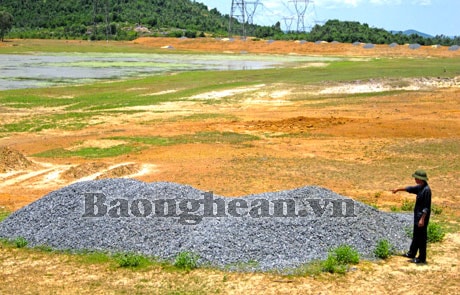
The Khe Chuoi dam project is in disarray due to a lack of funding.
The Khe Chuoi Dam is a key irrigation project for agricultural production in Dai Son commune. Decades old, the dam has deteriorated and no longer provides adequate water. In 2011, the province officially approved the investment for its construction. In early June 2011, the dam was drained to begin construction. The project is managed by the People's Committee of Do Luong district. According to the plan, the dam was to be completed within eight months of the water being drained. However, nearly a year and a half has passed, and from our observations, construction has shown no progress. Piles of sand and rocks remain scattered around the dam's banks, the dam itself is completely dry, and the construction site is eerily silent.
When discussing the aspirations of the local people with Mr. Nguyen Cong Chau, Vice Chairman of the People's Committee of Do Luong District, it was learned that the Khe Chuoi dam project received an investment of 8 billion VND from the province, allocated annually. The district, in coordination with local authorities, mobilized resources for construction and urged contractors to complete several items such as the new culvert, the operation building, and the main dam slope with a budget of over 5 billion VND. However, due to difficulties in securing funding from higher levels, the province has only allocated 1 billion VND for the construction of the Khe Chuoi dam project so far. The delay in funding is the main reason for the slow and unfinished construction of the dam.
Besides the lack of primary water sources for production and daily life needs, the Khe Chuoi dam is located at a high elevation relative to residential areas, fields, and villages. Without timely investment and construction, this structure is at risk of dam failure and safety hazards during the rainy season and storms. It is suggested that the province and Do Luong district should study and consider a specific plan to both accelerate the construction of the Khe Chuoi dam, ensuring water supply for production, and guarantee the safety of the structure during the rainy season and storms.
Luong Mai