

Deepening the bond between soldiers and civilians in the headwaters of the Chu River.
(Baonghean)On a trip back up to Thong Thu border commune (Que Phong district) one day at the end of July, at a temporary rest stop at Phu Phuong intersection, we coincidentally met a working group from the district coming from the newly relocated area. Comrade Kha Van Tam - Deputy Secretary of the District Party Committee - said: The force of 150 officers and soldiers from Regiment 764 (Provincial Military Command) helped the people in the Hua Na hydroelectric reservoir area relocate very effectively, and the people are very happy. Without the army, it is unknown when the relocation would have been completed, because the river water was high, the newly opened service road was muddy and dangerous, and there were many other hardships that only the army could handle.
The old command vehicle of the Provincial Military Command, after leaving the newly paved road built for the century-long project, continuously struggled with the access to the old villages that were hastily being relocated. It got stuck in the Nậm Piệt ravine (Lốc village). It struggled on the slippery service roads due to the rain. It wound its way along many steep slopes… We arrived at Ăng village (Thông Thụ commune) as dusk was falling. Amidst the continuous rain, the center of the village appeared with paths thick with mud, clinging to the wheels and feet. The village, with 114 households, was once quite bustling, situated right on the banks of the Chu River, but is now undergoing a “massive relocation.” The old charm is gone; the general scene now consists only of deserted house foundations, partially dismantled houses, and some houses waiting to be lowered onto rafts and trucks to their new homes. Standing out was the large number of soldiers in green uniforms, bare-chested, working in the capricious weather – alternating between rain and shine – to help the villagers. Down by the Chu River, near Don village, rows of rafts of timber belonging to villagers from distant hamlets gathered, waiting to be loaded onto trucks coming and going, adding a touch of liveliness to the otherwise tranquil scene. It was the hustle and bustle of the moment before this ancient land would be forever submerged under hundreds of meters of water.
The eight villages relocated from Thong Thu commune are: Hua Na, Na Cong, Mai village, Huoi Dua (at the foot of Bu Cao Ma slope), Loc village, Don village, Ang village, and Ca Na. Mrs. Lang Thi Hanh, 80 years old, from Ang village, recounted: “From the time I could see the sun until now, I’ve only eaten fish and drunk water from the Nam Chu River. Leaving is unsettling. But anyway, I’ll follow the government’s instructions; they’ll give us electricity, and it’s also for my children and grandchildren!” Mrs. Hanh’s words reflect the heartfelt sentiments of not only the people of Ang village.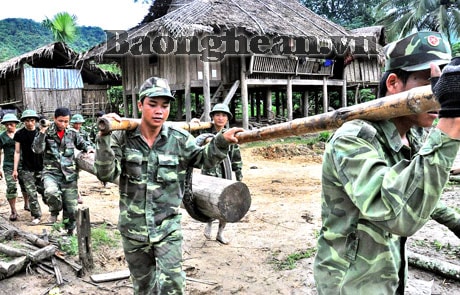
Soldiers from Battalion 41 helped move the family of Mr. Luong Van Thuan (Don village) to Muong Piet (Thong Thu).
I took a tour around Ang village with Mr. Luong Van Hai, Deputy Head of Ang (Thong Thu). The soldiers helped the villagers move most of their stilt houses. Many of the houses were large, with the number of pillars and planks equivalent to 2-3 other houses, requiring up to two days to dismantle. Soon, Mr. Hai and his family will also settle in Huoi Dua 2 village, along with dozens of other households. Ang village has 114 households, of which 61 households voluntarily relocated, and 53 households will move to new residences according to the plan of the Hydropower Project Management Board. In the new residences, the villagers will be allocated 400m2 of housing, 400m2 of garden land, and 200m2 of cultivated land per person. The compensation for stilt houses and crops (perennial trees, trees already producing fruit, etc.) has also been agreed upon by the villagers with the government's plan. Walking along the steep and slippery slope, Hai said, "If it weren't for the soldiers helping the people, I don't know when we would have been able to relocate the Ang village as planned. And you know what, the soldiers who came to help the people all took care of their own food and water..."
Welcoming us amidst the sudden jungle rains and the bustling scene of relocation in the old village, Major Phan Van Minh - Chief of Staff of Regiment 764 (Provincial Military Command), who has been stationed with his officers and soldiers since the early days of the troops' presence here, said: “Following the directive of the Provincial Military Command, and with the agreement of Military Region 4, the Regiment's Command has developed a plan: 'Each comrade writes a statement of determination to help the people.' The main task is to help the people of the villages relocated from the reservoir area in Thong Thu commune (Que Phong district) to unload and move their property and houses to their new homes as quickly and safely as possible.”
Loading timber from the river onto trucks.
In addition, they are ready to assist the local people with any task when requested, in order to ensure the progress of the Hua Na Hydropower Project. After thoroughly briefing and assigning specific tasks to each officer and soldier, on June 16th, 150 officers and soldiers of the Regiment (the core force being the personnel of Battalion 41) set off, mobilizing to the areas where the people needed them with the warmth and responsibility of the military-civilian relationship. The first stop, also the unit's base, was Ang village, the central location. From there, they would be divided into several groups to continue moving to other villages such as Hua Na, Don village, Ca Na village... Among them, some villages are remote, like Ca Na village, requiring two ferry crossings at a cost of 50,000 VND per person per trip. Most villages require navigating steep, slippery, and muddy slopes. The large logs required more than 10 people to carry them to the riverbank, where they were tied together into rafts and floated down the Chu River before reaching a collection point, where they were loaded onto trucks and transported to a new location.
In the beginning, the villagers were skeptical, fearing the soldiers might damage their houses. But after just two or three days, seeing how the soldiers treated their property as if it were their own, they completely trusted them. In many cases, homeowners were busy and couldn't help directly; they simply brought the soldiers over, said, "This is my house, please help me with this," and left. The soldiers neatly dismantled the house, carefully arranging the belongings, ready for the trucks to arrive and load. There was the case of Mr. Lo Van Thang from Hua Na village, whose parents were both over 80 years old, and who had to go to Vinh to care for his sick wife. On the last night before the soldiers withdrew, Mr. Thang only managed to quickly return to see the soldiers, saying, "All the money for my wife's hospital stay in Vinh is gone; I don't have any left to hire a company. Please, help me." And so, Mr. Thang returned to the hospital that same night. After deliberation, the unit decided to leave a team behind to help Thang's family, while the majority headed back to other villages. With that pace and sense of responsibility, in just 10 days, all the houses in Hua Na village were demolished, ensuring the plan was met.
One rainy morning, we, along with Lieutenant Colonel Pham Trong Danh (Battalion Commander of the Reserve Mobilization Battalion - 764th Regiment), crossed the Chu River to reach Don village, a village with 124 households, 18 of which were relocated under a project, while the rest were relocated independently. The Chu River was murky with rising water levels at this time of year.
Along the pathways, the shouts of soldiers helping to dismantle houses echoed everywhere. At the home of Mr. Luong Van Thuan, a team of 33 soldiers had finished dismantling the house for him and his wife, and the house pillars were now being carried on the soldiers' shoulders towards the riverbank. Ms. Ha Thi Xoan, Mr. Thuan's wife, while serving tea to the soldiers, said that this time, her family also resettled in Muong Piet. Besides the money for renting trucks from Thai An Company to transport and rebuild the house, and the land in the new village, which cost about 130 million dong, the rest was all thanks to the soldiers. Thanks to them, the surplus compensation money was still enough for the family to build a new life. From Don village, the soldiers had to divide into two teams to take turns transporting the wood to the river because it was too far and too difficult. The soldiers had to clear trees, cross fields, and use bamboo and reeds to pave the way. It took more than 10 people to carry one tree. Larger trees had to be pushed using wheelbarrows. Upon reaching the riverbank, another team was needed to lower the logs down to the dock via a steep slope of 70 degrees, about 20 meters high.
A brief moment of camaraderie between soldiers and civilians before bidding farewell to their old village.
There were many difficulties during this mission to help the people. Factors such as climate, terrain, living conditions, and access to clean water posed significant obstacles. Ensuring a daily food allowance of 50,000 VND per person in Thong Thu was also challenging. Often, roads were cut off, and supplies couldn't arrive in time, forcing the soldiers to rely on their own dried food reserves. But overcoming all obstacles, the soldiers of Regiment 764, "for the people, selflessly," fulfilled their duty, leaving a lasting positive impression of the soldiers of Uncle Ho's army in the hearts of the people. Major Nguyen Van Minh shared: "Through this field exercise to help the people, the officers and soldiers of the Regiment helped relocate 256 stilt houses in 5 of the most difficult villages with utmost enthusiasm and responsibility. The unit also maintained absolute workplace safety and military discipline." Furthermore, there is good coordination with border guards, local authorities, private companies, etc. The relationship between Party committees and authorities at all levels, from district to commune, and the unit is constantly strengthened and has been elevated to a higher level.
Leaving Thong Thu, a border commune in the western part of Nghe An province, the image of soldiers carrying heavy loads on their shoulders, supporting the stilt houses of the local people, stayed with us throughout our return journey. According to the latest information, after leaving Thong Thu, the officers and soldiers of Regiment 764 will return to help the people of Nam Giai (Que Phong) stabilize their lives. The bond between the military and the people remains as strong as the headwaters of the Chu River, like the Nam Piet River...
The Hua Na Hydropower Project (Dong Van commune, Que Phong district) commenced construction in March 2008, with PVN as the investor. It has a total capacity of 180 MW and a total investment of nearly 6,000 billion VND. To build the Hua Na Hydropower Plant, 1,362 households from 14 villages in Dong Van and Thong Thu communes had to be relocated to 14 resettlement sites, not including other voluntary relocation sites. On July 4, 2012, the project closed the diversion tunnel, officially beginning water impoundment in the reservoir to begin power generation by the end of the fourth quarter of 2012. After the residents accepted the compensation plan and received full relocation assistance, the district mobilized youth, military, and other organizations to directly assist residents in dismantling their houses and transporting them to the resettlement sites. In particular, this includes the contribution of 150 officers and soldiers from Regiment 764 (Provincial Military Command).
Tran Hai