

"Quỳnh Lưu Poetry of Four Centuries" - A Precious Collection
(Baonghean)From the 1960s to the last decade of the 20th century, Quynh Luu published four poetry collections: "Silver Water, Golden Rice" (1963), about the Binh Son irrigation and drainage project; "Waves of the Mai River" (1968), a collection of poems about the heroic years of the homeland fighting against the Americans, published by the Nghe An Department of Culture and Information; "New Quynh Luu" (1987), a collection of poems about Quynh Luu during the years of implementing the renovation process, published by the Nghe An Publishing House; and "Tung Linh Poetry" (2000), a collection of poems by authors in the Tung Linh Poetry Club, published by the Nghe An Union of Literature and Arts. These poetry collections recorded the milestones in the homeland's development and were limited by time, space, and thickness, not exceeding 150 printed pages.
To create a poetry anthology befitting a district with a rich cultural tradition has been the aspiration and hope of the authors and literature lovers of the district. Since 2000, the district has had the idea of compiling a century-long poetry anthology, but this has not yet been realized. To commemorate the 540th anniversary of the name Quỳnh Lưu and the 80th anniversary of the establishment of the District Party Committee, Quỳnh Lưu has released the poetry anthology: "Quỳnh Lưu Poetry Across Four Centuries" (Literature Publishing House). The beautifully printed, 615-page hardcover book features the title of the anthology and an image of the poet Hồ Xuân Hương against a yellow background, symbolizing the golden rice fields of Quỳnh Lưu. The back cover depicts a landscape painting of Cờn Temple – a cultural heritage site of the district.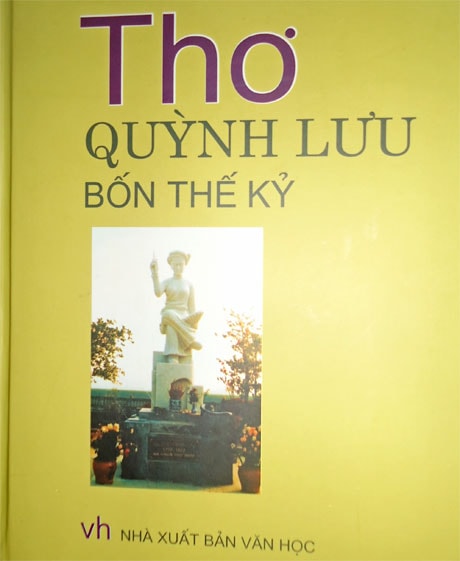
"Quỳnh Lưu Poetry: Four Centuries" compiles poems by poets from Quỳnh Lưu over four centuries, from the Minister of Public Works Hồ Sỹ Đống (1738-1785), the female poet Hồ Xuân Hương (1772-1822) to contemporary poets and authors, including the youngest generation (those born in the 1980s) and other poets writing about Quỳnh Lưu. The collection features famous poets of the country from different periods, such as the Queen of Nôm poetry – Hồ Xuân Hương, poet Hoàng Trung Thông, and Tú Mỡ (Hồ Trọng Hiếu). Alongside established poets in the national and provincial literary scene, there are also new faces with new styles such as Bùi Sim Sim, Phạm Thái Lê, Tô Hương Sen, Hồ Huy Sơn, and Trần Văn Khoa… The collection is divided into three parts:
Part 1: Medieval and Modern Poetry (from the 18th century to before the August Revolution) features 19 authors with 34 poems.
Part 2: Modern poetry (from the August Revolution to 2000), divided into 3 categories: Free verse and lục bát poetry, Tang Dynasty poetry, and satirical poetry.
Part 3: Poems about Quynh Luu, featuring 17 authors and 20 poems.
In the section on modern poetry, the most prominent force is from the period of reform to the present day, with the number of poems and authors accounting for more than half of the book. Currently, almost every commune has a poetry club; in the district, there is the Tang Dynasty Poetry Club, the Senior Citizens' Poetry Club, and the Song Mai Literature and Arts Club; these clubs serve as a playground for the elderly but have also created a commendable literary atmosphere.
Besides authors currently working and living in their hometown, the poetry collection also includes contributions from authors living away from home, from Hanoi, Ho Chi Minh City, Hai Phong, Quang Ninh, the Central Highlands, Vinh City, and various districts within the province. Modern poets such as Che Lan Vien, Ho Dzenh, and Tran Huu Thung have contributed to the rich and diverse flavor of Quynh's poetry. The collection represents an equal encounter between intellectuals and ordinary people such as farmers, workers, craftsmen, and veterans. Readers of all ages and levels of understanding can appreciate the beauty and charm of each poem. And as the introduction states: "The poetic themes, language, and imagery in this collection reflect the heroic people and land of Quynh Luu in the past; their diligence and creativity in building their homeland during the period of renewal. It is the heartfelt devotion of these people to their Motherland, the heartfelt emotions, the private, romantic and poetic aspects, all encompassed by compassion and humanity."
The collection of Quỳnh Lưu poetry spanning four centuries, along with Tuyên Văn Quỳnh Lưu, the Cultural Geography of Quỳnh Lưu, Quỳnh Lưu - the northernmost district of Nghệ An province, and the History of the Quỳnh Lưu District Party Committee, has created a comprehensive encyclopedia about Quỳnh Lưu district, partially fulfilling the aspirations of its people and those who love this land.
Tran Nguong