

Looking back at 4 years of transforming the cooperative market model in Vinh City.
(Baonghean)Following the policy of the Provincial People's Committee, in September 2008, three cooperative models for market service businesses (referred to as market cooperatives) officially held their founding congresses: Kenh Bac Market Cooperative, Cua Bac Market Cooperative, and Ben Thuy Market Cooperative (Vinh City). The purpose of this transformation was to establish a unified market management model, consistent with the socio-economic development orientation of the area, while creating a legal environment to encourage economic entities, organizations, and individuals to invest in the construction, management, and operation of markets, improving their efficiency in a civilized and modern direction.
The cooperative model for market management involves small traders becoming members and jointly contributing capital to establish a cooperative. Profits from managing and operating the market are shared among members, thus increasing the rights and responsibilities of the traders. Market cooperatives can also invest with other businesses according to their regulations. This model has been successful in several provinces such as Dong Nai and Can Tho.
After four years of operation, the cooperative model for market services has been well-received by both market management boards and business owners. Market cooperatives have truly undergone significant changes. Previously, all market operations and revenue/expenditure were under the direct control of the ward/commune People's Committee, resulting in a lack of autonomy for market management boards and hindering their operational capacity. Since transitioning to the cooperative model, market management boards have become completely independent in their revenue and expenditure management, taking full responsibility before the State and the law. Furthermore, due to their autonomous operation, with specific plans and solutions closely aligned with the market's development, the markets have become increasingly efficient, and the income of cooperative members has increased significantly.
In 2011, Ben Thuy Cooperative had a total revenue of 1,945,289,000 VND. This year, the estimated total revenue is nearly 2.5 billion VND, contributing 377 million VND to the state budget and earning a profit of 407 million VND; the average income per worker is 2.5 - 3 million VND.
After four years of operating under the new model, the Kenh Bac Market Cooperative has seen a continuous increase in total revenue. Total revenue in 2011 was 670 million VND, with a profit of 180 million VND. In 2012, revenue reached 780 million VND. The cooperative contributed 105 million VND to the state budget. The average income of its employees is 2.5 million VND per month.
In 2011, Cua Bac Cooperative had total revenue of nearly 400 million VND and net profit of 160 million VND. In 2012, revenue reached 520 million VND, and the average income of employees was 3.5 million VND/month.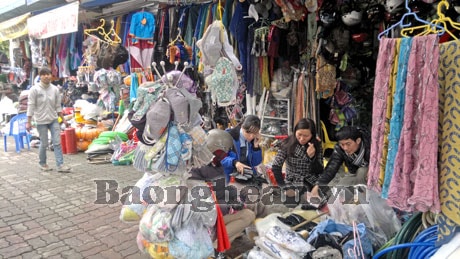
Grocery stalls at Cua Bac market - Photo: Long Van
Ms. Hong, a long-time businesswoman at Kenh Bac Market, said: "Since the transition to the cooperative model, the market has been upgraded, is cleaner, and the services within the market are quite reasonable. Therefore, traders here have the opportunity to expand their business and sell more goods."
These are clearly new models, but their initial operations have yielded many positive results. Currently, two-thirds of these market cooperatives have secured long-term land leases from the government, which is a very favorable condition for them to implement projects to upgrade the market to become more spacious and modern.
In 2012, Phong Toan Market, located in Ha Huy Tap ward, also began operating under this model. However, the difference is that Phong Toan Cooperative built a new market, not a conversion of the old one. Nevertheless, the effectiveness of these models over the years is undeniable. Hopefully, in the future, many more such models will continue to emerge in Vinh City and the province as a whole.