

Le Ninh Road Project: Land Clearance Stuck, Over 80 Households Suffer
(Baonghean)Planned in 1991 and construction beginning in 2006, Le Ninh Street – a first-class main street in Vinh City – remains unfinished to this day. As a result, the urban landscape of Northwest Vinh City is less attractive, and more than 80 households in the planned area are suffering…
The residential area of the Rubber Factory workers' housing complex, Block 8, Quan Bau Ward (Vinh City), is like a maze with narrow, winding alleyways and houses of varying heights. It took several attempts to find the house of the block leader, Le Huu Bien. When he learned that people had come to inquire about the situation of residents living in the planned area, Mr. Bien opened his heart and recounted the hardships, even though "we've talked about our neighborhood's problems countless times already."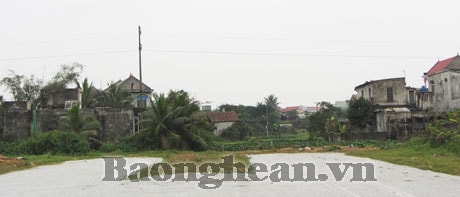
Le Ninh Street cannot be opened to traffic yet due to a lack of funds for land compensation and clearance.
According to Mr. Bien, Block 8 has 42 households located within the planned area. “The people are suffering terribly! Their houses are cramped and dilapidated, and they can’t even repair them. Every house has to build a water tank and buy tap water because they don’t dare contract with the water plant to supply water. Families with many children can’t separate or expand their homes. When they urgently need money, no bank will accept a loan because their land title is within the planned area. Even families eligible for housing assistance have had their benefits cut because their houses are in the planned area…” Mr. Bien stated. He added that residents of Block 8 have submitted petitions to various levels of government and have raised the issue at National Assembly and People’s Council meetings… Officials from the ward, city, and province are aware of the “suspended planning,” know the people are suffering, and have promised to resolve the issue, but the situation remains unchanged.
Together with Mr. Bien, we went to Mrs. Tran Thi Yen's house. The house, about 60 square meters (home to 3 households, 9 people), was cramped and damp. Mrs. Yen sadly said, "When the children grow up, they have to get married. Since we don't have money to buy land and build houses for them, we have to add an extra corner so they have a place to live..."
Compared to Mrs. Yen's family, the family of war invalid Nguyen Dang Han is even more impoverished. Their house, about 50 square meters, houses four households and 13 people. In Mr. Han's house, the tiny living room and bathroom are shared spaces, while the rest is enclosed into small "bunkers." Each "bunker" serves as a resting place for a family member, while Mr. and Mrs. Han have more space because their bed is in the kitchen. Mr. Han doesn't talk much about his family because "you can tell just by looking," but according to neighborhood leader Le Huu Bien, Mr. Han's family is extremely poor because of their housing situation. Mr. Han is both a war invalid and a disabled veteran; both he and his wife have suffered from cancer for quite some time. Mr. Bien said that Mr. Han's children have married and have children, all living with their parents, and on top of that, the cost of cancer treatment adds to their already difficult circumstances. Faced with this situation, the neighborhood committee requested financial assistance from the ward to repair Mr. Han's house. The ward approved the request, but when officials came to inspect, the funds were cut off because the house was located in a planned development area, meaning even with assistance, repairs would be impossible.
It is known that Le Ninh Street was planned in 1991; on October 16, 2002, the Provincial People's Committee approved the investment project in Decision No. 3795. Accordingly, the road has a length of 2,957m, with a planned width of 41m (roadway 22.5m, median 2m, sidewalks on both sides 16.5m, standard as a first-class main street). The starting point merges with Phan Boi Chau Street and Truong Chinh Street to form a three-way intersection in front of Vinh Train Station. The end point merges with National Highway 1A (North-South), National Highway 46 (Vinh - Cua Lo), and Dang Thai Mai Street (road leading to the North Vinh Industrial Zone) to form a large five-way intersection at Quan Banh junction.
In 2006, the Le Ninh road investment project began. According to the investor (Vinh Project Management and Construction Board), after receiving the contract, Hoa Hiep Co., Ltd. proceeded with the construction of the road with a commitment to complete it within 18 months, and the work should have been completed on schedule if the land clearance work had not encountered obstacles. “Previously, the obstacle in land clearance was the lack of resettlement land; now that resettlement land is available, there is a lack of compensation funds,” said Mr. Nguyen Sy Dieu, Head of the Vinh Project Management and Construction Board. According to Mr. Dieu, the contractor has completed nearly 90% of the work, with only a few hundred meters of road remaining to be finished. However, construction cannot continue due to obstacles in residential areas of Blocks 5, 7, and 8 in Quan Bau Ward.
On December 24, 2012, the City People's Committee submitted document No. 4936/TTr-UBND regarding the allocation of funds for compensation and land clearance for the construction of Le Ninh road, to the Provincial People's Committee and relevant departments and agencies. In this document, the City People's Committee requested the Provincial People's Committee to use the provincial budget already allocated to another road project in the city, transferring a total of 15 billion VND to the Le Ninh road project…
It is understood that finding funding for infrastructure development is extremely difficult at present. However, the authorities at all levels need to urgently consider and definitively resolve the land clearance issue for residential clusters 5, 7, 8, and 12 in Quan Bau ward, involving over 80 households, so that Le Ninh road can be opened to traffic. The Le Ninh road project has already received over 56 billion VND in investment (including road construction and resettlement area construction) and is basically complete. This road plays a crucial role in Vinh City's transportation system, contributing to traffic diversion, reducing traffic density on National Highway 1A, and developing tourism in Cua Lo - Vinh - Kim Lien (Nam Dan), promoting urbanization and socio-economic development in the northwestern region of the city. Furthermore, it is unacceptable for over 80 households to continue suffering by living in a planned area…