

The truth about the 1974 Paracel Islands incident.
More than three decades ago, on January 19, 1974, the Chinese army invaded the Paracel Islands, which were then under the control of the Saigon government.
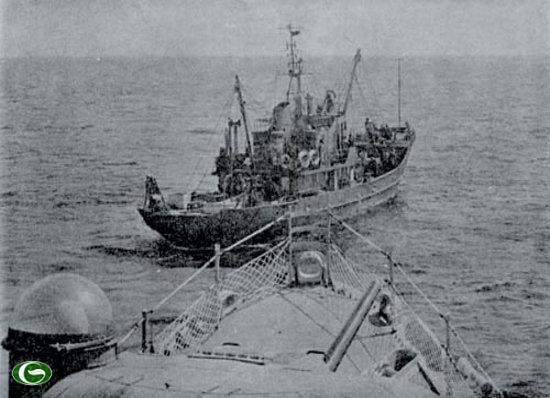
Armed Chinese fishing boats block Vietnamese vessels en route to the Paracel Islands.
Archival photo
So what was the truth about the Paracel Islands incident in January 1974? Was it a self-defense response by the Chinese military and people, as the aforementioned news outlets claimed, or was it an invasion of a territory with undeniable Vietnamese sovereignty?
Undisputable sovereignty
For over three decades, amidst the ups and downs of Vietnam-China relations, Vietnam has consistently affirmed that the Paracel and Spratly Islands are an integral part of its sacred territory. This sovereignty has been proven by the passage of time and the centuries-long history of the Vietnamese people and the Vietnamese State.
The establishment of Vietnam's sovereignty over Hoang Sa (as well as over Truong Sa) is evidenced not only by documents recorded by foreigners such as the book "Hai Ngoai Ky Su" by Thich Dai San written in 1696, or by many Western authors such as Le Poivre (1749), J. Chaigneau (1816-1819), Taberd (1833), Gutzlaff (1849)...; as well as tangible and intangible cultural heritage related to the activities of the ancient Hoang Sa Teams at Sa Ky estuary and Ly Son island (Cu Lao Re), but also recorded in many historical documents, including state-level documents of Vietnam.
To this day, we still have ample evidence of the sovereignty of the Dai Viet state (including the Northern region under the Trinh lords and the Southern region under the Nguyen lords, both supporting the Le dynasty) through the Thien Nam Tu Chi Lo Do Thu in the Hong Duc Map or the Toan Tap An Nam Lo in the Thien Ha Ban Do book (compiled by Do Ba Cong in the 7th year of Chinh Hoa - 1686) and the Phu Bien Tap Luc book by the scholar Le Quy Don (1776)...
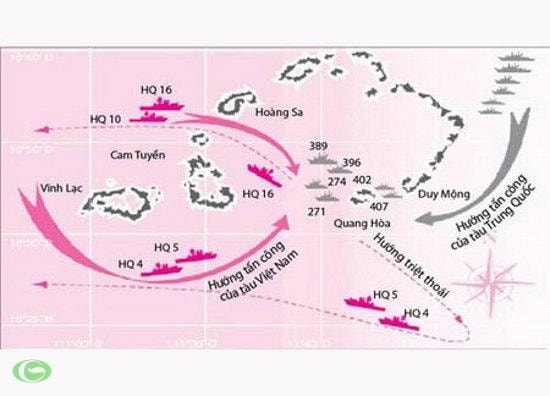
Diagram of the attack routes in the Battle of the Paracel Islands on January 19, 1974.
The map in Thien Nam Tu Chi Lo Do was drawn in the style of the time, with very clear annotations:“In the middle of the sea there is a long stretch of sand called the Golden Sandbank (Hoang Sa) stretching for 400 miles… Every year, at the end of winter, the Nguyen family sends 18 ships there to collect goods, mostly gold, silver, currency, weapons and ammunition…”.
The map in the An Nam Road Compilation clearly notes the place name "Golden Sandbank" in the open sea in front of inland locations such as the Dai Chiem, Sa Ky, and My A estuaries, Quang Nghia prefecture, and the districts of Binh Son, Chuong Nghia, and Mo Hoa.
In the book Phu Bien Tap Luc by scholar Le Quy Don (1776), Hoang Sa is described in even greater detail. In 1775, Le Quy Don was appointed by Lord Trinh to the Phu Xuan region as Deputy Governor to oversee the pacification of the two newly recovered provinces from Lord Nguyen, namely Thuan Hoa and Quang.
During the Nguyen dynasty, starting from the beginning of the 19th century, under the conditions where Vietnam (under the reign of Gia Long) and Dai Nam (from the reign of Minh Mang) had ended its fragmentation and division, and the nation was unified, territorial management was more fully documented and better preserved. The map created during the reign of Minh Mang, the Dai Nam Nhat Thong Toan Do, clearly depicts a vast territory including islands in the East Sea, noted as "Van Ly Truong Sa" (the general name for both the Hoang Sa and Truong Sa archipelagos according to contemporary understanding).
Two important geographical books of the Nguyen Dynasty, namely the Geographical Gazetteer in the Historical Records of the Dynasties (1821) and the book Hoang Viet Geographical Gazetteer (1833), both mention Hoang Sa in the section on Tu Nghia Prefecture and both record the contents of previous documents, including the activities of the "Hoang Sa Teams".
The official historical chronicle Dai Nam Thuc Luc, compiled continuously by the National History Institute of the Nguyen Dynasty until the first decade of the 20th century, repeatedly recorded events related to the Paracel and Spratly Islands as part of the national territory. Even in the Preliminary Section, which recounts events from the time of the Nguyen Lords concerning these archipelagos, this chronicle also mentions events from that era related to these islands.
Statistics show that in this historical work, the main section recording events related to these two archipelagos up to the time of printing contains 11 passages. Specifically, the content includes the state sending the navy and the Hoang Sa Fleet to the islands to "examine and measure the waterways" (volumes 50, 52... during the reign of Gia Long); sending people to Hoang Sa to "build temples, erect steles, plant trees," "draw maps of the terrain," and "plant wooden markers to establish sovereignty" (volumes 104, 122, 154, 165 during the reign of Minh Mang).
In addition, the book Khâm Định Đại Nam Hội Điển Sự Lệ (1851) also clearly records the work that the Đại Nam state had carried out on the Hoàng Sa territory. Particularly valuable are the royal documents of the Nguyễn dynasty kings (i.e., those with the king's handwriting) related to Hoàng Sa. The value of these original documents lies in the demonstration of the power of the head of state over this territory. For example, in his commentary on the report of the Ministry of Public Works dated February 12th, the 17th year of Minh Mạng (1836), the king wrote: "Each ship going to explore Hoàng Sa must bring 10 wooden markers (boundary posts) 4.5 thước (ta) long and 5 tấc wide, deeply engraved with the words 'In the year Bính Thân, the 17th year of Minh Mạng, the name of the naval commander ordered to survey and place markers in Hoàng Sa to leave a mark'"; or the royal comments on rewarding and punishing those who had merit or fault in performing their duties in Hoàng Sa, surveying and drawing maps, etc.
It was not until 1909 that China first mentioned its sovereignty over this territory. This shows that, throughout the three centuries prior (17th-19th centuries), successive historical documents of the Vietnamese State continuously demonstrated historical sovereignty and practical administration over the Paracel and Spratly Islands.
By the late 19th and early 20th centuries, France, as the protectorate of Vietnam,
Vietnam's sovereignty
The Saigon government, and later both the Saigon government and the Provisional Revolutionary Government of the Republic of South Vietnam, exercised Vietnam's sovereignty over the Paracel Islands and the Spratly Islands.
Here is some evidence:
In 1956, the naval forces of the Saigon government took over the Paracel and Spratly Islands when the French withdrew their troops.
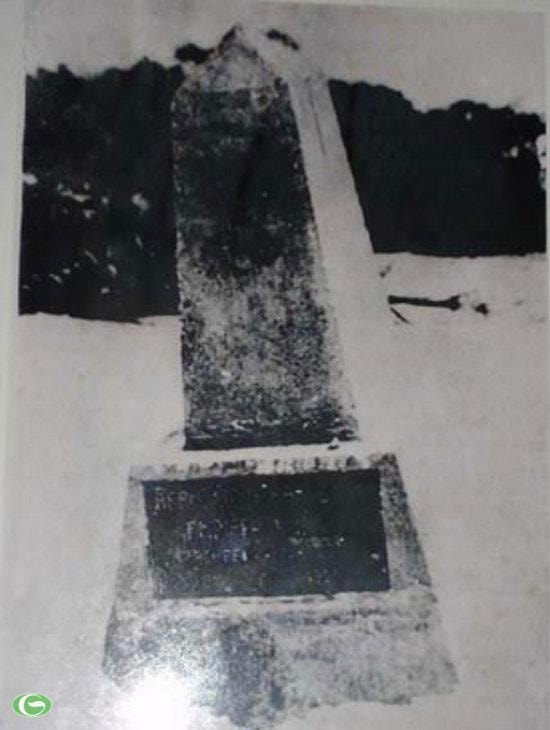
The Hoang Sa sovereignty marker in Vietnam.
Photo: taken at the Hoang Sa Archives, Da Nang.
In 1956, the Department of Mines, Industry and Small-Scale Industries of the region
On October 22, 1956, the Saigon government placed the Spratly Islands under the jurisdiction of Phuoc Tuy province.
On July 13, 1961, the Saigon government placed the Paracel Islands, formerly part of Thua Thien province, under the jurisdiction of Quang Nam province and established a commune there named Dinh Hai commune, directly under Hoa Vang district and placed under the authority of an administrative representative.
From 1961 to 1963, the Saigon government successively erected sovereignty markers on the main islands of the Spratly Archipelago, such as Truong Sa, An Bang, Song Tu Tay, etc.
On October 21, 1969, the Saigon government merged Dinh Hai commune into Hoa Long commune, also belonging to Hoa Vang district, Quang Nam province.
In July 1973, the Agricultural Research Institute under the Saigon Ministry of Agricultural and Land Development conducted a survey of Nam Ai (Nam Yet) Island in the Spratly Islands.
In August 1973, with the cooperation of the Japanese company Maruben Corporation, the Ministry of Planning and Development of Saigon conducted a phosphate survey in the Paracel Islands.
On September 6, 1973, the Saigon government annexed the islands of Truong Sa, An Bang, Itu Aba, Song Tu Dong, Song Tu Tay, Loai Ta, Thi Tu, Nam Ai, Sinh Ton and adjacent islands into Phuoc Hai commune, Dat Do district, Phuoc Tuy province.
The life-or-death naval battle of January 1974
Conscious of Vietnam's long-standing sovereignty over the Paracel and Spratly Islands, the South Vietnamese governments defended that sovereignty whenever a foreign country expressed an intention to claim or occupy any island in the two archipelagos.
On June 16, 1956, the Ministry of Foreign Affairs of the Saigon government once again affirmed Vietnam's sovereignty.
On February 22, 1959, the Saigon government temporarily detained 82 Chinese "fishermen" who landed on the islands of Huu Nhat, Duy Mong, and Quang Hoa in the Paracel Islands.
On April 20, 1971, the Saigon government reaffirmed that the Spratly Islands belonged to Vietnamese territory.
On July 13, 1971, the Foreign Minister of the Saigon government reaffirmed Vietnam's sovereignty.
The conflict peaked in January 1974, when numerous Chinese warships launched an attack to seize the western cluster of islands in the Paracel Islands.
On January 11, 1974, China brazenly declared the Paracel and Spratly Islands, then under the administration of the Saigon government, as part of its territory. Immediately following this declaration, the Chinese navy launched an invasion of the Paracel Islands by deploying numerous armed warships and fishing vessels to infiltrate the Paracel Islands' territorial waters.
On January 12, 1974, Foreign Minister Vuong Van Bac of the Saigon government vehemently rejected the arrogant rhetoric and condemned China's aggressive actions.
On January 16, 1974, the Saigon government issued a statement with clear legal, geographical, and historical evidence of Vietnam's sovereignty over the two archipelagos. At the same time, the Saigon Naval Command deployed four warships to the Paracel Islands to prevent activities violating Vietnam's sovereignty over the Paracel Islands by Chinese armed forces, but with a peaceful and restrained attitude.
On January 18, 1974, China reinforced its troops and warships to the Paracel Islands.
On January 19, 1974, China and the Republic of Vietnam fought a naval battle in the Quang Hoa Island area.
Mr. Lu Cong Bay, who was present at the Battle of the Paracel Islands 35 years ago as a sergeant on the warship HQ-4, recalled: “At exactly 8:30 a.m., the Chinese side opened fire first. A barrage of machine gun and 82mm mortar rounds hit the Vietnamese frogmen formation.”
At exactly 10:20 AM, the four warships HQ-4, HQ-5, HQ-10, and HQ-16 simultaneously opened fire. As planned, Captain Vu Huu San gave the order to "fire." The warships moved at extremely high speed, thick black smoke billowed up, and the hulls shook violently from the gunfire and the reverberation of the cannons.
The warship HQ-4 weaved like a snake, veering from right to left, thus avoiding the enemy's artillery barrage. Then columns of water erupted, and bullets whizzed around the ship. A shrapnel fragment pierced the command bridge, striking Lieutenant Roa in the leg as he tried to track the Chinese ship on the radar screen. Staff Sergeant Ry was hit by shrapnel in his left arm. Corporal Phan, the .30 caliber machine gunner on the top of the command bridge, was wounded in the chest, his shirt stained red with blood. The cries of the wounded echoed up to the command bridge.
Over the radio, I heard my friend, Sergeant Major Vuong Thuong, reporting: "HQ-10 has been hit by gunfire, Captain Nguy Van Tha is dead, and Deputy Captain Thanh Tri is seriously wounded in the abdomen. Most of the officers, non-commissioned officers, and sailors on the bridge are dead or seriously wounded" (Excerpt from Hoang Sa - Report 35 years later: 30 minutes and 35 years - Source: Tuoi Tre).
The naval battle lasted only 30 minutes. 74 South Vietnamese soldiers were killed.
On January 20, 1974, China deployed additional bombers to attack the islands occupied by South Vietnam. By the first week of February 1974, China had temporarily occupied the Paracel Islands and established a military base there.
Immediately after China used force to invade all the western islands of the Paracel Islands, which were under Vietnamese administration, on January 19, 1974 and February 14, 1974, the Saigon government issued statements regarding China's "blatant military invasion" and reaffirmed Vietnam's sovereignty over the Paracel Islands.
On January 20, 1974, the foreign minister of the Saigon government also telephoned and sent letters to the President of the Security Council and the Secretary-General of the United Nations, requesting necessary measures in response to the urgent situation regarding China's use of force to invade the Paracel Islands.
Meanwhile, on January 26, 1974, the Provisional Revolutionary Government of the Republic of South Vietnam also issued a statement protesting China's invasion of the Paracel Islands and announced Vietnam's position "on sovereignty and territorial integrity."
China's use of force to seize the Paracel Islands violated Article 2 of the UN Charter. In response to these actions, countries such as the Soviet Union, the Netherlands, New Zealand, Indonesia, and international organizations like the World Federation of Labor, Italian youth groups, the Australian Citizens' Council, the Australian Institute for Social Research, and the Australian University Committee for the Defense of Indochina, etc., voiced their opposition to China's territorial aggression by force. Simultaneously, in 1974, the UN Security Council adopted Resolution 3314, defining acts of aggression by force.
After the day of the month
So the historical truth about the Paracel Islands incident on January 19, 1974, is now clear. History cannot be concealed, nor can it be embellished or distorted. The historical records remain, and the witnesses are still there.
While the leaders of the two parties and two countries consistently emphasize the sixteen-word motto and the "four goods" in Vietnam-China relations, articles like the one above deserve criticism because they will tarnish the friendship and cooperation that the leaders and people of the two countries are striving to build.
According to VNN-M