
Lesson 1: The Gray Picture…!
With reserves of over 4 billion cubic meters of limestone, more than 1 billion tons of clay, and hundreds of millions of tons of additives such as basalt, kaolin, iron ore, etc., along with about 4-5 million tons of coal (Khe Bo - Tuong Duong coal mine and Don Phuc - Con Cuong coal mine) which is a type of coal with high calorific value suitable for cement production, Nghe An has a huge advantage to become one of the major cement production centers in the country. However, a sad reality is that this industry is currently in a bleak state…
(Baonghean)With reserves of over 4 billion cubic meters of limestone, more than 1 billion tons of clay, and hundreds of millions of tons of additives such as basalt, kaolin, iron ore, etc., along with about 4-5 million tons of coal (Khe Bo - Tuong Duong coal mine and Don Phuc - Con Cuong coal mine) which is a type of coal with high calorific value suitable for cement production, Nghe An has a huge advantage to become one of the major cement production centers in the country. However, a sad reality is that this industry is currently in a bleak state…
The cement manufacturing industry in our province developed from the early 1990s. At that time, a series of cement factories with vertical kiln technology were established, such as Cau Duoc Cement and Anh Son 12-9 Cement. However, the "golden age" of these models did not last long due to inefficient business practices and outdated technology.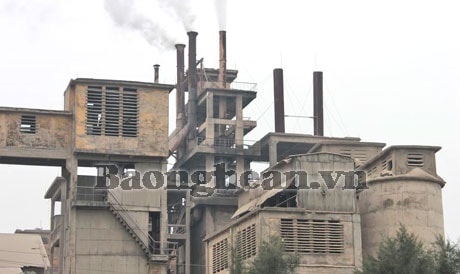
Cau Duoc Cement Plant uses vertical kiln technology for production.
Cau Duoc cement, once dominating the market in Nghe An and neighboring provinces, has faced numerous problems in management, production, and business after its transformation into a joint-stock company. These include the prohibition of clinker kilns within the city center (as the company is located in Vinh City), and the failure of a planned joint venture with Do Luong Cement Joint Stock Company. Therefore, to survive, this specialized cement manufacturing enterprise has had to shift towards producing building materials such as non-fired bricks and colored tiles. Mr. Dinh Bat Vinh, Director of Cau Duoc Cement & Building Materials Joint Stock Company, stated: “Because of our decades-long tradition of cement production, the company still has many business partners. Furthermore, to utilize the old cement grinding system, the company has purchased clinker from Hoang Mai and Tam Diep cement factories to produce PCB 30 and 40 cement for domestic use, rural development projects, and export.” Laos. In 2012, nearly 40,000 tons of cement were produced. Although the output is not large, this is a positive sign for Cau Duoc cement in the current difficult circumstances.”
Difficulties in basic construction investment and production-business are also occurring at Nghe An Petroleum Cement Joint Stock Company (formerly Anh Son 12-9 Cement). After officially merging into a member unit of the Vietnam Oil and Gas Group, this enterprise has the opportunity to innovate production technology, improve quality, and increase output. Currently, the Vietnam Oil and Gas Group has invested over 800 billion VND in installing a new production line using modern rotary kiln technology. The main construction items have been basically completed, but the investor has temporarily stopped injecting capital, thus halting the project's progress during its crucial final stages. Although relevant provincial authorities have issued requests and directly worked with the Vietnam Oil and Gas Group, the aforementioned issue has yet to be resolved appropriately. Currently, the company is still "waiting for capital" and must maintain cement production on the old line using vertical kiln technology to supply cement products to customers. The difficulty in securing investment capital for the new production line of Nghe An Petroleum Cement is becoming a concern for many levels and sectors.
Recently, two cement production investment projects in Nghe An province have been considered "highly anticipated": Do Luong Cement Joint Stock Company (capacity of 910,000 tons/year) and Saigon - Tan Ky Cement Joint Stock Company (phase 1 capacity of 910,000 tons/year). However, after many years of implementation, the Do Luong cement plant project has only completed the construction of the factory's office area. The project is behind schedule because the main shareholders have been unable to secure the necessary capital. Currently, the Vietnam Housing and Urban Development Group and the project's main shareholders have submitted a request to withdraw from the project, and the Provincial People's Committee is calling on The Vissai Cement Group Co., Ltd. to take over. So, after several missed deadlines, it remains uncertain when Do Luong cement will finally produce its first products. For example, the Saigon-Tan Ky cement plant project was granted an investment license by the Provincial People's Committee in September 2009 and construction began on May 19, 2010; however, from October 2010, the investor did not proceed according to schedule, so the Provincial People's Committee decided to terminate operations and revoke the investment certificate for the project.
The Hop Son - Anh Son cement plant investment project (formerly 19-5 Cement) is also facing a funding deadlock. The project, with a total investment of approximately 548 billion VND (capacity of 350,000 tons/year), was started on May 19, 2009, by Hop Son Cement Joint Stock Company. Due to financial difficulties, the investor has requested a temporary suspension of the project and asked the province to seek other capable investors to continue its implementation.
As mentioned above, there are many cement development investment projects in the province, but currently most of these projects are not progressing on schedule (only Hoang Mai Cement, using rotary kiln technology from the Republic of France with a capacity of 1.4 million tons/year, is operating effectively). This reality paints a bleak picture of the cement production industry in Nghe An.
According to the Vietnam Cement Industry Development Plan for the period 2011-2020 and orientation to 2030, as stipulated in Decision No. 1488/QD-TTg dated August 29, 2011, of the Prime Minister, Nghe An province is one of four regions with significant potential for cement development and supply nationwide, including: the Red River Delta region (Quang Ninh, Hai Phong, Hai Duong, former Ha Tay); Ninh Binh; Ha Nam; and the North Central region (Thanh Hoa, Nghe An, Quang Binh). |
(to be continued)
Hoang Vinh