

Facilitate the purchase and temporary storage of rice to the maximum extent possible.
This was the directive given by Deputy Prime Minister Hoang Trung Hai at a meeting with localities in the Mekong Delta and key food procurement units on the morning of February 27th to review the situation and direct solutions to overcome difficulties in rice and seafood production and consumption in the region.

Deputy Prime Minister Hoang Trung Hai requested that the objectives of temporary stockpiling be implemented correctly.
Photo: VGP/Nguyen Linh
The conference, held in Dong Thap province, aimed to discuss effective solutions for implementing the government's policy of temporarily stockpiling 1 million tons of rice, a policy that is crucial to the production and consumption of rice in the 2013 crop year.
Rice prices rise due to stockpiling.
According to a preliminary report from the Ministry of Agriculture and Rural Development, in the 2012-2013 Winter-Spring crop season, the Mekong Delta provinces sowed 1.53 million hectares, a decrease of 46,000 hectares compared to the previous year. To date, approximately 1.1 million hectares of rice have been harvested, yielding about 7.4 million tons of paddy rice, and the total yield for the season is expected to reach about 3.8 million tons of milled rice.
However, due to difficult consumption conditions, the selling price of rice for farmers has decreased. In response to this situation, on February 7th, the Prime Minister issued Decision No. 311/QD-TTg to temporarily stockpile 1 million tons of rice from the 2012-2013 Winter-Spring crop in the Mekong Delta provinces to alleviate the difficulties.
According to Truong Thanh Phong, Chairman of the Vietnam Food Association (VFA), since February 20th, traders meeting all three criteria to participate in temporary stockpiling have begun purchasing, and to date, 102 out of 119 businesses have reported purchasing for temporary stockpiling, totaling 211,844 tons, equivalent to 21% of the assigned target.
The State Bank of Vietnam has also directed 12 commercial banks to provide loans for the purchase of paddy and rice for temporary storage.
Following the implementation of temporary stockpiling, rice prices on the market have increased slightly compared to the beginning of the season. The average price of fresh rice in the fields has increased by 150-200 VND/kg, reaching 4,400 VND/kg for regular rice and 4,600-5,300 VND/kg for high-quality and fragrant rice.
According to Mr. Truong Thanh Phong, the current rice purchase prices for temporary storage as well as export are considered consistent with international market prices. With the current inventory of rice awaiting export by businesses at approximately 1.24 million tons and forecasts of supply and demand balance domestically and in the world rice market, by mid-2013, Vietnam is likely to export 3.5 million tons, maintain inventory at 800,000 - 1 million tons, and ensure good purchase prices for farmers.
"The purchase price is unlikely to go up until the Summer-Autumn crop season," Mr. Phong affirmed.
Deputy Minister of Industry and Trade Tran Quoc Khanh also stated that the government's policy of purchasing rice for temporary storage has stimulated prices and increased farmers' income. In 2013, Vietnam's rice exports faced many pressures, but the number of registered rice export contracts at the beginning of the year was very promising, exceeding 2.8 million tons, nearly double the amount compared to the same period in 2012. Therefore, temporary storage will help proactively manage rice consumption throughout the year.
Maximize facilitation of temporary procurement activities.
At the conference, opinions from localities in the Mekong Delta rice-growing region all showed positive results from the temporary rice procurement program. However, obstacles in implementing the program, such as complex loan procedures and slow disbursement, prevented many traders from purchasing rice in a timely manner. Some traders were unable to obtain loans because banks required collateral instead of rice for temporary storage.
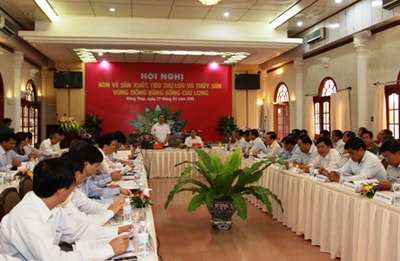
Photo: VGP/Nguyen Linh
According to Deputy Governor of the State Bank of Vietnam Nguyen Dong Tien, outstanding credit to rice purchasing businesses reached VND 17,013 billion at the beginning of this year, an increase of 4.56% compared to the beginning of last year. In the near future, the State Bank of Vietnam will balance capital sources and direct credit institutions to continue shifting the credit structure, focusing lending on agriculture and small and medium-sized enterprises.
According to business representatives, the current volume of purchased rice of the IR 50404 variety is large, potentially causing difficulties for exports due to its low quality, while long-grain rice varieties are in demand but have low production.
According to forecasts presented at the conference, many expressed concerns about the international market situation and the continued difficulties facing Vietnam's rice exports in 2013 due to competitive pressure from Thailand, India, Myanmar, and Pakistan, while some traditional markets reduced imports.
In his concluding remarks at the conference, Deputy Prime Minister Hoang Trung Hai assessed that the situation of the Winter-Spring crop – the most important crop of the year – is unfolding with a mix of advantages and difficulties. Market fluctuations and export challenges require accurate understanding of developments and timely, appropriate solutions to achieve the highest possible success in agriculture and ensure benefits for farmers.
The Deputy Prime Minister stated that the initial results of the temporary stockpiling program are positive. In the future, ensuring that this stockpiling program achieves its objectives will be crucial to the management and operation of the 2013 rice crop, as well as its production and consumption outcomes.
Deputy Prime Minister Hoang Trung Hai requested that advisory agencies learn from experience and create the most favorable conditions for the temporary storage work to be implemented on schedule and achieve its objectives. This includes considering extending the start time of temporary storage, setting appropriate quantities and floor prices for procurement, taking advantage of favorable weather to accelerate harvesting and procurement, and urgently providing early support for investment and agricultural mechanization, especially for harvesting and drying equipment which is currently lacking in some areas during peak harvest season.
In particular, the State Bank of Vietnam has directed that favorable conditions be created and disbursements be facilitated for traders to purchase rice for temporary storage in accordance with the policy. In the long term, expanding the model of the four-party linkage, large-scale model fields, etc., will support temporary storage more effectively.
Regarding exports, in the coming period, in addition to consolidating and maintaining markets and ensuring efficient consumption of rice in the mid- and low-end segments, we will continue to rationally plan procurement, processing, and export hubs to increase national competitiveness of exported agricultural and aquatic products.
However, the planting plan for the next season must gradually shift towards the premium rice market, specialty rice, and high-value rice varieties, while actively seeking and expanding into new markets.
Deputy Prime Minister Hoang Trung Hai instructed the Ministry of Agriculture and Rural Development and local authorities to support and supervise traders in accelerating the progress of temporary rice procurement and storage according to plan, to increase the use of high-quality rice varieties, and to minimize the sowing of low-value rice varieties such as IR50404 in the upcoming Summer-Autumn crop. The Ministry of Finance was also instructed to issue policies to facilitate the settlement of accounts for businesses implementing temporary storage.
According to (Chinhphu.vn) - LT