

A K5 memory
(Baonghean)In 1968, western Nghe An province – the border region adjacent to Xieng Khouang province and Muong May district of Bolikhamsai province – was an extremely volatile area... At the request of our Lao allies, the main units of Military Region 4 conducted numerous battles to defeat the Vang Pao rebels and right-wing factions along Route 7 in Laos, opening up the vital route from Vietnam to the Plain of Jars battlefield in Xieng Khouang.
In a separate working session on Western Nghe An, the Central Party Secretariat and the Government Council agreed with the proposal of Nghe An province and decided to launch a campaign to eliminate Vang Pao's rebels, codenamed K5; assigning the Ministry of Public Security and the Nghe An Provincial Party Committee to direct the Party Committee and the People's Armed Police Command to carry out the operation, with the task of: “Organizing forces to operate in the Muong Chuon, Pha Hom, and Pha Cat areas of Muong May district (Bolikhamsai province). Using surprise attacks, ambushes, and special forces combined with enemy troop mobilization to destroy and disintegrate enemy ranks and their hideouts, helping our allies expand and consolidate the liberated areas, while creating conditions for protecting the border from afar.”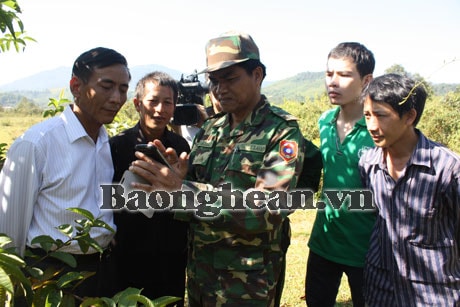
Colonel Kham Xa Voi – Political Commissar of the Xieng Khouang Provincial Military Command – introduced the planning for the K5 Campaign historical site in Khang Vieng village, Muong Moc district, Xieng Khouang province.
Following the Central Committee's decision, on November 5, 1968, the forces participating in Operation K5 were established, comprising the following units: the 5th Mobile Company of the People's Armed Police of Nghe An, the 6th Special Forces Reconnaissance Company, and the 12th Battalion of the People's Armed Police Command. These units assembled in Mon Son commune, Con Cuong district, and underwent rapid training. Comrade Nguyen Dinh Ba (later the Deputy Chief of Staff of the Provincial Border Guard), then the commander of the Muong Xen sub-district, was appointed as the commander of Operation K5.
During the campaign preparation period, the Nghe An Provincial Administrative Committee mobilized 200 civilian laborers to directly transport food, ammunition, and other supplies for the fighting.
After two months of training, on January 1, 1969, the forces participating in Operation K5 were ordered to depart from Tung Huong village, Tuong Duong district. Militia members departed from Phi Lo and Xop Nam to transport food supplies to the front lines. The silent but powerful footsteps of soldiers and civilian workers advanced from the Truong Son mountain range towards Muong May district (Laos), 30-35 km from the border. A vast mountainous area spanning thousands of square kilometers became the battlefield of Operation K5.
The weather here is extremely harsh; the rainy season brings muddy ground. During the dry season, there are months without water, thick fog, steep and treacherous mountain passes, sharp reeds, and even poisonous streams that blister the feet when wading in them... But with patriotic spirit and solidarity between the Vietnamese and Lao people, after two days of crossing the 1800m high peak in the Northern Truong Son mountain range, our troops reached Na Trang, seizing the important bridgehead position as planned. They coordinated with their Lao armed forces, assessed the situation, and planned their operations.
On the 30th day of the Lunar New Year in 1969, the campaign command, led by Comrade Nguyen Dinh Ba, decided to attack and destroy the Pha Hom outpost of the Vang Pao rebels, located 25km from the Vietnam-Laos border.
Recalling the battle to destroy the Pha Hom outpost, Comrade Nguyen Dinh Ba recounted the tense moments of the G-hour attack and the victories of the attacking units. At 6 PM on January 17, 1969, we attacked the Pha Hom outpost in three assault units. The main assault unit consisted of 47 comrades commanded by Comrade Nguyen Dinh Ba; the second unit had 15 comrades, commanded by Comrade Luyen; and the third unit had 7 comrades, commanded by Comrade Tuc. All three units secretly approached the enemy outpost. At exactly 3:15 AM, we began the attack. After only 15 minutes of fighting, the enemy's Pha Hom outpost was completely destroyed. We wiped out almost all of the enemy's commando and reconnaissance units; the rest, terrified, fled and scattered into the deep forest. The outpost commander, Ga Nenh, was shot in the leg, crawled a short distance, then embraced his wife and rolled down a ravine to escape.
The commando outpost was destroyed, and the people of Meo village (now the Hmong ethnic group) were overjoyed. Although Tet (Vietnamese New Year) had passed, the villagers still brought sticky rice and chicken to offer to the K5 soldiers so that "their children could happily celebrate the Vietnamese New Year."
Hai Thuong (Provincial Border Guard)