
Springtime outings and festivals
(Baonghean) - In 2013, 25 festivals will take place in our province, with the highest concentration from January to March of the lunar calendar (including 17 festivals from the mountainous to the lowland areas). Each festival has its own unique characteristics specific to each region.
(Baonghean) - In 2013, 25 festivals will take place in our province, with the highest concentration from January to March of the lunar calendar (including 17 festivals from the mountainous to the lowland areas). Each festival has its own unique characteristics specific to each region.
After the warm and joyful Tet holiday, on the 5th day of the Lunar New Year, we travel to Chau Cuong - Quy Hop to join the local people in celebrating the Pan Pang - Nang Ny Festival (or Muong Ham Festival). This is a unique and representative traditional cultural festival, deeply rooted in the folk culture of the Khun Tinh people. It originates from the legend of the love story of Nang Ny and Khun Tinh in the folklore of the Thai ethnic group in Western Nghe An, along with the legend related to Tao Noi in the late 17th century, who established the village and drove out the Xa invaders. This year, the festival officially takes place on the 5th and 6th days of the Lunar New Year. A special feature of the Pan Pang - Nang Ny Festival is the competition to write in the ancient Thai script. This cultural activity aims to preserve and promote the ancient Thai script of the Muong people, which is facing the risk of extinction. During this festival, many recreational activities such as throwing the "con" (a type of ball), archery competitions, tug-of-war, and gong playing took place vibrantly amidst the vast mountainous region of western Nghe An province.
Bidding farewell to Khun Tinh, we return to the birthplace of President Ho Chi Minh to celebrate the King Mai Temple Festival on the 15th day of the first lunar month. This year's King Mai Festival coincides with the 1300th anniversary of the Hoan Chau Uprising and the 1290th anniversary of King Mai's death, making the ceremonial and festive activities even more attractive and diverse. Mr. Nguyen Xuan Tam – Deputy Director of the Nam Dan Cultural and Sports Center – said: The 2013 King Mai Temple Festival will take place over three days (January 13-15, lunar calendar). The commemorative program has four parts: the opening ceremony, the festival by the Lam River; the ceremonial celebration; and the "Flame of Van An" art program, which is expected to be broadcast live on VTV and NTV.
From January 19th to 21st, the Cờn Temple Festival in Quỳnh Lưu takes place. The festival begins with processions of boats adorned with colorful flags and flowers, accompanied by the resounding sounds of drums and gongs. This year, a special reenactment of a naval battle, linked to the legend of the temple's founding, features blue and red armies clashing on a rugged mountain range from Ói village to Cờn Temple. In addition, various folk games such as swing riding, wrestling, human chess, dragon boat racing, and performances of traditional opera, folk singing, and ceremonial singing create a lively and vibrant atmosphere.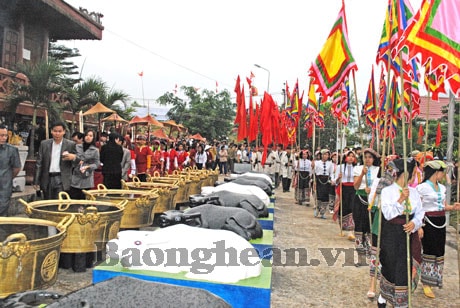
Nine-Compartment Temple Festival (Que Phong).
Around the same time, in Bach Ngoc commune, Do Luong district, the annual Qua Son Temple Festival, held from the 20th to the 21st of the first lunar month, is an occasion for the people to commemorate Uy Minh Vuong Ly Nhat Quang, the eighth son of King Ly Cong Uan. The most distinctive feature of the Qua Son Temple Festival is the procession of the deity to thank the Goddess of Mercy at Ba But Pagoda (Tien Tich Temple). Legend says that the Goddess of Mercy always helped Ly Nhat Quang in his military and economic development. At the Qua Son Temple Festival, visitors can immerse themselves in a sacred atmosphere with the spirit possession ceremony, processions by water and land, and many fun folk games: cockfighting, swinging, card games, human chess, wrestling… Particularly attractive to tourists is the boat race against the current on the Lam River. Also during this time, in Chau Tien commune, Quy Chau district, the Hang Bua Festival takes place. This is a festival rich in the folk culture of the ethnic minorities in the high mountains of Northwest Nghe An. The festival features spiritual rituals and cultural and sporting activities such as: cave games, cultural exchanges, crossbow shooting, throwing the "con" (a type of ball), stick pushing, modern sports, culinary culture competitions, Lai Pao Thai script writing competitions, yarn spinning competitions, incense making competitions, etc.
In addition, there are festivals such as the Van Temple - Cua Rao (Xa Luong - Tuong Duong) from January 20-22; Pu Nha Thau in Huu Kiem commune - Ky Son (January 16-17); Nguyen Xi - Nghi Hop - Nghi Loc (January 29 to February 1); Thanh Liet Temple (Hung Lam - Hung Nguyen) on February 6; Bach Ma Temple (Vo Liet commune - Thanh Chuong) from February 9-10; Lang Vac (Nghia Hoa - Thai Hoa town) from February 7-9; Chin Gian Temple (February 14-16) in Chau Kim - Que Phong; Ru Gam Temple - Xuan Thanh - Yen Thanh (February 14-16); Cuong Temple - Dien An - Dien Chau (February 14-15); and the Cua Temple Festival - Nghi Khanh - Nghi Loc, which is the final festival concluding the series of early spring festivals in Nghe An province.
Mr. Pham Tien Dung, Deputy Director of the Department of Culture, Sports and Tourism of Nghe An, said: In order for the festivals in Nghe An to truly promote traditional cultural values, the Department of Culture, Sports and Tourism of Nghe An has issued a directive to strengthen propaganda and inspection work; assigned relevant departments to participate in implementation and develop appropriate scenarios linked to the specific theme of each festival; and at the same time, established a management mechanism suitable to the scale, nature, and characteristics of the festivals in each locality to bring festival activities into order and preserve the regional cultural identity.
Thanh Thuy