

Branding is needed for Phu Loi Fish Sauce Village.
(Baonghean)For hundreds of years, the people of Phu Loi craft village (Quynh Di, Quynh Luu) have been proud of their special fish sauce product. Currently, facing competition from many fish sauce brands on the market, Quynh Di fish sauce needs a boost in brand recognition…
An unmistakable flavor.
With its unique processing method creating flavors distinct from other types of fish sauce, Quynh Di fish sauce has made a name for itself. The 1990s and 2000s were the most prosperous period for the fish sauce industry in Quynh Di. At that time, Quynh Di fish sauce sold out as soon as it was produced. The product was exported to many northern provinces such as Hai Phong, Nam Dinh, and Thai Binh… Many households have passed down the fish sauce production trade for more than four generations. Therefore, in 2005, the Provincial People's Committee issued a decision recognizing Phu Loi Fish Sauce Village as a provincial-level craft village.
The family of Ms. Tran Thi Ong (Phu Loi 2 hamlet, Quynh Di commune) is one of the oldest fish sauce producers. Ms. Ong herself has been in the business for over 40 years. Initially, she helped her parents, and after getting married and moving out on her own, she continued producing fish sauce. Each year, Ms. Ong's family produces about 1,500 liters of concentrated fish sauce from approximately 50 tons of fish. The fish is salted for about 12-14 months until it matures, resulting in a fragrant, dark yellow, clear, and thick fish sauce.
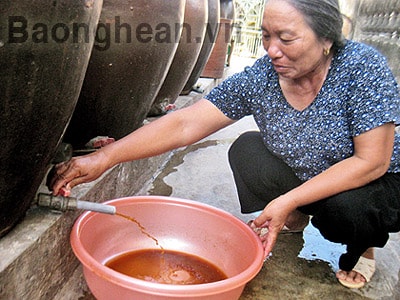
Traditional fish sauce production in Quynh Di.
Ms. Ong shared: "When producing fish sauce, each locality has its own secret recipe. Moreover, each family has secrets passed down from generation to generation. To make delicious fish sauce, you first need a good source of raw materials. The main ingredient that people in Quynh Di often use is anchovies. The fish must be fresh and thoroughly washed before fermentation. After selecting fresh fish, they are mixed with salt. During the fermentation process, to create a unique flavor, additives such as roasted sesame seeds, roasted rice, and granulated sugar are added. On sunny days, the fish must be stirred to ensure even fermentation, and after more than a year, it can be used. Besides the stirring method, people also use the pressing method, which takes 15-20 months to produce the fish sauce. Therefore, the fish sauce will have a richer flavor."
Because of this method of salting the fish, the protein content in Quynh Di fish sauce is always above 35 degrees. Many households have become wealthy through fish sauce production; houses and roads have been built in a spacious and modern style. The people's living standards have improved.
We desperately need a brand.
Quynh Di fish sauce is famous, but currently, the distribution process is still fragmented. Each year, the entire Quynh Di commune produces about 2 million liters of fish sauce. Dozens of households process 50-100 tons of fermented fish paste annually, while even smaller households process around 20-30 tons. Quynh Di fish sauce was quite popular between 2005 and 2008. However, since 2009, sales have significantly decreased. Especially since the emergence of modern fish sauce brands like Chin Su and Nam Ngu, which are heavily advertised in the media, fish sauce produced using traditional methods has become very difficult to sell.
Some large-scale producers sell by order, while the majority sell retail within the district and surrounding areas. Nguyen Ngoc Hoang, from Phu Loi 1 hamlet, Quynh Di commune, said: "For a long time, my family has sold to familiar customers. Sometimes they come to pick up, sometimes they call and we deliver. In addition, we also sell retail at grocery stores and distributors. Although we participate in the craft village, the sales process is still largely self-sufficient. They have suggested we register a trademark, but my family is worried about the cost, so we haven't done it yet."
Ms. Tran Thi He is a long-time fish sauce producer in Quynh Di commune. Currently, she has handed over the entire facility to her son, Nguyen Van Thanh, to manage. However, when we asked about the difficulties in sales, Ms. He sighed: "Selling Quynh Di fish sauce is becoming much more difficult than before. This year, the price of raw materials and other costs have increased, so the price of fish sauce will fluctuate. However, the family still maintains the same selling price because we mainly sell to regular customers and sell in small quantities through traders."
Not only is the traditional fish sauce production weak in terms of promotion and brand registration, but it also has limitations such as high salt content, requiring extra effort to dilute before consumption; and it turns black when stored for a long time, a weakness of Quynh Di fish sauce. Furthermore, the packaging is not suitable, and the designs are not attractive to consumers, making it difficult to compete in the market. Most households in Phu Loi fish sauce village are small-scale producers, making it difficult to collect large quantities to fulfill large orders or penetrate supermarkets and distributors. Therefore, building, strengthening, and promoting the brand of Phu Loi fish sauce is extremely necessary.
Text and photos: Pham Bang