

Measures to control gray cutworm infestation in vegetables.
The cutworm, scientifically known as Agrotis ipsilon, belongs to the family Noctuidae and the order Lepidoptera. The cutworm is a polyphagous pest that can damage a wide range of crops, including corn, beans, peanuts, tomatoes, and cucurbits. It is particularly damaging to seedlings, causing crop loss and significantly reducing yields.
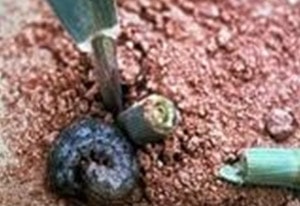
Gray cutworm damages corn crops.
1. Harmful characteristics
Newly hatched larvae live on the leaves, feeding on the leaf tissue and creating tiny holes on the leaf surface. At age 2, the larvae hide underground at day, right under the base of the plant, and emerge at night to feed on young leaves or gnaw around the young stems. From age 3-4 onwards, the larvae become more destructive, biting through the stems and pulling them down to the ground. Each night, a single larva can bite through 3-4 young corn plants. The larvae exhibit a feigning death behavior; when disturbed, they curl up and roll over, pretending to be dead.
2. Morphological characteristics
- The eggs are flattened spherical, milky white when first laid, then gradually turn pale pink, and dark purple when nearing hatching.
- The larvae are dark gray or grayish-brown, with a faint black band along both sides of their bodies, and a dark brown head. Each upper body segment has four small hairy protrusions, while the lower segments have four larger hairy protrusions. The last segment on the dorsal plate has two dark brown streaks.
- The pupa is reddish-brown in color, with a pair of short spines at the end of its abdomen.
- The butterfly is dark brown; the forewings are dark brown or blackish brown; the forewings have 3 stripes, one near the base of the wing is stick-shaped, the middle is circular, and the end of the wing is bean-shaped; the hindwings are grayish white.
3. Control measures
* Farming methods:
- Maintain field hygiene, remove weeds from the fields and around the edges to limit the number of alternative host plants for pests.
- Plow and expose the soil to the sun for two weeks before planting to kill eggs and pupae.
- Crop rotation: After several crops of corn, vegetables, beans, etc., rotate with one crop of rice or water-loving vegetables such as water spinach, watercress, etc., to kill pupae living in the soil and cut off the suitable food source for the pests.
* Manual methods:
- For small fields, when the pest density is low, pests can be removed by hand in the early morning or late evening by digging around the base of the affected plants to catch them.
* Biological control methods:
- Limit pesticide spraying to preserve natural enemies in the fields such as spiders, ladybugs, parasitic wasps, etc.
- Use sweet and sour bait traps to catch butterflies. To make a sweet and sour bait trap: Mix 4 parts sugar + 4 parts vinegar + 1 part alcohol + 1 part water. Put it in a sealed container, and after 3-4 days, add 1% insecticide. Wrap a rag or straw around the end of a stick, dip it in the bait, and place it on the edge of the field. Adult butterflies will fly in, eat the sweet and sour bait, and die. Re-dip the bait every 2-3 days.
* Chemical measures:
- Treat the soil before planting with some powdered insecticides such as: Basudin 10G, Vibasu 10H, Furadan 3G, Regent 3G…
- Use fragrant roasted rice bran mixed with Vibasu 10G insecticide to trap insects. Mix 2 kg of bran with 0.5 kg of insecticide and spread it over 1,000 m2 before dark. Spread the insecticide in rows or holes near the base of the plants.
- When pest density is high, choose mixed insecticides with multiple active ingredients and effects (contact, stomach poison, fumigation, systemic, and translaminar) or combine 2-3 insecticides with different effects to effectively control cutworms. Single insecticides can be used: Basudin 50EC; Shecpain 36EC; Gottoc 250EC or a combination of two different insecticides: Diptere 80WP + Karate 2.5EC; Sevin 40% + Sherpa 25EC; Ganoi 95SP + Abamectin 36EC, Regent 800WG + Sokupi 0.36AS… Spray in the evening, adding 10ml of adhesive or 20-30ml of mineral oil or 5 drops of dish soap to each 8-12 liter sprayer to increase adhesion to the insects' bodies, resulting in faster and higher mortality rates.
According to the National Center for Agricultural Extension - Ly