
Cement investment projects are at a standstill.
With reserves of over 4 billion cubic meters of limestone, more than 1 billion tons of clay, and hundreds of millions of tons of additives such as basalt, kaolin, iron ore, etc., our province has the advantage to become one of the major cement production centers in the country. However, a sad reality is that many large investment projects in this industry are facing difficulties in planning and investment capital...
(Baonghean)With reserves of over 4 billion cubic meters of limestone, more than 1 billion tons of clay, and hundreds of millions of tons of additives such as basalt, kaolin, iron ore, etc., our province has the advantage to become one of the major cement production centers in the country. However, a sad reality is that many large investment projects in this industry are facing difficulties in planning and investment capital...
Not long ago, with the investment in a series of large-scale cement projects such as: Do Luong Cement; Saigon - Tan Ky, Tan Thang (Quynh Luu), Hoi Son (Anh Son)... with the hope of becoming one of the major cement production centers of the country, but after a period of implementation, the results are now... not as expected!
The Saigon - Tan Ky cement project (with a phase 1 capacity of 910,000 tons/year) had its investment license revoked after a long period of stagnation. Then, the Hop Son cement project (Anh Son district) saw its investor request a temporary suspension due to a lack of capital… The large-scale Tan Thang cement project (Quynh Luu district), which started in 2010, has only managed to clear the land and select the main contractor. Currently, the investor is in the process of obtaining mining permits but is facing obstacles because the Rang Cua, Kim Giao, Nui Lem limestone quarries and the Da Bac clay quarry in Quynh Luu district, which will serve the Tan Thang cement project, are awaiting adjustment from the "Planning for exploration and exploitation of mineral reserves for expanded production and new investment" to the "Planning for exploration and exploitation of mineral reserves for cement raw materials until 2020," and this requires approval from the Ministry of Construction and the Prime Minister.
The Do Luong Cement Plant project, which commenced in 2005, was included in the investment portfolio for the 2005-2008 period and was expected to be operational in 2014 (according to Decision No. 1488/QD-TTg dated August 29, 2011, of the Prime Minister approving the Vietnam Cement Industry Development Plan for the period 2011-2020 and orientation to 2030). However, after nearly 9 years of implementation, only the office building at the plant has been completed. This project has changed ownership three times. After the Vietnam Machinery Installation Corporation (LILAMA), the Vietnam Housing and Urban Development Group (HUD) took over as the investor, then withdrew, and now the project has been transferred to The Vissai Cement Group.
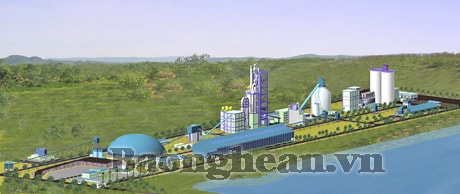
The Do Luong Cement Project has been underway since 2005, but to this day it remains only a… design rendering!
This transition is currently facing technological obstacles. Previously, the cement production project used Chinese technology (capacity of 900,000 tons/year), but this technology is now outdated, and the new investor, The Vissai Cement Group, has proposed adjusting the capacity to 2 million tons/year using European technology. This issue also requires the opinion of the Ministry of Construction and the Prime Minister.
Among the cement investment projects in our province, the Hoang Mai cement plant's second production line project seems more promising, but it is still facing obstacles due to planning issues (currently seeking the Ministry of Construction's opinion on relocating the second production line to Tan Thang commune, Quynh Luu district), including difficulties with the exploration and planning scheme for the Bac Thang raw material mining area and land compensation and clearance...
Currently, the Vietnamese cement market is experiencing an oversupply situation. Therefore, cement projects not included in the plan approved by the Prime Minister will not be added to the plan and will have to postpone their investment timelines. Thus, it is evident that large-scale cement projects in our province are facing difficulties, and the goal of becoming a major cement production center for the whole country is becoming more distant.
Hoang Vinh