
Rapid deployment, powerful breakthroughs.
With the decisive involvement of the Party Committee and the government from the town to the commune level, through many innovative approaches and especially the consensus in mobilizing internal resources from the people, the national target program on building new rural areas in Thai Hoa town has achieved clear results.
(Baonghean)With the decisive involvement of the Party Committee and the government from the town to the commune level, through many innovative approaches and especially the consensus in mobilizing internal resources from the people, the national target program on building new rural areas in Thai Hoa town has achieved clear results.
Many effective economic models
Following the paved road winding through lush green rubber forests, we arrived at Phu Thuan hamlet, Tay Hieu commune – a place where beekeeping for honey production and rubber cultivation are thriving, bringing a relatively high income to the local people. Upon meeting, after a few greetings, Mr. Nguyen Van Khuong – the hamlet head – enthusiastically led us to visit the family of Ms. Tran Thi Nguyet. Ms. Nguyet's family received 1.25 hectares of land from Tay Hieu 1 State Farm, but previously they only knew how to grow corn and peanuts, so their income was meager. It wasn't until they started planting rubber trees and began tapping latex in 2002 that their lives truly improved. With that much rubber plantation, the family earns an average of 5-7 million VND per month. "That's because the price of rubber latex has dropped; in 2010, when the price was high, we earned an average of 10-12 million VND per month," Ms. Nguyet said.
Not only Ms. Nguyet's family, but the entire Tay Hieu commune has 2,200 households. Besides two-thirds being workers at the farm, one-third of the households received land from Tay Hieu 1 Farm for cultivation, mainly rubber trees. Mr. Nguyen Dinh Chau – Vice Chairman of the Commune People's Committee, said: “The shift in crop structure to industrial crops, mainly rubber trees, has been identified by the commune as an effective direction to help increase people's income when implementing the New Rural Development program. During the implementation process, the commune has worked with Tay Hieu Farm to provide technical support to the people. Therefore, in the past two years, the area of newly planted small-scale rubber trees has increased rapidly, with more than 50 hectares newly planted in Phu Thuan hamlet alone.”
In Tay Hieu commune, beekeeping for honey production has also developed strongly over the past two years, bringing high economic efficiency to beekeepers. At the beginning of 2013, the Phu Thuan hamlet beekeeping club was established, bringing together 42 passionate members determined to get rich through beekeeping. Currently, the club has a total of over 300 bee colonies. To support beekeeping, Tay Hieu commune has organized training courses and provided technical guidance to beekeepers. “The commune will develop a beekeeping village in Tay Hieu that is effective and provides sustainable income for the people. This is also a core model for the commune to successfully implement criterion 13: “Forms of production organization” in the set of criteria for building new rural areas,” Mr. Chau said.
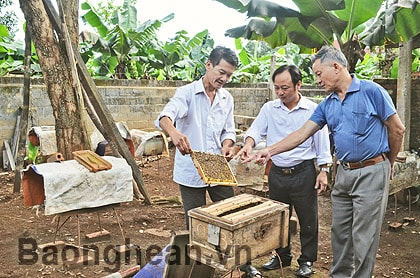
Mr. Mai Van Dung, head of the beekeeping club in Phu Thuan hamlet, Tay Hieu commune, introduced the honey bee farming model.
Not only rubber cultivation or beekeeping in Tay Hieu, but also, through the New Rural Development Program, Thai Hoa has supported and implemented many economic models with high economic efficiency such as: Quang Tien pink pomelo; high-income fields in Con Vang block (Quang Phong ward) and Co village (Nghia My commune); safe vegetable cultivation according to VietGAP in Nghia Thuan commune; experimental cultivation of 2 hectares of PQ1 mandarin variety in Nghia Tien commune… contributing to increasing people's income and rapidly reducing the poverty rate.
Maximizing the internal strength of the people.
Recognizing that the people play a central role in the New Rural Development program, Thai Hoa town mobilized the entire political system at all levels, thereby encouraging the people to utilize their internal resources alongside the State. In all wards and communes, people voluntarily participated, contributing labor and resources to create many new, spacious, clean, and beautiful roads. We visited Nghia My commune – one of the two localities selected as pilot sites for New Rural Development in Thai Hoa – and witnessed many changes in this rural area.
To effectively leverage the internal resources of the entire population, Nghia My started building new rural areas very early on, focusing on criteria such as rural transportation, poverty reduction, and the development of production models. As a result, in road construction, 326 households donated over 10,408 square meters of land worth more than 3 billion VND, dismantled fences, and contributed labor to upgrade and expand over 16 kilometers of roads to meet standards in the first phase. In the second phase, the people continued to contribute 3,713 cubic meters of sand and 5,977 man-days of labor to build 10 kilometers of concrete roads in 10 hamlets, helping Nghia My achieve the rural road standard in 2012.
Effective communication to help people understand the purpose and significance of building new rural areas has helped Thai Hoa achieve rapid breakthroughs in the past two years. Regarding rural road construction, to date, the Steering Committee for New Rural Area Construction of the town has marked 100% of the planned road routes, including the expansion of nearly 60km of village roads. People have voluntarily donated 63,000m2 of land, contributed over 3 billion VND in cash, and directly participated in 28,405 days of labor.
In addition, businesses in the area have contributed over 4 billion VND to jointly build new rural areas. Summarizing the new rural area construction movement over the past two years, two communes have achieved 14-18 criteria, and three communes have achieved 9-13 criteria. With enthusiasm and determination, on this occasion, to commemorate the 5th anniversary of its establishment, Thai Hoa continues to launch a month-long action campaign for building new rural areas throughout the town. It is believed that with high determination, the steadfast spirit of the Party committees and government at all levels, and especially the mobilization of internal resources among the people, Thai Hoa will achieve the goals of the New Rural Area Construction Program in the not too distant future.
Text and photos: Thanh Duy