

Commercial chili peppers grown in Hung Tien
(Baonghean.vn) -Overcoming initial difficulties when boldly replacing traditional crops with commercial chili peppers, farmers in Hung Tien (Nam Dan) now see growing chili peppers for sale to businesses as a genuine path to escaping poverty and becoming wealthy in their homeland.
We arrived in Hung Tien on a day at the end of May, right during the peak harvest season for chili peppers. Lush green chili plants stretched endlessly under the sweltering sun. Each plant was laden with ripe, bright red peppers. According to the locals, chili peppers are planted starting in September and harvested after three months. Especially after the spring harvest, the summer-autumn crop begins around May, which is also the peak season for large-scale chili harvesting. Therefore, this is also the time when farmers are tilling the land and harvesting in the fields.
We met them while they were harvesting chili peppers.UmbrellaMr. Nguyen Van Loi from Dong Son hamlet expressed his delight:TPreviously, my family grew watermelons, soybeans, and peanuts in this area following the model directed by the commune, but for the past two years, I've switched to growing chili peppers on two plots of land. Growing chili peppers isn't difficult; with proper care and techniques, you can manage them.OhguidecopperFrom the start of planting, we need to water continuously to keep the plants healthy and fertilize with manure. Harvesting will continue from December until the end of July, selling to the company. From the beginning of the season until now, my family has harvested 9 quintals per sao (approximately 1000 square meters) of chili peppers. The price of chili peppers is stable and the company guarantees purchase at 16,500 VND/kg according to the contract, meaning my family earns nearly 15 million VND per sao of chili peppers. Compared to peanuts before, which only yielded 1-1.2 quintals per sao at a price of 60,000 VND/10 kg, meaning we could only earn 720,000 VND per sao.
According to Mr. Loi's calculations, growing chili peppers yields outstanding results; selling one sao (approximately 1000 square meters) of chili peppers is enough to buy 3 tons of rice, and the value of one sao of chili peppers is 12 times greater than growing one sao of peanuts. He also mentioned that, on average, during the peak harvest season, farmers in the area can compete to harvest chili peppers.incubateHarvesting 10-15 kg of chili peppers per day is equivalent to an income of nearly 200,000 VND per day. This is indeed a significant source of income for farmers.
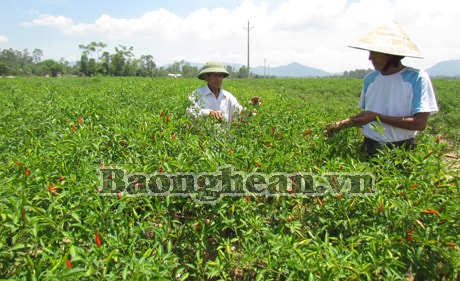
The chili pepper garden for export yields 9-10 quintals per sao (approximately 1000 square meters) for Mr. Nguyen Van Quang's family in Dong Son hamlet, Hung Tien commune.
Mr. Nguyen Van Quang's family in Dong Son hamlet has been cultivating chili peppers commercially for the past two years, with his 2 sao (approximately 0.2 hectares) of land dedicated to this crop. He also handles the seed supply for other farmers. Through discussions, it was learned that over 100 households in the commune currently grow chili peppers commercially, averaging 1.5 sao per household. Most households have switched from less productive cash crops. Since the beginning of the season, the farmers have received over 3 million seedlings from the enterprise, along with technical support on irrigation and care. Notably, the chili-growing areas included in the project have received investment and planning from the commune, including the establishment of irrigation canals and wells, and the provision of electricity, making cultivation very convenient. Therefore, many chili-growing households are looking to expand their cultivated area in the near future.
Through investigation, it was found that the model of growing chili peppers for export in Hung Tien has been implemented for local farmers for over two years (since 2011). After research and field surveys, the model was selected by the commune and businesses on two different land areas: one was a dry, highland area with inefficient production such as Con Dong in Xuan Lam hamlet and Tieu Than in Quyet Tien hamlet; the other was a planned high-income farming area with favorable irrigation and intensive farming conditions, namely Dong Trai in Dong Son hamlet. Initially, the chili pepper cultivation area was only 3 hectares, but gradually, recognizing the promising economic efficiency, ease of care, and the ability to harvest chili peppers on floodplains without worrying about natural disasters, the chili pepper crop proved effective on both land types. By this year's chili pepper crop, farmers in Hung Tien have expanded the scale of chili pepper cultivation to over 7 hectares in various areas such as Nam Son, Dong Linh, and Phuc Chi hamlets.
Mr. Bui Minh Thong, Vice Chairman of the People's Committee of Hung Tien commune, said:MThe commune has a contract with Stevia Asia Company in Nghe An to cultivate chili peppers for export. The agreed price, guaranteed by the company, is 16,500 VND/kg for fresh chili peppers. The company's peak purchasing period is from approximately April 30th to July 15th.annualFarmers ensure sufficient quantity and quality of finished chili products according to regulations. Chili plants have truly been and are still being cultivated.livebecoming a pointed tree in the arean.
Seeing that chili peppers were a new crop,giveTo ensure high and stable income, Hung Tien commune has implemented policies such as: providing 100% seed subsidies, 2 million VND/hectare for new planting (including 1.5 million VND/hectare in cash for producers, 500,000 VND/hectare for protection work, and 200-300,000 VND/sao for plowing and harrowing of land for chili cultivation). Currently, under the New Rural Development program, the commune provides a 30% subsidy for fertilizer and other materials. In the long term, Hung Tien is planning to develop 6 hectares of commercial chili fields in Dong Trai and Dam Bui areas of Dong Son hamlet into a chili field with an income exceeding 100 million VND/hectare.
Luong Mai