

Lesson 1: The State's Management Role
(Baonghean)In recent years, tourism in Malaysia and Singapore has emerged as a miraculous phenomenon in Asia; the number of tourists visiting these two countries is the highest among ASEAN countries, even rivaling the number of visitors to China and India. It is estimated that in 2012, Singapore received 13.2 million visitors, generating S$24 billion in tourism revenue; Malaysia received 25 million visitors and S$20 billion in tourism revenue… A reporter from Nghe An Newspaper had the opportunity to visit Malaysia and Singapore to learn about their tourism practices.
In Malaysia and Singapore, the tourism industry has generated significant income for society – contributing the third largest share to the gross domestic product. Therefore, tourism has received considerable attention, support, and investment from the governments of both countries. Each country has its own approach to tourism, but there are certain commonalities, namely:
In terms of foreign relations, the Malaysian and Singaporean governments are responsible for promoting their national tourism products by opening tourism promotion offices in many countries around the world and advertising on major international television channels. Annually, the governments invite journalists from various countries and tourism companies to visit to write articles and connect with domestic businesses.
Domestically, the Malaysian and Singaporean governments have instructed customs at border crossings to streamline entry procedures and ensure domestic security for tourists. (Malaysia stipulates that Vietnamese citizens traveling to Malaysia for up to 30 days do not need a visa; regardless of background, anyone with a clean record, no criminal history, and proof of having at least US$40,000 in their bank account, who enjoys traveling, loves Malaysia and its people, and ultimately intends to stay, will be granted a visa valid for 10 years).
Malaysia and Singapore have clear and consistent development plans, with a particular focus on investing in tourism infrastructure. From 1996 to 2000, the Malaysian government invested US$184.94 million, and from 2001 to 2005, it invested US$630 million. In 2012, Singapore spent S$300 million on tourism events, S$340 million on developing tourism products, and S$265 million on developing human resources for tourism. It is projected that by 2015, Singapore will invest S$2 billion in its Tourism Development Fund.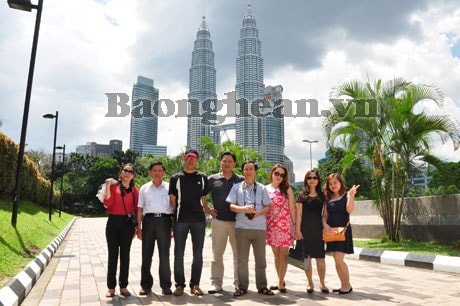
The Twin Towers - a highlight of Malaysian tourism. Photo: Minh Thong
Over 40 years ago, the Malaysian government recognized the need to diversify its economy to avoid over-reliance on exports. Tourism quickly became a key industry for the nation. In 1999, Malaysia launched a highly successful global promotional campaign with the slogan "Malaysia Truly Asia," and the country truly became a special destination in Asia. Starting in 2006, the tourism industry implemented the "Visit Malaysia" program, offering promotions on accommodation, travel, and shopping. Currently, the Malaysian government has finalized a total of 12 projects aimed at developing the tourism industry by 2020. At the grand tourism promotion event in 2014, organized by 13 ministries and agencies in collaboration with the Ministry of Tourism and the Malaysia Tourism Promotion Board, Malaysian Prime Minister Najib Razak called on the country's youth to each become a tourism ambassador.
In Singapore, tourism development plans were formulated even earlier: Since gaining independence in 1959, Singapore has developed six different tourism development strategies: the "Singapore Tourism Plan" (1968), the "Tourism Development Plan" (1986), the "Strategic Development Plan" (1993), "Tourism 21" (1996), "Tourism 2015" (2005), and "Tourism Boundaries 2020" (2012)... And the "Lion City" has sought to attract tourists by building numerous resorts, shopping centers, and attractive entertainment venues.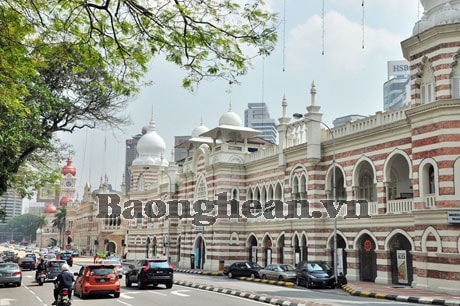
National Museum of Malaysia. Photo: Minh Thong
Visiting Malaysia and Singapore gives a clearer understanding of the government's role in managing tourism: To ensure tourists have a complete and accurate view of their countries, the governments of both nations require tourism companies to strictly adhere to regulations regarding the presentation of history, culture, country, and people. Specifically, when visiting states and cities in Malaysia or any area in Singapore, companies and tours must take tourists to certain locations according to a fixed itinerary.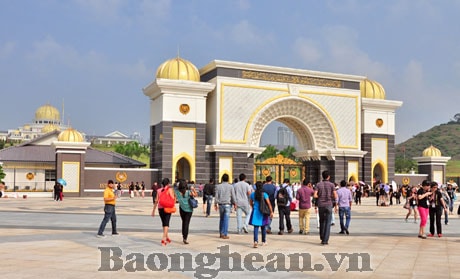
The royal palace of the King of Malaysia.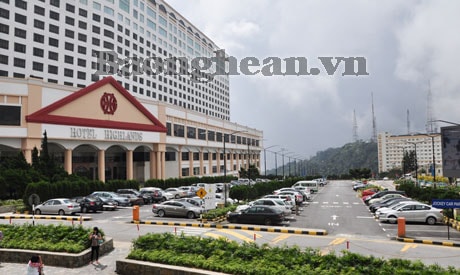
Resorts, shopping and entertainment centers, and casinos on Genting Highlands - Malaysia.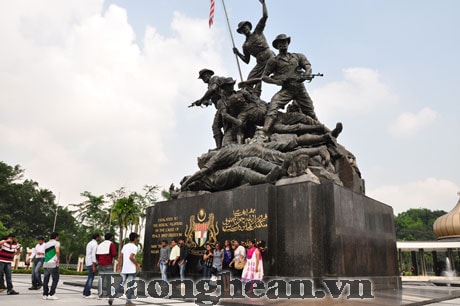
The Victory Monument is a sculptural work commemorating the soldiers who sacrificed their lives for their country in the two World Wars and the Malaysian Civil War.
Wong Sun Wah, a tour guide from Marine Discovery Holiday, said: When visiting Kuala Lumpur, tour companies must take tourists to visit places such as: the National Mosque on Sudan Avenue; the Batu Caves, a very sacred Hindu temple located in the north of the city; the new Royal Palace of the King of Malaysia, completed in June 2011; and the Petronas Twin Towers - Malaysia's newest symbol… If companies do not follow this tour itinerary, they will face severe penalties from the Vietnam National Tourism Administration.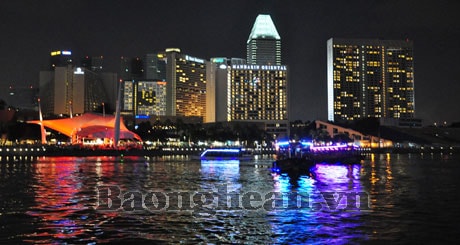
Nighttime cruise on the Singapore River. Photo: Minh Thong
Similar to Malaysia, Singaporean tourism companies are also required by the tourism industry to convey to tourists the image of a small island nation with limited resources, but one that has successfully leveraged its potential and strengths in geographical location and human resources to achieve remarkable development. Malaysian tour guide Wong Sun Wah added: To attract tourists, while Malaysia holds a major tourism event or festival every month, Singapore's tourism industry launches a new tourism product every six months.
Thanh Chung