

The villagers have lost their connection with the craft.
(Baonghean)The province currently has 111 craft villages officially recognized by the Provincial People's Committee and 285 craft villages recognized by the People's Committees of the districts. In recent years, these craft villages have developed quite rapidly in terms of number and diversity of types, contributing to the socio-economic development of the locality and providing employment for tens of thousands of workers. However, the current lack of successors poses challenges in preserving and developing traditional handicrafts.
The Phu Nghia carpentry village (Quynh Nghia commune - Quynh Luu district) was established over a hundred years ago, mainly concentrated in hamlets 1 and 4, and developed through hereditary trades, with some families practicing carpentry for three or four generations. Specializing in the production of household goods and handicrafts, Phu Nghia has long been famous for its exquisite wooden products such as beds, tea cabinets, and various types of tables and chairs. Their craftsmanship is comparable to that of artisans from Ha Tay and Nam Dinh provinces. Phu Nghia carpenters not only build temples, pagodas, and four-pillar houses, but also construct large-tonnage ships capable of sailing the open sea. Many generations here have been born, raised, and started their careers with the craft passed down from their ancestors. However, in the "whirlwind" of the market economy, the carpentry trade is no longer in its heyday, and the younger generation of workers in the village are also "opening" paths to new lands to find a livelihood.
Mr. Ho Van Quyet, the owner of a carpentry workshop in Quynh Nghia, said: "Currently, Phu Nghia village has 10 groups of craftsmen specializing in building wooden houses and restoring temples and shrines; 3 workshops specializing in building and repairing boats; and more than 50 workshops for civil and handicraft carpentry. About five years ago, young people were still interested in the craft and applied for jobs at the workshops in large numbers, but now it is very difficult to find a young person who is 'dedicated' to the profession, even though the income is not low. Currently, the daily wage for a male worker is 150,000-180,000 VND and 100,000-120,000 VND for a female worker sanding, but it is still not enough to attract young people to stay in the village. For example, my workshop, which used to have 7-8 workers before 2010, now only maintains 3 workers each day."
Along with many other traditional craft villages in the province, Ba Ba blacksmith village (Hamlet 5, Thanh Luong Commune - Thanh Chuong District) has long been famous for its products such as knives, scissors, chisels, and other tools. However, over time, very few highly skilled blacksmiths remain, while few young people are interested in this craft...
In some workshops where young people are employed, they are mostly wage earners, and they are willing to quit if they find a higher-paying job elsewhere. Currently, the youngest blacksmith in Thanh Luong is nearly 40 years old, while those considered highly skilled are mostly over 50... Mr. Nguyen Van Truong (from Hamlet 5), 40 years old but still considered one of the younger blacksmiths in the commune, said: "There are very few people under 40 pursuing blacksmithing in the village. Nowadays, not many young people want to follow the profession because mastering this craft takes at least 3 years of diligent study, requiring patience, meticulousness, and a keen sense of hearing, sight, and touch, as there are no written documents detailing the formulas; only those who came before pass them down to those who come after."
Mr. Nguyen Van Binh is one of the oldest blacksmiths in Ba Ba village. As the fourth generation to continue the craft, Mr. Binh shared: "I don't know exactly when blacksmithing originated, but in the 1990s, it flourished because there weren't as many products for manufacturing or metal products made with machinery as there are now... My family has two sons, and although I've tried to persuade them and teach them the trade, neither of them wants to follow in my footsteps; they only want to go south to start their own businesses. Perhaps by the end of my life, the family blacksmith shop will have 'died out.' I'm just worried that this traditional craft passed down from our ancestors will fade away, and that would be a great pity!"
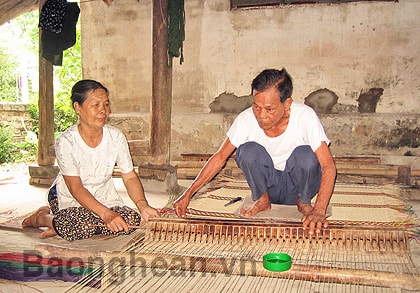
Production of sedge mats in Hung Hoa craft village (Vinh City).
Hung Hoa commune (Vinh City) has a traditional sedge mat weaving craft. Most residents have known how to weave mats since they were nine or ten years old. Many families have been involved in mat weaving for three or four generations. When sedge mats were in high demand, people and vehicles flocked here to buy and sell them, even exporting them to neighboring Laos... But that's a thing of the past. Now, the sedge fields are shrinking, and the younger generation is turning their backs on the craft, causing many households to abandon their looms. The dedicated artisans are getting older and less involved in production, so the risk of this traditional craft disappearing is increasing.
According to Mr. Nguyen Tan Thinh, Director of Thinh Loc Co., Ltd. - a company specializing in supplying raw materials and distributing products to rattan and bamboo weaving villages - these traditional craft villages are losing workers, especially young workers, because most handicraft products are quite meticulous, requiring the craftsman to be patient and persistent, yet the income from the craft is not high. Coupled with small-scale, fragmented production, a monopolistic mentality, and reluctance to share, the businesses and production facilities in these villages are isolated in their search for markets and product development. This also leads to products lacking competitiveness, and the value achieved does not match their potential, resulting in low income for the craftspeople. To retain workers and ensure the sustainable development of traditional craft villages, more support from the State is needed in improving designs, providing information on consumer markets, supporting the development of raw material sources, capital, and production facilities.
According to surveys in craft villages, many businesses are willing to pay salaries, provide free vocational training, and supply raw materials for young people to work from home, with guaranteed product sales or employment at the businesses, earning between 1.5 and 3 million VND per month. However, young workers in these villages remain uninterested. There are many reasons for this, but fundamentally, the income level does not meet expectations; some young people have misconceptions or underestimate the importance of developing traditional crafts, believing that these trades are not prestigious and that it is difficult to become wealthy. Therefore, honoring and creating opportunities for young people to learn about successful models or examples of young people who have become wealthy through craft villages is essential.
Text and photos: Ngoc Anh