

Increase production value
(Baonghean)In recent years, the people of Quynh Lien (Quynh Luu district) have boldly invested in semi-automatic irrigation systems right in their fields, enabling them to produce lush, healthy vegetables year-round. From one crop to the next, from one season to the next, the land never "rests" in Quynh Lien...
The rice fields of Quynh Lien (Quynh Luu district) are experiencing peak sunshine thanks to a semi-automatic irrigation system that ensures consistent moisture, resulting in lush, green crops on 302 hectares of land throughout the commune. Quynh Lien is a coastal commune with no rice cultivation area, so it specializes in growing commercial vegetables and other crops.
We visited the home of Mr. Bach Van Thanh in Hamlet 3, Quynh Lien - the first person in the commune to tinker with and invent a semi-automatic irrigation system for the fields.
About six years ago, Mr. Thanh quit his carpentry job and focused on vegetable farming. His family cultivates 11 acres of land. The crops need irrigation year-round, so his family spends 6-7 hours watering them every day.
From then on, he nurtured the idea of using machinery to replace human labor. Initially, he experimented in his garden with a system of plastic water pipes buried underground, with a pipe every 2.5m – 3m. He plugged in an electric pump, and dozens of pipes sprayed water evenly throughout the garden like rain.
Following these results, Mr. Thanh decided to invest in bringing a semi-automatic irrigation system to his fields. All he needed to do was dig a well, or drill a well in the field, and buy plastic pipes to carry water. If using good quality pipes, the installation cost 3 million VND per sao (approximately 1000 square meters), while average quality pipes cost 2 million VND per sao.
Mr. Thanh said: “After investing in a semi-automatic irrigation system at the field, the economic value of the crops increased by about 30%. The biggest benefit is that I no longer have to spend time watering, allowing me to do more things and increase my income. My family cultivates 11 acres of land, and if we watered by hand, two people would have to water continuously all day to meet the plants' water needs. Now, I just need to plug in the power cord and water the entire field. In the meantime, I can weed or do other tasks, reducing the amount of money I previously spent on labor. Chayote, gourds, bitter melon, cucumbers, onions, carrots, sweet cabbage… in the garden and in the fields are always green and healthy, yielding high productivity.”
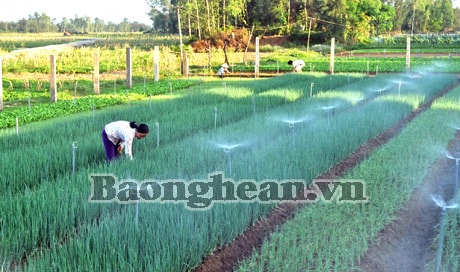
Farmers in Quynh Lien use semi-automatic irrigation systems in their fields.
A tour of the colorful fields of Quynh Lien commune reveals that few places cherish every inch of agricultural land as much as they do here. Even the barren white sand along the coast has been transformed into fertile land for growing watermelons, cabbage, cucumbers, and other vegetables. Electricity, wells, and semi-automatic irrigation systems cover the fields. Farmers are constantly improving their methods of commercial vegetable production. Following the invention of Mr. Bach Van Thanh, who introduced the semi-automatic irrigation system to the fields, the people of Quynh Lien are now actively applying it widely.
With 8 sao (approximately 0.8 hectares) of land, the farming work was too arduous. In 2012, Mr. Nguyen Dinh Thong and Ms. Nguyen Thi Huong's family in Hamlet 4 decided to invest in a semi-automatic irrigation system for all 8 sao of their cultivated land. Now, they just plug it in and the pump evenly irrigates the entire area, ensuring the crops always have sufficient moisture. Watermelons, radishes, chayote, sweet cabbage, spring onions, carrots, etc., thrive and yield higher productivity.
Ms. Huong said: “In previous years, especially during the summer months, growing sweet cabbage required constant hand-watering to prevent leaf burn. Even in the scorching sun, we had to stand and water the plants continuously from 9 am to 2 pm, and on many days, we suffered from sunstroke and dizziness. The watering process alone took a lot of time and effort…”
Ms. Vu Thi Binh from Hamlet 4 happily shared: “My family cultivates 10 sao (approximately 1000 square meters) of arable land, and we are busy with farming all year round, never having had a proper meal. In 2011, seeing many households in the commune installing irrigation systems, which reduced labor and resulted in healthier crops, and with an investment of 2 million VND per sao for installing plastic pipes, it wasn't too expensive. My family decided to invest in installing a semi-automatic irrigation system on 7 sao, and for the past two years, the harvest yield has been significantly higher, the vegetables are of better quality, and the value of our produce has increased.”
Quynh Lien commune has 302 hectares dedicated to the production of commercial vegetables and crops. Since 2011, local people have significantly invested in semi-automatic irrigation systems at the fields, resulting in higher production efficiency than before.
To date, nearly 100 hectares in the commune have been equipped with irrigation systems. The application process has shown many benefits of this irrigation system in agricultural production; the water spray is gentle like small raindrops, cooling the plants lightly, preventing soil erosion or damage to the plants, and always ensuring adequate moisture.
Especially during the summer months, crops always need water, and if farmers stand watering for hours on end, it can easily affect their health. Previously, in this area, even the households with the most land could only cultivate 10 sao (approximately 1000 square meters) because they lacked the manpower to water the crops. Now, with semi-automatic irrigation systems, many households have expanded their production area to up to 20 sao. Quynh Lien has 100% vegetable production, so using the irrigation system is very effective. Even in hot weather of 38°C-39°C, the crops remain green and healthy, bringing in high income.
In 2012, the total area for vegetable production in the commune increased to 1,105 hectares, with an average harvest yield of 16 tons/ha, a total production of 12,800 tons, and a value of nearly 13.9 billion VND, a 15.3% increase compared to 2011…
Quynh Lan