

Lesson 1: Electric Bicycle Quality - Who is in Charge?
(Baonghean)Having been present in the Nghe An market for quite some time, mimicking the designs of trendy motorcycles, electric bicycles (ECS) have still faced consumer indifference. Only in the last year or so has the ECS market suddenly boomed, primarily targeting students and the elderly. There are many issues surrounding this vehicle, touted as environmentally friendly.
Nowadays, electric bicycles have become a familiar mode of transportation for middle and high school students in Vinh City. The sight of groups of students riding electric bicycles before and after school is no longer uncommon. Therefore, the market for this new product has quickly become flooded with businesses.
Mr. Nguyen Huu Quang, a repairman at Hai Huong shop (23 Quang Trung Street), which specializes in selling bicycles and electric bikes, led us to examine various models while asserting: "There are no Taiwanese joint venture bikes, and Japanese bikes are even more out of the question. They're all 'Chinese' bikes. The only difference is whether they're good quality Chinese bikes or not." At this shop, one Honda electric bike (HDE 141) was priced at 10 million VND, while four other Yamaha models of various generations ranged from 9 to 9.5 million VND. According to Quang, electric bikes usually come with four batteries, with a 6-month warranty, and the frame and body have a 1-year warranty. However, if the batteries fail, a new one costs 2 million VND.
At Thu Thao Electric Bike Shop, also on Quang Trung Street, they specialize in selling two types of electric bikes: Yamaha (priced from 10 to 11.5 million VND/bike) and Bridgestone (priced above 13 million VND). The owner, Ms. Xuan, claims that all the bikes in her shop are imported from Taiwan and are of "high" quality, hence the high price. She says some bikes cost over 16 million VND (equivalent to a mid-range motorbike) because they are "genuine" products. However, when asked if brands like Yamaha and Honda are actually Japanese or joint ventures with Japan, Ms. Xuan shook her head and evaded the question. According to our survey, along Quang Trung Street, besides the large shops that specialize solely in motorbike sales, there are about 10 other shops selling electric bikes. Along the facade of the A5 building (Quang Trung Street), there are numerous shops selling electric bicycles such as Bao Loc, Van Ly, Mai Cuc... The owner of one of these shops said: "This product sells best at the beginning of the school year, when parents buy them for their children as rewards or so that their children have a means of transportation at the start of the new school year. Normally, sales are very slow, only one bicycle sold every few days."
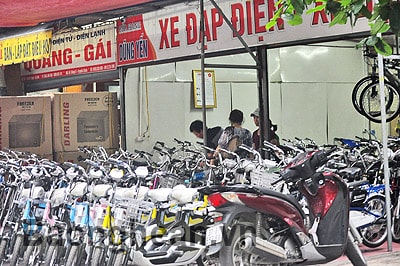
An electric bicycle shop on Quang Trung Street (Vinh City)
According to our survey, there are currently 51 electric bicycle brands on the market, with Yamaha having the most (154 models), followed by Honda (36 models), and Giant (imported directly from China) with 35 models. Next are Bridgestone with 22 models, Hitasa with 25 models, Dayyang with 13 models, and so on. Notably, many brands only have a single model, such as Davinci (priced at just over 3 million VND), or Kamora, which also lacks clear origin information and has a similar price. Brands like Lying, Makita, and Manbo also only have one model with very unclear origins. Furthermore, four brands bear Vietnamese names: Tam Ky, Phuong Hoang, Thong Nhat, and Nam A. While Thong Nhat electric bicycles have a clear origin and a brand history of over 50 years, with products exported to several countries, the remaining brands have little market recognition or acceptance. These brands also only launch between 1 and 4 models.
From a price perspective, it's easy to see the vast difference in quality. Giant electric bikes (a lesser-known brand) mostly cost over 11,000,000 VND, while familiar brands like Yamaha are mostly under 10 million VND, and Jili bikes are all 10 million VND or more. Honda, a very famous Japanese brand, has models like the HDC 16A priced at only 7.2 million VND. Besides that, there are also models like the Asama A-36 at only 3.5 million VND, the Manbo (4.5 million VND), and the Yamaha 202 (6.9 million VND)... This chaotic pricing makes it difficult for us to distinguish between good and bad bikes. Because brands like Honda are even cheaper than Jili (a Chinese brand). Not to mention models like the Asama A-36, which costs only 3.5 million VND and comes with 3 batteries – who knows what the "quality" is like?
To find out about the quality of this type of vehicle, we contacted the Department of Science and Technology and the Sub-Department of Standards, Metrology and Quality. However, neither of these agencies is responsible for regulating electric vehicles. At the Vehicle and Driver Management Department (Department of Transport), considered the most "vertical" authority regarding this type of vehicle, an official stated: "Actually, if our department were to issue a document on managing electric bicycles, there would be absolutely no basis for it. Motorcycles require registration papers, and drivers need licenses and insurance. Meanwhile, electric bicycles are just bicycles with added motors; you buy them and ride them, that's all. Issuing regulations to manage electric bicycles is not appropriate. As for the quality of this type of vehicle, that's up to the buyer and seller to agree upon. However, we agree that there should be specific management of electric bicycles because of their relatively high speed, lack of noise, and the fact that most users are students with underdeveloped awareness, making them very susceptible to unforeseen consequences."
By design, electric bicycles are generally limited to speeds below 40 km/h. Therefore, the entire frame structure, wheels, etc., can only withstand that limit. However, according to our investigation, some owners have modified these bikes with speed boosters of Chinese origin (ranging from 1.5 to 2 million VND per unit), pushing the speed to over 50 km/h. This further increases the danger. On the night of May 8, 2013, we rode an electric bicycle to learn more about this type of vehicle. Listening to loud music and making rather unpleasant remarks were what we witnessed from the students when asked by authorities to explain their violations...
(to be continued)
Text and photos: Tran Hai