

Mobilizing the people's strength in Tao Son (Anh Son)
(Baonghean) - Following National Highway 7B, passing through Lang Son, you arrive at Tao Son commune. Here, rural roads have been widened, and markets and schools are well-built. Meeting us while harvesting spring pumpkins in the fields of Hamlet 6, Ms. Mai Thi Ha excitedly said: “This is my first pumpkin crop on land that was recently consolidated and allocated to a household in the village. We planted the pumpkins in early February and harvested them in April. The pumpkins are all bought up by local dealers in the commune. After harvesting the pumpkins, we will plant corn.” According to Ms. Ha, thanks to the land consolidation and reallocation, farmers received contiguous plots of land. Many households have switched to different crops to increase their income. Pumpkins are easy to grow, adaptable, and require little investment, costing around 500,000 VND per sao (approximately 1000 square meters), making them a popular choice. Currently, there are two facilities in the commune specializing in collecting pumpkins for export to northern provinces. According to Ms. Ha, the market price for pumpkins is 8,000 VND/kg. In this first pumpkin crop, she harvested nearly 1.5 tons per sao (approximately 1000 square meters), and after deducting expenses, she earned a profit of nearly 14 million VND per sao (in almost 3 months), which is a significant income for farmers in Tao Son.
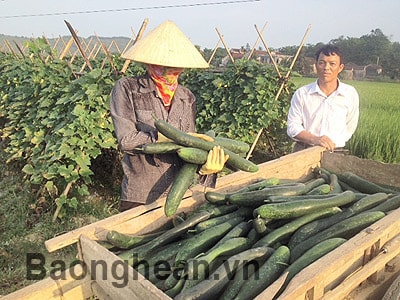
Farmers in Cao Son harvest pumpkins on converted land.
Besides crop conversion, the rural road construction movement in Tao Son is also quite vigorous. A major road (Type A) located in Hamlet 3, with a total length of over 500m, was completed at the end of January, with a roadbed width of 5.5m. To implement the plan, the hamlet's steering committee held a meeting with residents to discuss and agree on the contribution levels. The hamlet's approach was that households with structures and land affected by the road corridor clearance contributed their own funds and materials, while the hamlet mobilized labor to rebuild and restore the lost structures and fences. Each household in the hamlet also contributed an additional 20-30 thousand dong to support those whose structures needed to be cleared... Mr. Dao Van Quy from Hamlet 3 happily said: "To contribute to the road construction, each person contributed 400,000 dong. My three main laborers contributed their labor for a month, and we are currently completing the road shoulders and drainage ditches."
Tao Son currently has over 2,000 hectares of natural land and over 1,000 households. Its geographical location makes it isolated from National Highway 7 across the Lam River. Before embarking on the New Rural Development program, Tao Son had only met 5 out of 19 criteria. Several key criteria remained weak, such as the road system, which mainly consisted of dirt roads (only 2km of concrete and 4km of asphalt); the kindergarten and secondary school systems were inadequate, and the market was makeshift; the economic structure shifted slowly, with fragmented land holdings averaging 9-10 plots per household. From 2001-2007, the Party Committee and People's Committee of the commune introduced watermelon cultivation to farmers on arable land and rice paddies, reaching up to 130-150 hectares at one point. However, from 2011-2012, watermelon quality deteriorated, and market access became difficult, leading people to switch to growing pumpkins, bitter melons, and chili peppers.
Mr. Hoang Dinh Son, Chairman of the People's Committee of Tao Son commune, said: "In the spirit of building new rural areas, the commune has set the common goal of transforming the crop structure, building large-scale model fields, and constructing new rural infrastructure to change the face of the agricultural economy, rural areas, and farmers. In the spirit of mobilization and democracy, the people have become aware of the necessity and proactively consolidated land in each area. Regarding new rural infrastructure projects, the commune allows each hamlet to make its own decisions, with each hamlet having different forms and methods of contribution, avoiding a rigid system. In that spirit, we encourage people to dismantle structures, donate land, and provide materials. The commune supports 4 million VND/km for construction machinery costs plus 40% of the sand cost."
The people have become the central figure in determining all local changes. To date, Tao Son has developed over 70 hectares of pumpkin cultivation on converted land, generating hundreds of millions of dong per hectare. After land consolidation, the average household now owns only 3 plots, including 1 plot for vegetables and 2 plots for rice. Land use efficiency has increased 3-4 times compared to before. Particularly in areas converted to cassava and pumpkin cultivation, the income is consistently stable. Pumpkins fetch good prices in the market and have proven to be exceptionally effective. The cassava grown by farmers in Tao Son is purchased directly from the Thanh Chuong Cassava Factory at reasonable prices. In terms of transportation infrastructure, the entire commune has concreted over 10 km of Class A roads. In early 2012, the Tao Son market was completed and put into use with a total cost of nearly 2.8 billion dong, of which the State supported nearly half the cost, and the rest came from the local budget. The market area covers over 5,000 square meters, with a market hall measuring 30 meters long and over 20 meters wide. It has 4 rows of business kiosks, with 30 permanent kiosks providing stable employment for local farmers.
Thanks to the identification of building new rural areas as a top priority to improve people's lives, Tao Son commune has now achieved 10 out of 19 criteria for new rural areas, bringing targets such as healthcare infrastructure, electricity, rural markets, and transportation infrastructure to completion and meeting standards. In the coming time, based on focusing on directing basic economic goals in building new rural areas, Tao Son will continue to transform the crop structure, build large-scale model fields, develop mechanical services, civil carpentry, milling, phone and motorbike repair, etc.; and focus on expanding and introducing high-quality cash crops.
Text and photos: Luong Mai