

Utilize water resources to boost summer-autumn production.
(Baonghean)Like many other localities, Quy Hop district faced a severe drought at the start of the 2013 summer-autumn crop season. Many production areas suffered from serious drought, making planting almost impossible. However, thanks to the utilization of water resources, especially the "golden rains" from June 20th to 26th, Quy Hop district was able to secure sufficient water for planting.
Ms. Phan Thi Thao from Hoc Moi hamlet, Chau Thai commune, confided: “My family only has 2 sao (approximately 0.2 hectares) of rice paddies. Every summer-autumn crop season, we worry about drought, which affects crop yields, sometimes resulting in no harvest at all. Recently, 0.5 sao of our spring rice crop was completely lost due to drought. Summer-autumn production takes place under prolonged hot weather conditions, with fields drying up. Farmers have to pump water for days before the fields can be irrigated. Fortunately, thanks to the recent miraculous rains, we were able to plant rice again.”
Mr. Nguyen Cong Giap – Vice Chairman of the People's Committee of Yen Hop commune, said: “In the 2013 summer-autumn crop, Yen Hop commune cultivated 170 hectares of rice, of which about 50% had reservoirs for pumping water during droughts, and the remaining 50% depended on natural water sources. In addition, the commune also had 306 hectares of short-term industrial crops, including sugarcane. Although there are 5 reservoirs in the area, including Ban Khang dam, Dong Bai dam, Ban De dam, Khe Ngang dam, and Ban Tho dam, they are all small and have been silted up over the years, resulting in insufficient water for irrigation. Therefore, combating drought for rice and sugarcane crops is very difficult. Agricultural officials have to take turns working all night, carefully conserving every drop of water to irrigate the fields for the people. In the spring of 2013, the entire commune lost 30 hectares of rice with no harvest due to drought; in addition, 20 hectares were affected, with poor yields. Entering the 2013 summer-autumn crop production under these conditions "The prolonged hot weather and drought in the fields caused great concern among the people. After the rain from June 20th to 26th, the people of our commune have planted rice on over 90% of the area."
In Chau Dinh commune, Mr. Nguyen Van Suu – Chairman of the People's Committee of the commune – said: Chau Dinh commune has a total agricultural production area of 1,500 hectares, including 700 hectares of sugarcane, 220 hectares of rice, and more than 500 hectares of other crops such as corn, cassava, and peanuts. The commune has 4 reservoirs and 1 gravity-fed dam. The water reserves are only sufficient to irrigate about 50% of the area, with the rest relying on rainwater. Currently, two reservoirs, Hoc Moi and Na Noi (serving to irrigate 30 hectares of rice), have dried up and have had no water since the beginning of the year.
To combat the drought, the commune has installed 4 electric pumping stations and 1 mobile pump. When necessary, these pumps can be mobilized simultaneously, but they are only enough to irrigate over 20 hectares. In addition, people are also using mini pumps to pump water into their fields. To date, thanks to the rainfall in recent days, local people have urgently planted 90% of the 2013 summer-autumn rice crop. The commune has also converted 10 hectares of land without irrigation to corn cultivation to avoid the drought.
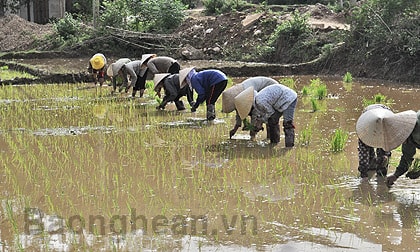
Taking advantage of the available water, people in Chau Thai commune (Quy Hop district)
Actively plant rice across the entire area.
Speaking with us, Mr. Pham Van Thong – Deputy Director of Quy Hop Irrigation Company Limited – said: “Since the beginning of June 2013, a severe drought has occurred in the area. The company has coordinated with the agricultural committees of the communes to schedule and concentrate water supply. In some severely drought-affected areas such as Chau Cuong and Dong Hop communes, mobile pumps have had to be mobilized to supply water for people to sow and plant. According to the plan, the total area for summer-autumn rice planting in the entire district is 1,600 hectares; recently, thanks to the rain from the impact of typhoon No. 2, the water supply has basically met the needs of the people for planting 95% of the area.”
"During the 2013 summer-autumn crop season, with the possibility of continued drought, we have assigned local officials to regularly inspect the condition of the infrastructure and water sources. If landslides, sedimentation, or leaks are detected, timely solutions will be implemented to prevent water loss. If the situation becomes critical, all available personnel, machinery, and fuel must be mobilized, along with the agricultural and forestry committees of the communes, to schedule and concentrate water supply, ensuring maximum possible service under the given conditions."
The Quy Hop Irrigation Company Limited manages and operates 12 irrigation works, including 4 reservoirs and 8 diversion dams. Before the recent rains, the usable capacity of the reservoirs was very low, with some reservoirs only at 10-20% capacity; if there is no rain, there will be a severe water shortage for irrigation. A characteristic of the mountainous Quy Hop district is that 100% of the irrigation works are gravity-fed, not requiring pumps. During droughts, when there is no water from upstream, pumps must be used in streams to irrigate the fields.
Recognizing that droughts are common during the summer-autumn crop season, and to ensure sufficient irrigation water for rice fields, in addition to rational planning based on surface water resources, the People's Committees of the communes and the Quy Hop Irrigation Company Limited have directed water conservation from the time the spring rice crop begins to ripen, repaired leaks in dams and reservoirs, and regulated water appropriately. During the production process, they have actively cleared canals, built embankments around fields and plots, developed drought mitigation plans, and effectively implemented these plans.
Text and photos: Quynh Lan