

Reduce rice losses during and after harvest.
HOW MUCH MONEY IS THE MEKONG DELTA LOSING?
Rice production in the Mekong Delta reaches 24 million tons per year. If we assume a 10% loss rate, the amount lost would reach 2.4 million tons. With the low prices this year, the value of this loss would amount to nearly 10 trillion VND. With over 700,000 hectares of cultivated land and a production of over 4 million tons, Kien Giang province has the largest rice area and production in the country, and also the highest level of mechanization, yet its rice loss rate is still significant.
According to Dr. Do Minh Nhut, Deputy Director of the Department of Agriculture and Rural Development of Kien Giang province, the province currently has 1,381 combine harvesters, harvesting 65% of the area. Surveys show that the spillage rate of combine harvesters is 3%, resulting in a loss of 4 million tons x 65% x 3% = 78,000 tons. For the remaining harvest, which is done by hand and threshed with threshing machines, the spillage rate is 5%, resulting in a loss of 4 million tons x 35% x 5% = 70,000 tons. Thus, in Kien Giang alone, the loss in harvesting and threshing is 148,000 tons, not including losses in other stages such as drying, milling, and storage.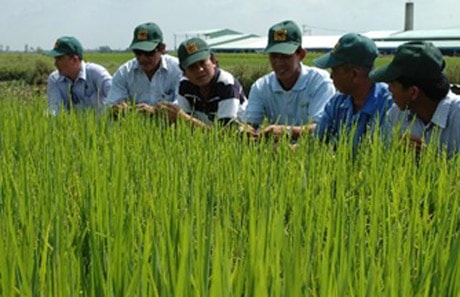
Rice fields fertilized with Agrotain have dense foliage, strong stems, and excellent resistance to lodging.
According to Dr. Le Van Banh, the entire Mekong Delta currently has 10,000 combine harvesters, which only cover 50% of the area, and the yield of rice processed through drying only reaches 30-40%. This shows just how enormous the losses are.
The summer-autumn crop has a higher rate of loss than the winter-spring crop because the harvesting time is often affected by rain, floods, and lodging. The cost of harvesting with combine harvesters for standing rice is 2 million VND/ha, but for lodged rice it is 2.5 - 3 million VND/ha, and of course, the rate of loss in these fields is difficult to measure.
HOW MUCH QUALITY WAS LOST?
In Kien Giang province, surveys show that 70% of the rice harvested manually is harvested by farmers who habitually leave the harvested rice in the fields for several days before gathering it. Drying the rice in the fields not only results in significant losses but also causes the grains to crack. In the Mekong Delta, midday temperatures reach 38°C, but nighttime temperatures drop to only 25°C. This large temperature difference causes the rice grains to lose moisture and then reabsorb it, leading to a decline in rice quality.
For households that have already dried their rice but lack storage facilities, they pack it in used fertilizer bags and leave it on their porches, causing the rice to reabsorb moisture, and the temperature dropping from 14 to 15 degrees Celsius significantly reduces its quality.
In the case of the summer-autumn crop, if there are storms, the rate of loss will be uncontrollable; many rice fields will sprout right in the field, or the rice may have been brought home but there is no place to dry it.
Another significant but often overlooked source of loss is harvesting at the wrong stage of ripeness. Many fields are left to ripen excessively, resulting in spoilage, wasted produce, and reduced quality.
How to harvest rice at the right ripeness? The growing time of different rice varieties varies; some take 90 days, others 100, 125, or even 140 days. However, they all share one thing in common: the time from flowering to ripening is approximately 30 days. For rice, the best time to harvest is when 85% of the grains on the ear are ripe, because the remaining 15% may appear unripe but are actually full and will ripen naturally after harvest.
Because of these characteristics, harvesting should be carried out between the 26th day after the rice has finished flowering and no later than the 30th day.
PROACTIVE MEASURES TO PREVENT HARVEST LOSSES
Besides selecting strong-stemmed varieties, technical measures and fertilization regimes have a significant impact on ensuring strong stems and good resistance to lodging in rice plants. Observations of lodged plants and fields show that they are broken and crushed at the second internode. This breakage hinders nutrient transport, leading to empty grains and a sharp decrease in yield.
The strength of the stem internodes is related to potassium nutrition during the seedling stage. If the field has sufficient potassium, these internodes will grow large, strong, and tightly wrapped with leaf sheaths, making them even stronger. Therefore, applying potassium-rich base fertilizer, or applying potassium fertilizer early with sufficient content, is essential. For rice grown in the Mekong Delta, the potassium requirement is approximately 60 kg K2O/ha, which should be divided into two applications: the first application (50%) 7 days after sowing, and the remaining 50% applied 40-45 days after sowing during the panicle initiation stage.
To help rice plants become strong and resistant to lodging, in addition to avoiding excessive nitrogen fertilization, calcium, silicon, and other trace elements are also needed.
Over the years, Binh Dien Fertilizer Joint Stock Company has researched and produced specialized fertilizers for rice, such as Dau Trau 997, Dau Trau 998, and Dau Trau 999. When using these specialized fertilizers, rice plants become stronger and more resistant to lodging. Currently, Binh Dien is producing and supplying the market with a new generation of specialized rice fertilizers: Agrotain Rice 1 + TE and Agrotain Rice 2 + TE. Compared to the previous generation, these fertilizers are superior because they contain added Agrotain, which helps prevent 25% nitrogen loss.
According to (VOV)-LC