
Commercial crab farming
The results after three years of implementing the "Commercial Sea Crab Farming" model have opened up a new direction for seafood farmers. Accordingly, coastal residents have the opportunity to apply scientific and technological advancements to production, create marketable products, increase economic value, and convert inefficient or disease-prone shrimp farming areas to crab farming.
(Baonghean)The results after three years of implementing the "Commercial Sea Crab Farming" model have opened up a new direction for seafood farmers. Accordingly, coastal residents have the opportunity to apply scientific and technological advancements to production, create marketable products, increase economic value, and convert inefficient or disease-prone shrimp farming areas to crab farming.
Over a three-year period (2011-2013), with funding support from the provincial budget, the Nghe An Agricultural Extension Center successfully implemented a "Commercial Sea Crab Farming" model on an area of 2.5 hectares. Using intensive farming methods, over a five-month period in the districts of Quynh Luu, Dien Chau, Nghi Loc, and Vinh City, households with experience in aquaculture, financial potential, enthusiasm, dedication, and a willingness to invest were selected to participate in the commercial sea crab farming project.
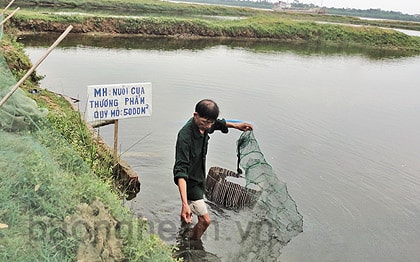
Commercial crab farming model in Hung Hoa commune (Vinh City)
During the initial phase of implementing the model, the weather was highly unpredictable, water sources were largely dependent on natural conditions, and the prices of feed, supplies, and veterinary medicine increased significantly. Crab farmers faced numerous difficulties, and the growth and development of the crabs were also somewhat affected. However, by proactively forecasting and predicting the situation and developing production plans, the farmers were able to promptly address technical issues and increase investment. In particular, all households strictly adhered to the technical procedures for crab farming as instructed, from pond preparation and management to disease prevention measures. The first farming season was considered successful, with a relatively high survival rate (60-65%), crabs reaching 3-4 crabs per kilogram, and a harvest yield of 1.5-1.9 tons per hectare.
For example, in 2012, Mr. Vo Van Mai's household in Hamlet 3, Nghi Xa Commune (Nghi Loc District), with a 0.5-hectare pond, stocked 5,000 crab juveniles, averaging 40 crabs per kilogram, and fed them mainly with trash fish. After 5 months of farming, the survival rate reached 60%, the average size of the crabs was 0.3 kg/crab, yielding 900 kg of marketable crabs. Selling at the pond for 320,000 VND/kg, he earned 288 million VND. After deducting expenses such as: 5,000 juvenile crabs (averaging 8,000 VND/crab, costing 40 million VND); 4,000 kg of trash fish (averaging 6,000 VND/kg, costing nearly 24 million VND); and other expenses of approximately 6 million VND, his family earned a net profit of 218 million VND.
To achieve high efficiency, crab farmers stated: First, ponds must be renovated according to proper technical procedures, ensuring high-quality juvenile crabs. The initial size of the juvenile crabs released should be ≥2cm/crab, and the most suitable stocking density is 1 crab/m2. The crabs' daily food mainly consists of trash fish, and the food must be completely fresh. The pond environment must be clean, preventing excess food from polluting the pond environment. Regularly cleaning the pond bottom to remove rotting leftover food and changing the water according to the tide ensures a clean pond environment and stimulates the crabs to feed, molt, and grow and develop quickly.
Currently, the Provincial Agricultural Extension Center has organized a summary and evaluation of the results and discussed measures to replicate the model. Based on the results of the experimental farming models, research, analysis, evaluation, and forecasting of the development potential of the crab species, as well as the practical conditions in the localities, experts and farmers unanimously agree that the coastal communes of Nghe An province have the full potential to develop a commercial crab farming model. This model not only brings high economic value but also has social significance, contributing to environmental protection, providing high-quality and safe products for consumers, and introducing good, easy-to-raise, and disease-resistant crab species to the people. In addition, commercial sea crab farming provides a basis for farmers to diversify their livestock species and farming methods, contributing to increased income, improved family finances, job creation, diversification of farming species, and the creation of new products to meet the ever-increasing market demand.
A particularly important point to note when implementing this model is the emphasis on biosecurity in farming. Therefore, technical staff need to focus on training farmers involved in commercial crab farming to master the knowledge, know how to apply new scientific and technical advancements to production, minimize disease outbreaks, and achieve high economic efficiency.
Vu Xuan Nam (Vinh City Agricultural Extension Station)