

High-yield integrated fish farming techniques
1. Prepare the fish pond.
- When draining or removing mud, only leave a layer of mud 15-20cm thick.
- Clear the bushes and create an open surface for the pond.
- Ensure the embankment is secure, and inspect and seal any leaks.
- Apply lime powder at a rate of 7–10 kg per 100 m² of pond area.
- Fertilization: Three days after liming, apply a base fertilizer by evenly spreading 20-30 kg of well-rotted manure and 50 kg of green leaves per 100 square meters (using leaves from soft-stemmed plants suitable for green manure). The green leaves can be chopped and spread evenly across the pond bottom, buried in the mud, or bundled into small bunches of 5-7 kg and submerged in the corners of the pond.
- Fill the pond with water to a depth of 0.3 - 0.4 meters, soak for 5 to 7 days, remove all the green manure residue, then fill the pond with more water until it reaches a depth of 1.5 - 2 meters. Note: The water entering the pond must be filtered using a fine mesh filter to prevent predatory or unwanted fish from entering.
2. Release the seeds.
- Stocking density should be 1-1.5 fish/m2; in areas with clean water and good access, it can be 2-3 fish/m2.
- The fish are released when the weather is cool, such as early morning or late evening.
- Before releasing the fish fry, they need to be acclimatized to the pond water environment by immersing the bags containing the fish in the pond for 10-15 minutes, then slowly opening the bags to prevent the fish from experiencing environmental shock.
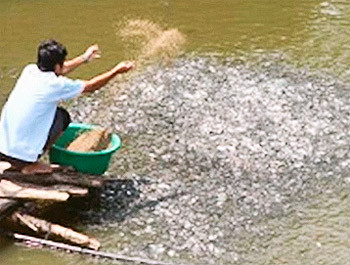
Illustrative image
3. Mixed rearing ratio
The ratio of polyculture depends on pond conditions and feed availability.
Some formulas for grouping fish.
* The main activity is raising tilapia.
Tilapia 60-70%
Carp 10-15%
Other types 20-25%
* The main activity is raising grass carp:
Grass carp 50%
25% carp
20% carp
Carp 5%
* The main activity is raising carp.
Indian carp 50%
20% carp
Grass carp 10%
Carp 10%
Morgan fish 10%
Currently, most fish farmers mainly choose to raise monosex tilapia, common carp, and grass carp.
4. Care
Regularly check your fish pond every morning and afternoon for any unusual fish activity.
The four key feeding techniques are: quantity, quality, time, and location.
Serving size:
For fish up to 100g, the ration should be 3-5% of the fish's weight.
Fish size <100 – 300 g 2 – 3% of body weight
Fish size > 300 g: 1.5% of fish weight.
- Feed the fish twice a day: 6-8 AM and 4-6 PM. Reduce the amount of food on days with changing weather. Especially, do not feed the fish if they are surfacing.
5. Measures to prevent fish diseases
5.1. Comprehensive disease prevention
+ Regularly apply 1-2 kg of lime per 100 m³ of water per week. During rainy weather, use 2 kg of lime per 100 m³.
+ Hang bags of lime (2-4 kg/bag) at feeding points.
+ Before releasing the fry, soak them in a salt solution of 2-3 kg/100 liters of water for 5-10 minutes.
+ Choose the appropriate farming method and species for each pond.
+ Regularly use biological products such as EMC, BIODW, BIOBAC… to improve the water environment in the aquaculture pond.
+ Supplement with 200-300g of vitamin C per 100kg of feed, feeding the fish regularly to increase their resistance to disease.
+ Changing the pond water: In areas with a convenient water source, we can regularly change and add fresh water to the pond. The amount of water replaced should be 20-30% of the pond's water volume.
5.2. Preventing fish diseases using certain herbs:
+ Banana tree: chop the trunk into small pieces and cut the leaves into sections to feed the fish.
+ Garlic: Finely mince garlic and mix it into the feed at a dosage of 0.5 - 1 kg per 100 kg of feed. Feed for 6 consecutive days.
+ Purslane: Wash thoroughly with salt water and feed 1.5 - 3 kg of purslane per 100 kg of fish.
+ Black nightshade plant: Grind the plant to extract the juice and use the pulp to feed the fish at a dosage of 2-3 kg/100 kg of fish/day.
All of these herbs are effective in preventing and treating intestinal diseases in fish.
6. Fish disease treatment measures
6.1. Red spot disease in fish
* Symptoms of the disease
- The fish eat less or stop eating altogether, swimming sluggishly near the surface. Their skin is dark, loses its mucus coating, and becomes dry and rough.
- Red spots appear on the body and the bases of the fins around the mouth. Scales fall off and peel away, ulcers penetrate deep into the body with a characteristic fishy odor. The anus is swollen and red, the abdomen may be distended, the fins are frayed and torn, and the fin rays gradually shorten.
- Anatomical findings: Hemorrhagic abdominal cavity with significant fluid accumulation; internal organs such as the liver, spleen, and kidneys are hemorrhagic; the intestines are empty and may be distended with gas; the intestinal wall is hemorrhagic with numerous areas of necrotic decay.
- Hemorrhagic disease occurs mainly in grass carp, common carp, silver carp, etc.
- Disease outbreak seasons: spring, early summer, and autumn.
* Disease prevention and treatment measures
- Treat the pond water environment using one of the following chemicals:
+ Use 1 kg of potassium permanganate for every 1000 m³ of pond water.
+ Use 1kg of Vicato for 2,500-3,000m³ of pond water.
+ Use 1 liter of BKC for every 3,000 m³ of pond water.
- Phòng bệnh dùng Tiên Đắc1 của Trung Quốc: 1kg thuốc/2.000kg cá,ăn trong 5 ngày liền và 30 - 40 ngày cho ăn 1 lần. Trị bệnh dùng 1kgthuốc/1.000kg cá, ăn 5 - 7 ngày liên tục kết hợp với vôi, thêm nước, tăng thức ăn tinh.
- Trộn thuốc KN04-12 cho cáăn với liều lượng 200g cho 100kg cá/ngày cho ăn 5 - 7 ngày liên tục.
6.2.Bệnh thối mang ở cá
* Dấu hiệu bệnh lí
- Cá bơi lội tách đàn, chậm chạp trên mặt nước, bắt mồi giảm hoặc không bắt mồi.
- Da cá chuyển dần sang màu đen, mang rách nát, thối rữa và dính đầy bùn. Bề mặt xương nắp mang xuất huyết,ăn mòn có hình dạng không bình thường. Các tơ mang thối nát, có dính bùn, lớp biểu bì phía trong lá mang xuất huyết.
* Phân bố và lan truyền bệnh
- Bệnh thường xảy ra ở nhiều loài cá: cá trắm cỏ, trắm đen, cá chép, mè hoa.
- Bệnh xuất hiện vào mùa xuân, đầu hè, mùa thu, thích hợp ở nhiệt độ nước 25 – 350C.
- Bệnh hay xảy ra ở cá nuôi lồng bè mật độ cao, nước lưu thông kém, ở cá nuôi ao có nhiều mùn bã hữu cơ,ngư dân gọi là “bệnh mang đóng bùn”.
* Treating illnesses
- To treat the disease, you can combine mixing antibiotics into the fish feed for 5-7 days to kill the pathogens inside the pond and spreading lime powder in the pond at a rate of 1-2 kg per 100m².3The water in the fish pond is used to kill pathogens from the external environment.
- Use the antibiotic Erythromycin 4 g/100 kg of fish/day.
- Administer the antibiotic Oxytetracycline 20-40 mg/kg of fish/day.
6.3. Diseases caused by anchor worms.
* Symptoms of the disease
- Infected fish have poor appetite, become emaciated, and show inflammation and hemorrhage around the areas where the parasites attach. The areas where the anchor parasites attach provide conditions for bacteria to invade and multiply.
- The areas where the anchor worms attach themselves may look like anchors to the naked eye.
* Phân bố và lan truyền bệnh
- The disease causes significant harm to fish fry and fingerlings.
- Large fish and anchor worms do not cause significant harm, but they create favorable conditions for other pathogens such as fungi and bacteria to invade, leading to mass mortality.
* Treating illnesses
- Bundle neem leaves together and place them in the pond at a rate of 5-7 kg/100m2.
6.4. Wheelworm disease
* Symptoms of the disease
- The fish's body and gills are covered in a lot of cloudy white mucus.
- The fish have gray skin, are itchy, and float in schools to the surface of the water.
- When the disease is severe, the gill filaments are destroyed, and the gills are covered in a silvery-white mucus. The fish swim erratically, then flip over, circle around, sink to the bottom, and die.
* Phân bố và lan truyền bệnh
- They usually parasitize external bodies such as gills and skin.
- This disease is common in several fish species: grass carp, common carp, silver carp, catfish, etc. The disease mainly causes damage in the fry and juvenile stages.
- The disease occurs year-round but mainly in spring, early summer, and autumn. The optimal temperature for disease development is 20-30°C.0C.
* Treating illnesses
- Use a 2-3% salt solution to bathe the fish.
- Use 500-700 g of copper sulfate (CuSO4) per 1000 m².3water.
7. Harvesting
- Stop feeding the fish 2 days before harvesting. High-density polyculture with good investment in feed can yield 12-15 tons/ha/season.
According to khuyennonghanoi - LY