
Cua Lo tourism: Needs to diversify its attractions.
Cua Lo boasts a coastline stretching over 12 km, encompassing three islands of varying sizes: Ngu Island, Mat Island, and Lan Chau Island. With its long coastline, clear blue waters, clean environment, and friendly, hospitable people, Cua Lo is attracting tourists from all over the country.
(Baonghean)Cua Lo boasts a coastline stretching over 12 km, encompassing three islands of varying sizes: Ngu Island, Mat Island, and Lan Chau Island. With its long coastline, clear blue waters, clean environment, and friendly, hospitable people, Cua Lo is attracting tourists from all over the country.
Officially established in 1994, nearly 20 years is not a long time compared to the more than 100 years since the French discovered Cua Lo's tourism potential. However, looking back at what has been achieved, it can be considered a turning point. Separated from Nghi Loc district, where the people mainly worked in fishing and agriculture, Cua Lo has, through its efforts, transformed into a seaside tourist city with streets, cultural buildings, hotels, and restaurants; kiosks nestled amidst pine forests and lush green lawns. Having developed later, Cua Lo has learned valuable lessons, achieving both a spacious urban area and modern planning while still ensuring the preservation of the natural ecological environment.
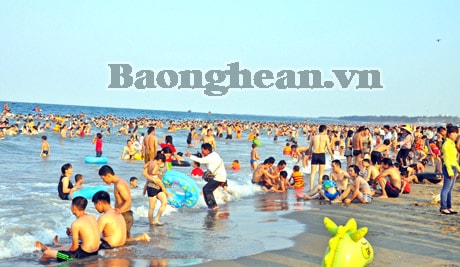
Cua Lo during peak tourist season.
Cua Lo beach attracts tourists not only with its clear water and fine sand, but also with its abundance of seafood. There are crabs, shrimp, squid, scallops… Another unique characteristic of Cua Lo that impresses tourists and is considered a local "specialty" is the professionalism in their service, yet they retain the genuine and warm nature of the people of the coastal village. The smiles on the sun-tanned faces of the mothers and sisters in the fishing village who run tourism businesses are considered a charming feature and an attractive draw for visitors to Cua Lo.
Today, traveling to Nghe An and Cua Lo is very convenient thanks to a well-developed transportation system. Along with roads and railways, many new flight routes have been opened, so even though it's thousands of kilometers away, visitors can reach the sea in just over an hour's flight. From a small fishing village, the coastal town has now become a tourist city with nearly 300 accommodation establishments and almost 7,000 rooms, capable of serving approximately 18,000 guests per day. Many of these establishments meet 1-4 star standards, accommodating and hosting international events.
Over the years, the number of tourists visiting Cua Lo has consistently increased. In 2012, Cua Lo welcomed nearly 2,000,000 visitors, generating 1,120 billion VND in revenue from tourism services, an increase of over 17% compared to 2011. In the first six months of 2013 alone, the number of overnight visitors reached 575,000, an increase of 0.8% compared to the same period; revenue from tourism activities reached 760 billion VND, an increase of 15% compared to the same period...
It can be said that, from a barren land, in less than 20 years, Cua Lo has strived to become the coastal tourist city it is today. However, while in the past Cua Lo developed so rapidly that many tourists were amazed upon their return after only a year, now Cua Lo needs to reconsider its approach. Being complacent with what it has makes it difficult to achieve a sustainable development strategy aimed at year-round tourism. It's worth remembering that quite some time ago, the town planned projects such as the "Ethnic Culture Tourism Village" located south of the Cua Lo tourist area and the "Historical and Cultural Ecological Village" in Nghi Thu... to enrich tourism products in the area, but due to a lack of capital and determination, these projects failed.
Located right on the coast, Lan Chau Island stands out as a highlight in Cua Lo coastal town. From this vantage point, one can observe the entire town, Cua Lo port, and gaze out at the vast ocean. To cater to the needs of domestic and international tourists, Lan Chau Island is being planned as a high-end tourist and water sports area. A pier will be built here to serve tourists visiting Ngu Island, Mat Island, and other sea and island tourism routes in the town. Many such plans have been drawn up over the years, but currently, the road to the island, only a few hundred meters long, is very makeshift, paved with earth and stones, and overgrown with weeds on both sides. A beautiful island with many legends, but due to a lack of adequate investment, it remains considered an untapped potential.
The owner of the drinks stall right in front of the road leading to the island said regretfully: "I've been selling here for 5 years, and many customers have come, but not a few of them have been disappointed." Pointing to the rough, rocky road leading up to the island, she explained that the road has been there for a long time, but because it wasn't paved with concrete, it erodes after each rainy season and they have to temporarily lay down stones like this. For each customer who comes to the island, the contractors here have to collect 5,000 dong to salvage the debris.
It has been learned that Song Ngu Son Joint Stock Company is currently exploring investment opportunities in the Lan Chau - Song Ngu eco-tourism complex, including resort villas, entertainment areas, and sports facilities. The goal is to build a high-end, internationally-standard beach resort on 62.6 hectares of land with an estimated investment of approximately 1800 billion VND. However, the investor's capacity and the project's feasibility are still under consideration.
Mr. Doan Tien Dung, Vice Chairman of the People's Committee of Cua Lo town, said: Due to its harsh natural conditions and the fact that the tourist season only lasts 3-4 months, attracting investment from businesses is currently very limited. When investing capital, businesses calculate what they will get back. Meanwhile, the budgets of the province and the locality are limited, so investment lacks coordination. In its 19 years of establishment, amidst a multitude of tasks, Cua Lo has focused on planning, environment, transportation infrastructure, tourism, and fostering cultural behavior among business owners. Regarding investment on Lan Chau island, the town's leaders believe the investment direction remains unclear.
The goal of developing Cua Lo into a year-round tourist destination is currently in a vicious cycle. Investors are hesitant because the business only operates for a few months; however, the lack of investment also prevents Cua Lo from diversifying its services and offering attractive entertainment options. Having closely followed tourism activities and visited numerous domestic and international destinations, Mr. Thanh – Director of Huu Nghi Travel Center and Head of the Nghe An Travel Association – believes that most tourists research what a destination has to offer. Therefore, Cua Lo needs to create a unique image of its beaches, highlighting what makes it different from other coastal areas. Besides high-end services, it's necessary to offer tourists the opportunity to explore traditional culture, learn about the simple lives of local people, discover unique culinary traditions, and appreciate enduring folk songs.
Regarding this issue, when asked why, alongside developing onshore tourism infrastructure, Cua Lo has not yet developed initiatives such as boat tours on the Lam River combined with Nghe An folk singing, which is very successful in Hue, or opening up connections with tours along the Lam River, Nam Dan, or Bai Lu (Nghi Loc), the town's leaders stated that this requires the involvement of other sectors and localities. They acknowledged this, but acknowledged their limitations, as investing in tourism requires significant capital, while resources are limited, and besides, Cua Lo alone cannot accomplish this.
To make Cua Lo a popular tourist destination not only in the summer, it's necessary to diversify and improve the quality of tourism, better meeting the needs of tourists for relaxation, entertainment, and shopping. Cua Lo town needs to continue expanding its tourism space southward, especially developing high-quality eco-tourism areas on Lan Chau island. The key is to have a boost, investors with vision and dedication, and the decisive involvement of leaders to steer the Cua Lo tourism ship towards greater heights...
Thu Huyen