

Building on tradition to create progress
Nguyen Van Ha – Deputy Secretary of the Party Committee, Chairman of the People's Committee of the commune
Originating from the land of Loc Da – Duc Thinh in the former Yen Truong commune of Chan Loc district (now Nghi Loc district), in 1946 the two communes of Duc Thinh and Loc Da merged to form Duc Loc commune (belonging to Hung Nguyen prefecture). In March 1947, Duc Loc commune merged with Yen Dung and Yen Luu to form Hung Phong commune. Implementing the Central Government's policy of dividing large communes into smaller ones, in July 1953 Hung Phong commune was divided into three communes (Hung Loc, Hung Hoa, Hung Dung), and the new commune was named Hung Loc from that date. On December 26, 1970, the Party Committee and people of Hung Loc happily received Decision No. 80-BT of the Prime Minister's Office merging Hung Loc commune into Vinh City.
Hung Loc is an ancient land in Viet Thuong, located at the end of the left bank of the Lam River near Cua Hoi, which flows into the East Sea, and is steeped in the culture and civilization of the Red River Delta. On this land, over 600 years ago, there are still traces of the military encampment of Tran Quy Khoang, the king who led the resistance against the Ming army in Nghe An during the Later Tran Dynasty…
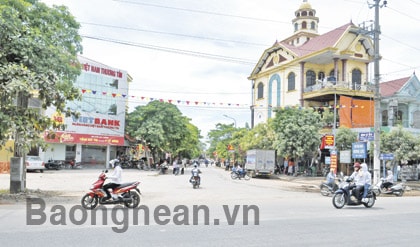
Hung Loc commune center (Vinh City). Photo: Minh Quan
Under the light of Marxism-Leninism and the Party, in 1930-1931, this area witnessed many fierce struggles during the Soviet-Nghe Tinh uprising. In Nguyen Ai Quoc's article "Red Nghe Tinh" sent to the East by the Communist International on February 19, 1931, there is a passage that reads: "In Loc Da village, 2 km from Vinh, 4,000 workers from Vinh City and farmers from Hung Nguyen and Nghi Loc attended a memorial service for the fallen soldiers…". This same area produced outstanding individuals such as Hoang Trong Tri, Hoang Ba, Tran Canh Binh, Duong Xuan Thiep, Uong Nhat Vuong… who were representative of the Soviet revolutionary movement of Loc Da – Duc Thinh.
Following the revolutionary path, 60 years after its separation from Hung Phong commune (Hung Nguyen district), under the leadership of the Party Committee, the people of Hung Loc united and strived to successfully carry out the "Resistance War - National Construction" cause. They simultaneously boosted production and built new production relations, progressing from the labor exchange group movement to the establishment of agricultural cooperatives, trading cooperatives, credit cooperatives, etc. The emulation movements such as "Each person works twice as hard," and "Firm hands on the plow, firm hands on the gun" helped defeat the destructive war waged by the invading American imperialists.
During the two wars of resistance against French and American imperialism, Hung Loc commune had 832 young people enlist in the army, 560 serving as civilian laborers on the front lines, and 85 volunteer youth. The commune has 182 martyrs who sacrificed their lives for the cause of national liberation and reunification, 497 wounded and sick soldiers, 22 families with meritorious service to the nation, 19 veteran revolutionary cadres, 5 people awarded Certificates of Merit by the Government, and 1 mother awarded the title of Heroic Vietnamese Mother. For these great contributions, Hung Loc commune was awarded the title of Heroic Commune of the People's Armed Forces by the State.
After 26 years of reform, the Party Committee and government of Hung Loc have focused on leading and directing, leveraging the combined strength of the entire political system and all sectors of the population to achieve many important results in various fields. The economy continues to grow year after year; the economic structure has fundamentally shifted from traditional agricultural production to commodity production oriented towards high-tech agriculture; infrastructure has been fundamentally invested in, and investment resources have been effectively exploited and utilized to serve production development, poverty reduction, and social security.
The cultural and social sectors have seen positive developments, completing the construction and restoration of national-level historical and cultural relics (Trĩa Temple, Hoàng family church, Uông family church). Education and training have risen from an average level to one of the city's leading levels. Many key goals and targets have been achieved and exceeded compared to the annual plan and resolutions of the commune's Party congresses. The material and spiritual lives of the people have improved step by step, contributing to strengthening and consolidating the people's trust in the Party's policies.
Implementing the Resolution of the Party Congress for the 2010-2015 term (23rd term), Hung Loc focused on developing agricultural production towards a commodity-based approach, gradually concentrating on building brands with strong market competitiveness; developing industry, handicrafts, trade, services and urban areas; building technical infrastructure focusing on rural transportation, concreting irrigation canals, creating a movement to transform the structure of crops and livestock, transfer advanced technologies, and form specialized areas for aquaculture and safe vegetable production...
With funding from the budget and social contributions, projects such as kindergartens, commune health stations, village cultural houses, piped water programs, roads, and concrete drainage ditches have been newly built, renovated, and upgraded, actively supporting socio-economic development. In 2012, the commune's economic growth rate reached 7.6%, the average income per hectare of cultivated land was 50-60 million VND/year; average per capita income reached over 23.8 million VND/year; the poverty rate decreased from 4.07% to 1.6%; people's lives improved, and the rural landscape gradually transformed. The people contributed 430,000 man-days of labor, over 1 billion VND, and donated 8,400 m2 of land, completing 4 km of concrete roads in the villages and constructing 3 flood-resistant internal field roads (Hoa Tien, My Ha). The goal is to achieve 16 criteria for building new rural areas by the end of 2013 and 19 criteria by 2015.
The campaign to build solidarity houses has yielded practical results, with 41 houses donated to policy beneficiary families and poor households, and 14 houses renovated. The emulation movement to build culturally exemplary families and hamlets has been strengthened, with the percentage of culturally exemplary families reaching 89.37%, and sports families reaching 43%. 13 out of 20 hamlets have achieved the title of culturally exemplary unit, 3 schools continue to maintain national standards in education, and the commune has met national criteria for health care at level 2 for the period 2010-2020.
After 60 years of construction and development, Hung Loc has undergone many changes and advancements. However, frankly speaking, the economy is still underdeveloped, small in scale, and its growth rate is not commensurate with its potential advantages; although people's lives have improved, many difficulties still remain; and the leadership capacity of the Party committee, government, and mass organizations... in some aspects has not yet met the requirements.
To overcome the aforementioned limitations, the Party Committee and the government will continue to effectively implement several tasks: Proactively exploit potential advantages, mobilize, manage, and effectively utilize resources for socio-economic development, strengthen national defense and security, and strive to complete the targets set forth in the Resolution of the 23rd Party Congress of the commune. Focus on leading the work of building a strong Party in terms of politics, ideology, and organization; continue to implement Resolution No. 4 (11th Party Congress) of the Central Committee on "Some urgent issues concerning Party building today"; promote the "Study and follow the moral example of Ho Chi Minh on the mass-oriented style, setting an example; upholding the exemplary responsibility of cadres and Party members, especially key leading cadres at all levels" at the grassroots level. Build and consolidate a strong political system, improve the effectiveness and efficiency of government management and administration, innovate the content and methods of operation, and improve the quality of activities of the Fatherland Front and people's organizations. Promote administrative reform, enhance public service ethics, and wholeheartedly serve the people.