

Who will remember this in the future?
(Baonghean)In just the last few decades, from nearly 400 traditional craft villages, the number of villages that still preserve their crafts and are recognized as craft villages throughout the province has dwindled to just over 100. The decline of these craft villages has left many feeling disappointed and regretful, because losing traditional craft villages means losing a part of the culture and unique identity of each region…
We visited Do Nha village in Hung Nhan commune (Hung Nguyen district) because we had heard that it was a village with a unique and unparalleled mat weaving craft. Sadly, it now only exists in memory, in a few brief lines of the book "History of the Hung Nhan Commune Party Committee".
According to the elders in the village, the Hung Nhan area along the Lam River was once just a desolate alluvial plain. One day, a group of people from outside the region arrived, found the land fertile, and stopped, anchored their boats, and established a settlement. Their main occupation initially was fishing, but finding it arduous and physically demanding, spending all day exposed to the elements, the oldest member of the group came up with the idea of using the bamboo and reeds in the area to weave shelters for their boats.
Gradually, the population grew, and people moved from boats to land, establishing villages and hamlets. The traditional craft of weaving boat covers to protect against rain and sun was adapted and transformed into a traditional weaving craft. At the Rậm Temple in Hưng Nhân commune, three figures are still worshipped: Mr. Xuân of the Nguyễn family, Mr. Hiếu of the Phạm family, and Mr. Rằng of the Trần family, who are considered the founders of the weaving craft and the founding fathers of the village. The weaving craft of Do Nha village dates back to the late Lê dynasty, flourished until the 20th century, peaked in the 1989s and 1990s, and then completely disappeared in the early 2000s.
Speaking about the craft, Mr. Pham Ngoc Anh, nearly 60 years old, regrets that although he is much younger than many others in the village, he is one of the longest-serving craftspeople. He learned the craft from his parents and grandparents since he was 5 or 6 years old. The craft of weaving bamboo mats was once very popular; out of nearly 100 households in the village, over 90% practiced it. Although called "bamboo mat weaving," the village's products are very diverse and abundant, ranging from woven bamboo roofs for covering boats, woven mats, baskets, and screens for houses, to woven decorative panels and horizontal plaques…
During the war against the US, to ensure supplies for the battlefield and for transporting goods and weapons to the South, Mr. Anh's family home was chosen for weaving mats. "Back then, every night, we would choose the largest houses, divide into small groups, sit inside, light lamps, and close the doors to weave. For months on end, we wove day and night, but no one complained of fatigue because we knew the soldiers and people of the South were eagerly awaiting these shipments." After the complete liberation of the South, as the country entered the period of socialist construction, Do Nha village was the only village in the entire commune chosen to establish a small-scale handicraft cooperative. The mat weaving craft sustained the entire village, with products transported by river and road to various provinces and cities.
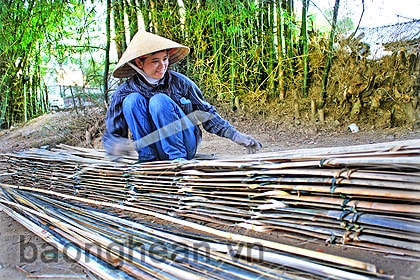
Do Nha weaving village, Hung Nhan commune, Hung Nguyen district. Photo: Phan Van Toan
Today, the "Handicraft Cooperative" brand has become a challenge for the villagers. The reason is that back then, out of 10 hamlets in Hung Nhan commune, 9 were allocated agricultural land because they lacked supplementary occupations. Do Nha village (hamlet 9), with its weaving craft, was oriented towards service and commodity production, and therefore was not allocated land. Unexpectedly, the craft only thrived for a few years. In the 1990s, with the rapid economic development and technological advancements, woven products were no longer favored by consumers. Instead of using products made of rattan and bamboo, people switched to using plastic, wood, and corrugated iron goods.
With their traditional craft gone and no land for production, the Hung Nhan commune authorities have repeatedly discussed ways to help the residents of Hamlet 9 transition to new occupations in recent years, but all attempts have failed. Most recently, thanks to a project by the Cooperative Alliance, the people of Hung Nhan were able to go to Yen Yen district (Nam Dinh province) to learn the craft of rattan and bamboo weaving for export. However, after completing the training and successfully producing three batches of goods, production has been quiet ever since because there is no market for the products, and no organization has come forward to guarantee their purchase. Now, when asked about the possibility of reviving the craft village, everyone in the commune shakes their heads. Mr. Nguyen Cong Hoan, Chairman of the Hung Nhan Commune People's Committee, also expressed pessimism when asked about the traditional craft village: “There’s no way out. We’ve tried to invite three organizations to conduct surveys, and the commune has even mortgaged assets to borrow money from the bank to buy machinery to support production, but it has all failed…”
Mr. Pham Ngoc Anh, knowing that the craft village is in its dying stages, still tries to hold on, even though he only weaves a few mats each month for a few people in the commune who need them. He accepts the loss of the craft because it's the law of time, but what he regrets most is the "spirit" of the craft village, the sense of community and connection that once existed, which is now difficult to preserve despite efforts. Then, the children of the village, even if they work as factory workers or elsewhere, will return when they are forty or fifty years old. At that time, without the craft and without land, how will they make a living?
The loss of traditional crafts and the unique cultural characteristics of the village is something many people regret. I happened to meet Mr. Nguyen Van Hung in Dong Van hamlet (Hung Tien commune, Nam Dan district) when he had just returned from working with sand and gravel for a boat at the Diu wharf. He shared: “Now, I only need to wake up at 3 or 4 in the morning and work for about 4 or 5 hours to earn 400,000 to 500,000 dong, but I still don't feel as happy or optimistic as I did when I used to weave baskets in the village…”
Then he told me about the time when the whole village of Dong Van was engrossed in making baskets and containers. That was in the 1990s and before, when economic conditions were still tight, and farmers were accustomed to using baskets and containers to hold agricultural products. The products of Dong Van village in the past were popular because, firstly, they were inexpensive; secondly, they were high-quality, beautiful, and durable; and thirdly, they were convenient, serving both as containers and sunshades. In terms of economic value, compared to other goods, it wasn't high, but it was a product that yielded a fourfold return on investment because the raw materials and labor could all be utilized within the village and commune.
Like Mr. and Mrs. Hung, every three days they make a trip carrying six baskets on foot from here to Truong Hoi area, Nghi Cong commune, to sell, which allows them to buy one or two yens of rice. This job not only helps him raise three children and provide them with a good education, but more importantly, it cultivates perseverance and hard work. With this side job, the village is no longer idle, and young people don't have to wander north and south to work for a living or get involved in drug abuse and gambling as they do now – Mr. Hung sighed.
Next to Dong Van village, Mr. Nguyen Dinh Ngu (Dong Trung village), nearly 80 years old, still clings to the craft of making ladders and poles. He confided that this is an "improved" craft after the traditional mat-making craft of the village declined. Although the work is hard, and even with strenuous effort, he only earns one or two million dong a month, he doesn't give it up because he wants to preserve the craft and pass it on to his grandchildren so that they will know about the traditional craft of their homeland when they grow up.
According to a survey by the Cooperative Union, there are 369 craft villages throughout the province, mainly focusing on export-oriented rattan and bamboo weaving, silk reeling and weaving, brocade weaving, and seafood processing. However, since 2002, the province has only restored and recognized 119 craft villages with 12 craft groups. Many crafts, after years of neglect, lack of investment, and no market, have begun to decline, such as the bamboo weaving craft in Hung Nhan commune (Hung Nguyen district), the basket making craft in Hung Tien commune (Nam Dan district), the Do paper making craft in Nghi Phong commune (Nghi Loc district), the bronze casting craft in Dien Thap commune, and the blacksmithing craft in Dien Tho commune (Dien Chau district).
According to Mr. Nguyen Van Hung, former Chairman of the Provincial Cooperative Union, the reason for the decline of traditional craft villages is that their products are no longer suitable for current consumer needs. Many localities have not paid enough attention, and management officials have many limitations and have not recognized the importance of developing small-scale industries and building craft villages. People lack flexibility, are slow to change, have poor ability to improve designs, and are not sensitive to consumer tastes, leading to difficulties in maintaining and developing traditional crafts. The majority of young people are not enthusiastic about the "hereditary" craft. Most of them want to leave their hometowns and find a more modern profession.
To accelerate the development of craft villages, our province has already developed a detailed plan for the development of craft villages until 2015. What is needed now is more policies to support the development of craft villages, encourage organizations and individuals to invest in building infrastructure for craft villages; link planning and infrastructure construction with the issuance and effective implementation of policies on attracting investment and investment incentives… Focus on supporting market development policies, supporting product design, selecting and transferring technology, supporting the construction of quality management systems according to standards; prioritize the development of traditional crafts, crafts that exploit the potential of land and labor, and utilize local raw materials, especially those from agriculture, forestry, and fisheries…
Our province is focusing all its human and financial resources on building new rural areas. Among the solutions to achieve the criterion of increasing income, developing and restoring traditional craft villages is considered a long-term, stable measure to address rural employment, increase income, and accelerate the economic restructuring process in agriculture and rural areas. This is also a foundation for preserving cultural identity and developing tourism. If we succeed in this, the old traditional craft villages will certainly be restored, gradually returning the cultural identity of each rural area in Nghe An province.
My Ha