

There is a surge in orders for footwear exports.
Entering the second quarter of 2013, the production and business activities of footwear enterprises began to pick up again as export orders increased and stabilized from now until the end of the year.
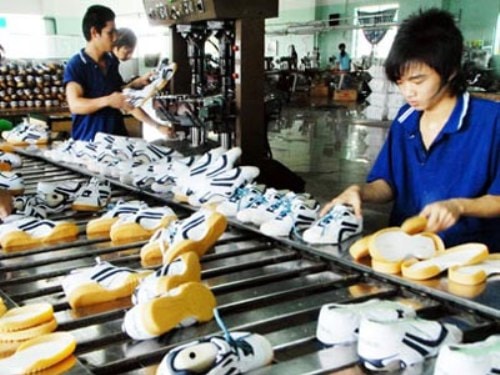
These positive signs, along with many new business opportunities, offer hope for the footwear industry to successfully achieve its export target of over $9 billion in 2013.
According to the Ministry of Industry and Trade's report on industrial production and trade in the first six months of 2013, the production volume of leather footwear in the first six months was estimated at 124.1 million pairs, an increase of 12.9% compared to the same period last year. The total export value of the industry in the first six months of 2013 was estimated at US$4,079 million, an increase of 16.4% compared to the same period last year. The types of footwear exported by Vietnam's leather and footwear industry mainly include products with outsoles and uppers made of rubber, plastic, tanned leather or synthetic leather, and uppers made of textile materials…
Traditional markets such as the US, UK, Belgium, Japan, and China continue to consume large quantities of Vietnamese leather and footwear products. Footwear manufacturers have stable orders, with many large businesses receiving orders extending to the third quarter of 2013 as importers prepare to take advantage of the tax benefits when Vietnam officially benefits from the Generalized System of Preferences (GSP) (tariff rates reduced from 13%-14% to 3-4%) on all goods imported into the EU market from January 1, 2014. EU tariffs will be 0% when the Free Trade Agreement (FTA) between Vietnam and the EU comes into effect.
Therefore, Vietnamese footwear will be more competitive in the EU market in the near future.
This is a significant advantage for Vietnam in attracting orders from other countries, and there has already been a shift of orders from the Chinese market to Vietnam.
However, despite the increase in export orders, footwear exported to markets, especially the EU and the US, has high quality and technical standards. This requires Vietnamese footwear businesses to invest heavily in technological development and improve quality to meet these requirements.
Furthermore, Vietnam's footwear exports still face risks due to the current volatility of the global market and the heavy reliance on imported raw materials. To date, the localization rate is only 40-45% (mainly shoe soles and stitching threads), while the most important raw materials, leather and artificial leather, still have to be imported.
The Ministry of Industry and Trade has encouraged footwear businesses to increase investment in material production and promote linkages between businesses to develop a raw material supply chain for production, aiming for sustainable development.
According to baocongthuong-PH