

Addressing the issue of farmers returning or abandoning their agricultural land.
(Baonghean)Currently, throughout the province, more than 950 hectares of land were not used for the 2013 summer-autumn crop season due to low economic efficiency. This raises a problem requiring comprehensive solutions, including investment in irrigation systems; research into intensive farming techniques and land conversion, forming concentrated production areas, and creating conditions for people to confidently engage in production.
Nam Dan is one of the localities with the largest area of abandoned land in the province during the 2013 summer-autumn crop season (approximately 700 hectares), mainly located in the communes of Nam Dien, Nam Anh, Nam Trung, Nam Phuc, Nam Cuong, Nam Kim, and the Bau Non area of Nam Thanh commune. According to Mr. Dinh Xuan Que, Vice Chairman of the District People's Committee, the situation of some farmers abandoning their fields in Nam Dan has been occurring for the past few years. The main reasons are that the land is located in low-lying areas that are always prone to flooding, resulting in many crop failures. In addition, the price of rice is too low while the costs of investing in seeds, fertilizers, and labor are increasing. Furthermore, people have to invest in building infrastructure for their fields, costing between 300,000 and 400,000 VND per sao (approximately 1000 square meters), leading many to abandon their fields and seek other jobs with higher incomes.
To address this situation, the district has implemented several solutions: Focusing on land conversion, which is an opportunity to improve the agricultural system; encouraging farmers to consolidate land and introduce mechanization into production to free up labor and lower production costs; for low-lying areas, the district will coordinate with centers to find short-term rice varieties to avoid natural disasters; strengthening propaganda and guidance to farmers to avoid being complacent with the current situation of having enough rice to eat, but to focus on producing high-quality, high-economic-value commercial rice; shifting the crop structure from rice to other crops such as corn and vegetables for consumption and livestock; strengthening policies to invest in building farm economic models, seeking markets, and calling on businesses to invest in and guarantee the purchase of products from farmers.
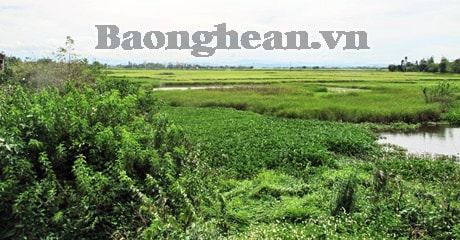
The fields in Hung Thinh commune (Hung Nguyen district) are not being used for production.
during the 2013 summer-autumn crop season.
According to Mr. Hoang Duc An, Deputy Head of the Agriculture and Rural Development Department of Hung Nguyen district, out of 5,700 hectares of rice-producing land in the district, 867 hectares are located in low-lying areas, concentrated in the communes of Hung Trung, Hung Nhan, Hung Thinh, Hung Loi, and the town center. For the past three years, these areas have continuously suffered crop failures during the summer-autumn season. The worst was in 2012, when 1,800 hectares of land in the entire district were flooded, with 1,100 hectares completely destroyed. Therefore, in the 2013 summer-autumn season, 300 hectares of land were left uncultivated by farmers. However, this area was still put into production in the spring season.
Unlike Nam Dan district, to overcome the problem of not being able to cultivate summer-autumn crops in these low-lying areas, in addition to introducing short-day varieties such as P6 mutant and VS1, Hung Nguyen district directed farmers to raise fish in a third crop. In fact, in 2012, Hung Nguyen directed farmers to successfully raise fish in a third crop on more than 300 hectares in low-lying, crop-failing areas, yielding higher economic returns than rice cultivation. However, in the long term, the district requests that the central and provincial governments provide support policies for building embankments to prevent flooding in Hung Dao, Hung Trung, and Hung Tay communes; and to drain floodwaters from low-lying areas by expanding the 33B Ben Thuy drainage canal for Hung Thinh and Hung Loi communes.
In addition, some other localities such as Vinh City, Yen Thanh, Do Luong... also have a situation where farmers are no longer enthusiastic about farming. To overcome this situation, in the coming time, the province needs to pay more attention to investing in the canal and irrigation system to ensure farmers can produce with peace of mind; research appropriate technical measures, including the use of short-day, flood-tolerant varieties and appropriate intensive farming methods; localities should continue to promote land consolidation and exchange, review farming households, and transfer land to other households if they no longer need to produce agricultural land, in order to form concentrated intensive farming areas.
Minh Thu