
This model needs to be replicated in Hung Tan.
Currently, some people in various localities are abandoning their fields, believing that production yields are uncertain. However, in many places, the authorities are still persistently urging people to stay on their land and maintain production. Hamlet 8 - Hung Tan (Hung Nguyen district), with its model of growing pumpkins in a third crop on land previously used for two rice crops, has proven highly effective, affirming the enduring truth: "With human effort, even stones can be turned into rice."
(Baonghean)Currently, some people in various localities are abandoning their fields, believing that production yields are uncertain. However, in many places, the authorities are still persistently urging people to stay on their land and maintain production. Hamlet 8 - Hung Tan (Hung Nguyen district), with its model of growing pumpkins in a third crop on land previously used for two rice crops, has proven highly effective, affirming the enduring truth: "With human effort, even stones can be turned into rice."
In 2007, realizing that his family's 6 sao (approximately 0.6 hectares) of rice land was insufficient, Mr. Nguyen Trong Chuong from Hamlet 8 (Hung Tan – Hung Nguyen) boldly leased an additional 12 sao of rice land from several elderly families in the hamlet with limited labor. To date, he manages to cultivate two rice crops (spring and summer-autumn) and one pumpkin crop (third crop) annually on his 18 sao of rice land. Mr. Chuong said: "In recent years, I and my neighbors have introduced short-day, high-yield, high-quality, and disease-resistant rice varieties. For the spring crop, we usually use the main rice varieties AC5, glutinous rice 87, and glutinous rice 352. The average yield reaches 3 quintals per sao, with a total rice production of over 4 tons per year. This is the main food source for my family throughout the year. For the summer-autumn crop, I allocate 100% of my land to glutinous rice 352 for sale to the market." However, due to the characteristics of the low-lying, waterlogged land, frequent rain and cold weather, and pest and disease outbreaks, the harvest yield this season is often unstable, averaging just over 2.5 quintals per sao (approximately 250 kg per 1000 square meters)...
Due to the lack of alluvial land, Mr. Chuong and his neighbors have persistently pursued continued production on rice paddies. Previously, sweet potatoes, corn, and beans were commonly grown, but the heavy clay soil, the long planting-to-harvest time, and the difficulties in irrigation resulted in low yields. Currently, switching to growing green squash is much more advantageous. According to Mr. Chuong, the process of preparing seedlings is centralized, with netting to protect them from rain and wind. Plowing, fertilizing, creating ridges, and transplanting seedlings are all simple tasks. The squash cultivation process only requires careful tending, tilling, and sufficient fertilization with nitrogen and potassium until the squash reaches a height of 50cm, at which point trellises can be constructed.
The time from planting to harvesting is short, about 2.5 months. According to Mr. Chuong's calculations, 1.5 sao (approximately 1500 square meters) of pumpkins grown on rice land will yield 7 quintals per sao. The price of pumpkins purchased directly from the field by traders is 4,000 VND/kg. Towards the end of the season, the price increases, reaching 5,000-6,000 VND/kg. Thus, Mr. Chuong's more than 1.5 sao of pumpkins brings in a total income of nearly 6 million VND, with a net profit of nearly 4 million VND per sao within 3 months of production and harvesting. According to him, growing pumpkins on rice land is the most suitable third crop ever. The efficiency of growing pumpkins is four times higher than growing rice, and seven times higher than previous crops. Thanks to this, his family has ample money to provide for their children's education.
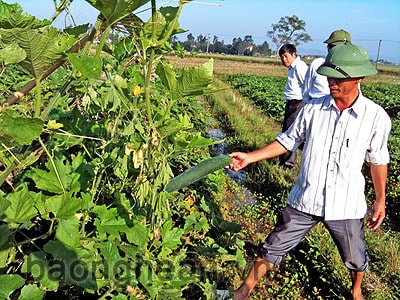
Visiting a model farm growing green squash in the third crop on rice paddies in Hamlet 8, Hung Tan Commune.
Along with Mr. Chuong, many households in Hamlet 8 have developed pumpkin cultivation on rice paddy land, with an average area of 1-2 sao (approximately 1000 square meters) per household. For example, Mr. Nguyen Trong Viet, Ms. Nguyen Thi Hien, Ms. Nguyen Thi Loan, and Ms. Le Thi Nhung all earn a net profit of 3-4 million VND per sao... Notably, in the past year, the villagers have applied trellis techniques, helping the pumpkin plants grow well, preventing weeds, and protecting the fruit from rain, humidity, pests, and diseases. The pumpkin harvest has doubled compared to before the trellises were installed. Recognizing the effectiveness of growing a third pumpkin crop on rice paddy land, many households in the hamlet have joined in planting and intensively cultivating this crop.
Ms. Ho Thi Hoa also maintains over 1 sao (approximately 1000 square meters) of land for a third crop of pumpkins on her rice fields, excitedly boasting: "In the whole hamlet, those with more rice fields find it easier to grow pumpkins. Those without fields are managed collectively by the hamlet to facilitate care, pest control, and harvesting. Thanks to this, as soon as the summer-autumn rice harvest is over, everyone eagerly starts planting pumpkins without any further discussion." Currently, in Hamlet 8, Hung Tan, 50 out of 103 households are developing production according to the model: two rice crops and one green pumpkin crop per year on their rice fields. The total area of pumpkins converted to a third crop in the hamlet reaches nearly 5 hectares, with a harvest yield of 32 tons per year. The model of converting land used for two rice crops to pumpkin cultivation here has attracted the attention of people from 23 communes and towns in the district, who have come to visit and learn from it.
In a conversation with Mr. Nguyen Xuan Hanh, Secretary of the Party Branch of Hamlet 8, Hung Tan Commune, it was learned that the hamlet currently has over 32 hectares of agricultural land. Two-thirds of this area is low-lying land. The hamlet has focused on mobilizing people to reclaim land from higher to lower elevations, and improving the irrigation system and roads in the fields. The hamlet has implemented a policy of mobilizing contributions from households at a rate of 58 kg of rice per sao (approximately 300,000 VND per sao per household) to invest in land improvement for three consecutive years. Annually, the hamlet mobilizes residents to contribute nearly 10 million VND more to invest in, upgrade, and improve irrigation canals. As a result, investment and intensive farming have become more convenient than before. In particular, the agricultural service cooperative has effectively supported farmers in areas such as irrigation, fertilizer, seeds, technical assistance, and pesticides, allowing them to focus on production.
It is evident that the main reason why farmers in Hung Tan are so committed to their land and fields is the application of advanced, short-day, high-quality intensive farming techniques. Their agricultural products are easily sold. After each harvest, traders from all over come directly to their homes to purchase the produce. Currently, the minimum selling price for AC5 rice is 70-80 thousand VND/10 kg, reaching up to 100 thousand VND/10 kg at peak times. The price of 352 glutinous rice is also quite stable at 70-80 thousand VND/10 kg. Thai winter squash (3rd crop) sells out as soon as it's harvested. Thus, in addition to achieving food self-sufficiency, farmers in Hamlet 8, Hung Tan, have proactively shifted towards commercial production. Currently, the average per capita income reaches 22 million VND/year, an increase of 5 million VND/person/year compared to 2010.
Mr. Nguyen Huu Thong, Vice Chairman of the People's Committee of Hung Tan commune, said: "The effectiveness of the model of converting rice land to grow pumpkins in the third crop season in Hamlet 8, Hung Tan is a prime example of mobilizing people to maintain their rice fields. The commune is determined to direct and assign responsibility to all departments, agencies, and localities to resolutely not leave the third crop season on land used for two rice crops fallow. The Resolution of the 21st Party Congress of the commune, term 2010-2015, clearly states: Making winter crops the main crop, with green pumpkins being the main crop on paddy fields, garden land, and land used for two rice crops in higher areas with convenient drainage such as Hamlets 3, 5, 6, and 9."
Hamlet 8 is the most favorable area for introducing pumpkin cultivation in the third cropping season. The commune aims to utilize local land resources, labor, and the advantages and intensive farming practices of the local people. To support the people in developing winter crop production, in 2012 the commune allocated 15 million VND from its budget to invest in pumpkin seeds and seedling bags. Based on this success, the commune will continue to direct and expand the model in Hamlet 8 in the future, striving to achieve 30-50 hectares of green pumpkins in the third cropping season on land previously used for two rice crops.
Clearly, in the suburban plains like Hung Tan, farmers lack alluvial land. The low-lying fields are frequently affected by storms and floods, making rice yields difficult to guarantee. The heavy clay soil also poses significant challenges, leading farmers to abandon their fields. However, thanks to flexible policies on converting double-cropping land to a third crop, not only in Hamlet 8 but throughout Hung Tan commune, people have found a sustainable and highly effective path in agricultural production.
Text and photos: Luong Mai