

5 traditional remedies for colds caused by wind and cold.
Colds occur in all four seasons, but are most common during transitional periods. Here are some effective traditional remedies for this illness.
Patients exhibit mild fever, chills, aversion to wind, headache, with or without sweating, nasal congestion, runny nose, thin white tongue coating, and a floating pulse. If accompanied by dampness, there is pain in the body and joints. The treatment involves dispelling wind-cold (using warming and pungent herbs to relieve external symptoms), and if accompanied by dampness, add herbs to eliminate wind-dampness. The following are some effective traditional prescriptions for this condition:
Nine-Ingredient Ginger and Angelica Soup:6g of Rhizoma Zingiberis, 6g of Radix Saposhnikoviae, 6g of Radix Atractylodes macrocephala, 4g of Radix Asari, 8g of Radix Ligustici, 8g of Radix Angelica dahurica, 8g of Radix Rehmanniae, 8g of Radix Scutellariae, 6g of Radix Glycyrrhizae. Decoction to be taken once a day. Treats colds caused by wind and cold, accompanied by body and joint pain (with dampness).
Ephedra Decoction:Ephedra 6g, almond 8g, cinnamon 4g, licorice 4g. Decoction to be taken once a day. Used for headaches, fever, fear of wind, aching joints, lack of sweating, and difficulty breathing (asthma).
Cinnamon Twig Decoction:Cinnamon bark 12g, peony root 12g, licorice 6g, fresh ginger 12g, jujube (crushed) 12 fruits. Decoction to be taken once a day. Used for people who are afraid of wind and cold, have a low-grade fever, spontaneous sweating, heavy breathing, and dry vomiting.
Incense sticks:80g of Cyperus rotundus, 80g of Perilla frutescens, 40g of Citrus peel, 20g of licorice. Grind into powder. Take 12g daily with warm water or infusion with 3-5 slices of fresh ginger. Treats colds, headaches, fever, abdominal distension, belching, and loss of appetite.
Dried perilla leaves, dried Solanum torvum, dried Cyperus rotundus, 80g each; dried tangerine peel 40g. Grind into powder. Take 20g daily, steeped in boiling water.
Wind-Breaking and Poison-Dissolving Powder:40g Bupleurum chinense, 40g Angelica dahurica, 40g Ligusticum chuanxiong, 40g Notopterygium incisum, 40g Angelica pubescens, 40g Poria cocos, 40g Platycodon grandiflorus, 20g Glycyrrhiza glabra, 40g Mentha arvensis, 40g Saposhia divaricata. Grind into powder. Take 12-20g daily or decoct and drink. Treats colds caused by wind-cold accompanied by body and joint pain (with dampness).
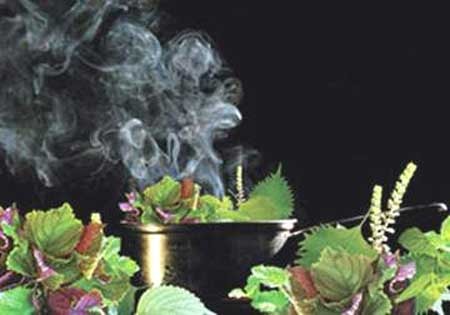 |
| Herbal steam baths containing essential oils are effective in treating colds. |
Types containing essential oils for disinfecting the respiratory tract: lemon leaves, pomelo leaves, perilla, oregano, mint, lemongrass, tea tree, and mulberry.Combine the use of this herbal steam treatment with 3 types of medicinal herbs:
Types with antibiotic effects: chrysanthemum...
Types that have fever-reducing effects: bamboo leaves, fig leaves.
And massage the following acupoints: Fengmen, Hegu, Quchi; if you have a headache, massage Baihui and Taiyang as well; if you have a cough, massage Chize and Taiyuan; if you have a stuffy nose, massage Yingxiang...
Acupuncture point location
Fengmen: located 1.5 cun laterally below the spinous process of the second lumbar vertebra.
Hegu (Hegu point): Bring your index finger and thumb together; the acupoint is at the highest point of the muscle between the index finger and thumb.
Kuk Chi: Bend the elbow towards the chest; the acupoint is at the end of the crease of the elbow joint, where the long supinator muscle, the radial muscle I, and the short supinator muscle attach to the elbow joint.
Baihui: located in the indentation at the very top of the head, at the intersection of the line connecting the two ear peaks with the vertical line of the body.
Temples: the indentation at the end of the eyebrow.
Chizhe: Bend the elbow, the acupoint is located in the depression on the outer edge of the biceps brachii tendon, the inner edge of the upper part of the long supinator muscle, and the brachiocephalic muscle.
Taiyuan: located on the horizontal line of the wrist, in the depression above the radial artery, below the radial artery groove.
Nghinh Huong: the point where the horizontal line at the base of the nostril meets the nasolabial groove.
According to Dr. Nguyen Duc Quang - Health & Life - NT