
Rain and storms cause vegetable prices to rise.
(Baonghean.vn) - Although Typhoon No. 10 only affected Nghe An at noon on September 30th, women had been anxiously stocking up on vegetables since early morning.
(Baonghean.vn) - Although Typhoon No. 10 only affected Nghe An at noon on September 30th, women had been anxiously stocking up on vegetables since early morning.
Due to a sudden surge in demand, the price of green vegetables has doubled compared to normal days, yet they're still selling out quickly. Observations suggest that the price increase isn't solely due to rising input costs, but rather because traders, taking advantage of consumer sentiment, have arbitrarily raised prices.
Having just unloaded her basket of water spinach from her cart, Ms. Thanh, who specializes in selling vegetables and fruits from Nam Dan to Quang Trung market, was already bustling with activity as many people crowded around her basket, asking to buy. Some took two bunches of water spinach along with a gourd or pumpkin, while others bought three or four bunches, plus gourds, green bananas, sweet potato leaves, tomatoes, and so on. Ms. Hanh from C3-Quang Trung exclaimed, "Just hearing about the storm and the vegetables are already this expensive! They'll be even more expensive tomorrow, and with the storm, I'm afraid there won't be any. It's better to buy and store them at home now, so we don't have to worry about the market tomorrow." Ms. Thanh replied, "That's right, I only have this much water spinach, ma'am. With the rain and flooding, who will be able to harvest it tomorrow? If there is any tomorrow, it will be twice as expensive. With the storm hitting Central Vietnam, we might have rain and floods for a whole week."
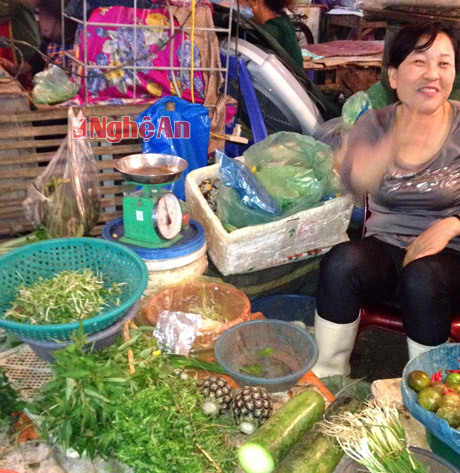 |
| The vegetable stalls in the main market are short of common vegetables. |
It wasn't just Ms. Thanh; other women with stalls at the entrance to Hung Dung market also sold out their goods before they could even unload them. They said some customers bought as much as 200,000 dong worth of vegetables to eat gradually.
After the customers had left, Ms. Thanh confided, "It's really great selling during the storm. I hoarded goods for days, and now even with the high prices, they're still selling like hotcakes..." Many small traders took advantage of the storm to stock up on goods at exorbitant prices: water spinach 8,000 VND/bundle, sweet cabbage 7,000 VND/bunch (up 3,000 VND/bunch), sweet potato leaves 10,000 VND/bunch (up 4,000 VND/bunch), amaranth 8,000 VND/bunch (up 4,000 VND/bunch), and jute mallow 6,000 VND/bunch (up 3,000 VND/bunch).
Similarly, at Quan Lau market, water spinach costs 7,000 VND/bundle, gourds have doubled in price to 20,000 VND/small gourd, and 25,000 VND/large gourd; sweet cabbage and tomatoes cost 20,000 VND/kg, an increase of 5,000 VND/kg; cabbage costs 25,000 VND/kg, an increase of 9,000 VND/kg; bitter melon costs 18,000 VND/kg, an increase of 8,000 VND/kg,... Ms. Hue, a small trader at Quan Lau market, said: "Early this morning, when I went to get vegetables, I heard people talking: 'With this storm, vegetables will be so expensive,' so I had to buy double the usual amount. It's not often I get a little profit, so even a few thousand dong increase per bundle of vegetables is worth the effort of going to get them in the rain and wind." When asked if the wholesale price of vegetables from the market was higher than usual, Ms. Hue said it was higher, but not as much as the price increase reaching consumers.
Unlike vegetables, the prices of other food items are stable, for example: pork tenderloin costs 95,000 VND/kg, pork belly, pork loin, shoulder, and leg cost 80,000 VND/kg, grade 1 ribs cost 95,000 VND/kg, and grade 2 ribs cost 90,000 VND/kg.
Prices of fresh food items such as beef, poultry, eggs, and seafood have only increased slightly, ranging from 1,000 to 3,000 VND per kilogram depending on the type.
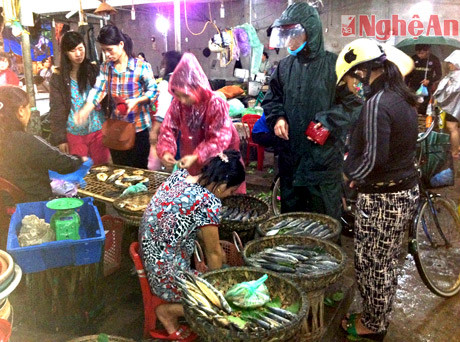 |
| Grilled fish stalls are very popular. |
However, by late afternoon on October 30th, most seafood had already sold out. Many customers, worried about the approaching storm, rushed to stock up on dried and grilled fish.
Thanh Nga