
Why did the Soviet Union collapse?
(Baonghean) - The collapse of the socialist system in the Soviet Union and Eastern Europe in the late 1980s and early 1990s was a particularly important event for the world, a tremendous loss for communists in the process of realizing Marxist-Leninist theory. The dissolution of the Soviet Union at the end of 1991 fundamentally changed the world political landscape.
(Baonghean) - The collapse of the socialist system in the Soviet Union and Eastern Europe in the late 1980s and early 1990s was a particularly important event for the world, a tremendous loss for communists in the process of realizing Marxist-Leninist theory. The dissolution of the Soviet Union at the end of 1991 fundamentally changed the world political landscape.
During the period 1918-1920, Soviet Russia was surrounded by imperialism and attacked from all sides by the White Guards (with foreign support). In this particularly difficult period, the fledgling Soviet Russia faced a precarious situation. Under the leadership of Lenin and the Bolshevik Party, Soviet Russia overcame this perilous challenge and continued to develop.
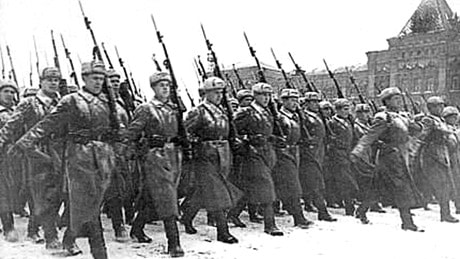 |
| A parade of Soviet Red Army soldiers in Red Square. |
After more than seventy years of continuous existence and development, by the late 1980s, the Soviet Union had become a leading world power. With immense military, scientific, technological, and economic strength, the Soviet Union was capable of confronting the global capitalist system and thwarting any aggressive schemes and activities of imperialism to protect world peace.
The Soviet Union collapsed at its peak.
Why?
Hundreds, even thousands, of articles, monographs, and books have attempted to explain this issue, with those by those directly involved offering the most convincing explanations. In commemoration of the 96th anniversary of the Russian October Revolution (November 7, 1917 - November 7, 2013), this article aims to provide an in-depth look at the disintegration of the Soviet Union.
1. The real socialist system, with the Soviet Union as its cornerstone, made an enormous contribution to world development.
In the latter half of the 20th century, there were more than a dozen ruling Communist Parties in the world, forming a powerful socialist system capable of restraining any unilateral, aggressive, and counter-revolutionary actions by imperialism, led by the United States.
It was thanks to the existence of the powerful socialist system that hundreds of enslaved and oppressed nations rose up in national liberation revolutions, undermining old colonialism and defeating new colonialism. Ultimately, the formation and development of the Non-Aligned Movement was the result of the proletarian-bourgeois struggle on a global scale, a great achievement of the ruling Communist Parties in the 20th century. In other words, it was the communists, first and foremost the ruling Communist Parties in countries belonging to the socialist system, who inscribed a glorious milestone in the process of human civilization.
The ruling Communist Parties built a powerful social system (the socialist system), which in many fundamental areas of social life is better and more superior than capitalism. Even today, 22 years after the collapse of the Soviet Union, 59% of Russians surveyed still believe that socialism has more positive aspects than negative ones, and the majority of Russians still reminisce about the golden age of the Soviet Union.
Ironically, it was the ruling Communist Parties, primarily the Communist Party of the Soviet Union, that lost their leadership, causing the powerful socialist system they had built with the guidance of hundreds of millions of people to collapse and disintegrate. It is important to note that the Communist Party of the Soviet Union lost its leadership and the Soviet Union disintegrated without resorting to a war against imperialism.
In reality, the Communist Party of the Soviet Union, directly and primarily the Politburo and the Central Committee, had become corrupt, lost its way, and caused the collapse of the Soviet Union. The highest leaders, the members of the Politburo of the Communist Party of the Soviet Union, acknowledged this. Of course, the subversive activities of international anti-communist forces through the "peaceful evolution" strategy were also a cause of the Soviet Union's collapse, but certainly not the main or primary cause.
2. How did the Communist Party of the Soviet Union become corrupt and degenerate?
Here are some of the major manifestations that can be mentioned in advance:
Firstly, the Communist Party of the Soviet Union violated the principle of democratic centralism in its party activities. This was accompanied by several ills: authoritarianism, tyranny, an unwillingness to accept opinions different from their own; disregard for the collective, contempt for subordinates, considering their own opinions as absolute truths that everyone must obey, viewing those with opposing opinions as opponents, even enemies. When necessary to protect their "authority," they were ready to treat comrades and fellow party members as enemies. As a result, the party lost all vitality and fighting spirit. Party activities became dull, rigid, and one-sided monologues. Under these conditions, many loyal and upright party members were not appreciated, forced to endure in silence to survive, while opportunists and sycophants had the opportunity to advance.
Secondly, the Politburo and the Central Committee of the Communist Party of the Soviet Union became bureaucratic and detached from reality, losing the close relationship between the Communist Party of the Soviet Union and the Soviet people. This bureaucracy caused leaders at all levels of the Communist Party of the Soviet Union to become detached from reality, lacking a proper understanding of the social situation they were leading and managing. They were indifferent to the legitimate aspirations of the masses, and even lacked empathy or reaction to the suffering and injustices of a segment of the population, including some lower-level party members and officials.
- Thirdly, the moral and lifestyle degradation of some high-ranking leaders holding key positions is manifested in prominent ways: selfishness, prioritizing personal interests, family, and relatives over the interests of the Party and the people; localism, factionalism, and appointing close associates, including those weak in ability and lacking in morality and lifestyle, to leadership positions to create a protective shield; corruption, extravagance, hypocrisy, and in some cases, moral and lifestyle decay.
The above are the most prominent manifestations of the degeneration of a segment of cadres and party members of the Communist Party of the Soviet Union, especially key cadres at high levels.
Only when degeneration and corruption occur at the center of power (the top leadership) of the Party does it become a threat to the Party, marking the eve of its disintegration and collapse. The Communist Party of the Soviet Union and its Eastern European "versions" fall into this category.
Typically, these manifestations do not exist in isolation, but always coexist, are related to each other, and influence each other; sometimes one serves as a prerequisite or condition for the existence and development of the other. These manifestations of degeneration do not appear suddenly, but develop gradually, starting as a small festering sore and progressing through many stages. These ailments silently accumulate continuously over months and years, weakening the Party's fighting spirit, reducing its sensitivity, and preventing it from formulating correct and feasible policies and decisions. Within the Communist Party of the Soviet Union, there was genuine polarization: a segment of cadres and party members became wealthy rapidly due to privileges and special advantages, while the majority lived in hardship; many party members said one thing and did another, speaking differently in meetings, thinking one thing and expressing another. The fighting spirit in party activities gradually cooled, and many party members became indifferent to political issues related to the fate of the Communist Party of the Soviet Union.
According to F. M. Rudinsky, the 20 million members of the Communist Party of the Soviet Union could be divided into four categories: 1. Genuine party members, who usually constituted a small percentage; 2. Those who mechanically carried out and implemented the Party's directives and resolutions (accounting for over 96%); 3. Opportunists, sycophants, and flatterers (mostly within the government apparatus); 4. Silent people (most of them were knowledgeable individuals who remained silent for fear of retaliation and dared not speak out).
Nii Ryskov, former member of the Politburo of the Communist Party of the Soviet Union and Prime Minister of the Soviet Union (1985-1990), argued that there were two parties within the Communist Party of the Soviet Union: one party of tens of millions of ordinary members and another of top officials within the Soviet party and state system. These high-ranking party members were increasingly alienated from the tens of millions of ordinary members. In essence, these members did not represent or protect the interests of the class or the nation, but only sought to cling to power for their own personal gain.
Due to the aforementioned ailments, the vast majority of the population lost faith in the leadership of the Communist Party of the Soviet Union, became indifferent to the country's major political issues, and some even hoped for change. This was the state of the Communist Party of the Soviet Union and Soviet society in the late 1980s and early 1990s, on the eve of its collapse and disintegration (1989-1991).
3. Let's try to discuss the causes.
Regarding the subversive activities of the US and international anti-communist forces, there is clearly ample information and documentation to confirm this. We must absolutely not be vague or lose vigilance.
The negative aspects of the market mechanism are also a cause. However, if we overemphasize or exaggerate the negative aspects of the market mechanism, it will be difficult to explain the degeneration of the Communist Party of the Soviet Union and the Communist Party of China during the periods of Mao Zedong, Stalin, and Prez Nev's leadership, because during Mao's, Stalin's, and Prez Nev's eras, there was no market economy.
Having carefully studied the process of degeneration within the Communist Party of the Soviet Union, including both ruling parties that lost power and those that remain in power today, we would like to raise two issues for discussion.
- Firstly, organizationally, throughout its existence and development, the Communist Party of the Soviet Union failed to establish an effective mechanism to ensure genuine democracy in Party activities. The Communist Party of the Soviet Union violated the principle of democratic centralism throughout its operation. In our opinion, this is the starting point and origin of all other manifestations of the Party's degeneration (bureaucracy, ideological and political corruption, moral and lifestyle degeneration, division and disunity...). Wherever and whenever democracy is vibrant in Party activities, the Party has immense vitality. The Bolshevik Communist Party of Russia under Lenin's leadership is a prime example.
Ultimately, the lack of democracy in Party activities meant that the leadership of the CPSU lacked comprehensive information on various issues, especially those crucial to the Party's survival. This lack of democracy meant that Party meetings were often one-sided monologues from the highest leaders, completely lacking feedback from below. This lack of democracy also meant that outstanding, perceptive, sharp, and intelligent Party members had no opportunity to express their ideas. In such an organization, the highest-level staff lacked sufficient comprehensive and multifaceted information; therefore, decisions on policies and strategies were often inconsistent with reality, even contrary to the laws and objective reality. Perhaps this is one of the fundamental reasons why, despite numerous resolutions and directives, very few were implemented. In medical terms, there are many medicines, but no specific cure, so the illness only worsens.
From a systems theory perspective, a party organization can be viewed as a system. To ensure the sustainable existence of that system, information exchange is essential. Without this exchange (in both directions, from inside to outside and from outside to inside), the system will inevitably collapse and transition to a different state. A lack of democracy in party activities, meaning a lack of information exchange (from top to bottom, from bottom to top, from within the party to the outside world and vice versa), will inevitably lead to the degeneration of the party system in various forms as described above. If this is not rectified and is allowed to continue, the degeneration of some key party members will eventually lead to the degeneration of the ruling party.
Let's return to the Communist Party of the Soviet Union to better understand the issue of democracy within the party. The principle of democratic centralism in party life is clearly stated in the Statutes and Program of the Russian Bolshevik Communist Party from 1903. The Statutes of the Communist Party of the Soviet Union, through many changes, remain a document that very strictly and clearly defines the rights and responsibilities of party members. Why couldn't the deviations of Stalin and Preznev be prevented, why couldn't the abuse of power, arrogance, and betrayal of Gorbachev be stopped? Why did tens of millions of Communist Party members of the Soviet Union not react when Gorbachev announced the dissolution of the party? In other words, the lack of democracy in Party life and the absence of effective mechanisms for monitoring power, especially the complete lack of mechanisms to monitor the activities of the General Secretary and the Politburo, were the root causes of the abuse of power and tyranny by the leaders of the Communist Party of the Soviet Union, giving the party a massive physical body (tens of millions of members) but no soul, no vitality.
The reality confirms that the former Communist Party of the Soviet Union had no force or mechanism to supervise and critique the activities of the General Secretary or the Politburo. This small group, sometimes only a handful of people, held supreme power, acting arbitrarily. Anyone with a different opinion would be labeled as "opposition," "reactionary," "anti-Party," or even "traitor to the Fatherland"...
Due to the lack of democracy in Party activities, members of the organization have very loose relationships with each other, the Party has lost all vitality, and its fighting spirit remains only in resolutions.
Due to a lack of democracy in Party life, a process of division quietly took place within the Communist Party of the Soviet Union, as well as in the Communist Parties of the socialist countries in Eastern Europe, long before its collapse and disintegration. This division occurred within the Central Committee and the Politburo. Party members thought one thing but said another, not daring to express their own opinions even on issues related to the Party's survival. In meetings, people said one thing, and mostly insincerely; outside of meetings, they spoke differently among themselves. Superiors imposed their will, and subordinates adjusted their behavior to conform to their superiors. All official information from above, and especially from below, lacked authenticity. Less than a month before its collapse and loss of leadership, the leaders of a ruling Communist Party still affirmed the fighting spirit of their party, still declared that the vast majority of the people were grateful to the party, followed the party, trusted the party, and that the vast majority of party members were trustworthy and loyal...!
Due to a lack of democracy in Party activities, the Communist Party of the Soviet Union made mistakes in evaluating cadres, training cadres, selecting and appointing them to key positions in the Party and the State. A lack of democracy fostered flattery and subservience, creating favorable conditions for pragmatism and opportunistic self-interest to flourish within the Party, especially in high-level leadership positions. Everyone knows that cadres determine everything, and practice confirms this. However, the Communist Party of the Soviet Union made mistakes in the use and placement of cadres.
Secondly, the degeneration of the Communist Party of the Soviet Union was due to its members, primarily those holding key leadership positions at high levels, lacking political maturity and a true understanding of class consciousness and communist ideals. Upon joining, all members swore an oath of their communist ideals, promising to wholeheartedly strive for the benefit of the class and the working people, and pledging loyalty to communist ideals… But once they joined the party, they lacked training, and in practical activities, they gradually strayed from their oaths and promises. This was the process of dehumanization among party members, leading to the degeneration of the party itself. Of course, not all party members experienced this process of degeneration.
Of course, there are many other issues concerning the causes and conditions that led to the degeneration of the Communist Party of the Soviet Union and the collapse of the Soviet Union. Here, we do not have the opportunity to present all of them, but only to highlight the most important and fundamental factors. These can be considered the source of all degeneration of ruling parties in general, and of the Communist Party of the Soviet Union in particular.
*
* *
In 2013, the Russian people in particular, the people of the 15 former Soviet republics, as well as the Vietnamese people and progressive humanity in general, commemorated the 96th anniversary of the Great October Revolution (November 7, 1917 - November 7, 2013). Socialism had existed in Russia for 74 years (1917 - 1991), and the Soviet Union had collapsed 22 years prior (1991 - 2013). Russians in particular, and progressive humanity in general, still need to continue to study and explain thoroughly and convincingly the issues related to the collapse of the Soviet Union.
After all this time, let us summarize the following three major issues:
- Firstly, the period from the Russian October Revolution to the collapse of the Soviet Union (1917-1991) can be divided as follows: 1. The first generation of revolutionaries, led by Lenin, led the young Soviet Russia through the critical period of 1917-1920 to ensure its survival and development; 2. The second generation of leaders, led by Stalin, destroyed German, Japanese, and Italian fascism and made the Soviet Union a world power; 3. The third generation of Soviet leaders, from Khrushchev to Brezhnev, participated in the Great Patriotic War (1941-1945) and made the Soviet Union a leading world power; 4. The fourth generation of leaders, with Gorbachev as its core, were those born during the Great Patriotic War and had not yet experienced the trials of war.
It was the fourth generation of leaders that caused the Communist Party of the Soviet Union to lose its leadership, leading to the collapse of the Soviet Union.
Secondly, the fourth generation of Soviet leaders, with Gorbachev as the core, held all the power and resources of the country in their hands, but they did not follow the will of the people, lacked popular support, and thus lost their entire legacy and were discarded by history.
It turns out that seizing all national power and resources is not as difficult as winning the hearts of the people. Those who fail to win the hearts of the people have already failed while in power.
- Thirdly, both ruling and non-ruling communist parties need to learn from the failures of the Soviet Communist Party and the collapse of the Soviet Union in order to surpass themselves for the happiness of the people and the prosperity of the country.
Mistakes and shortcomings are unavoidable, but they are not truly dangerous. The most dangerous thing is the unwillingness to admit mistakes and shortcomings, especially the lack of political will to avoid them and correct them.
Le Van Cuong(Former Director of the Institute for Strategic Studies, Ministry of Public Security)