

"The betel quid is the beginning of a conversation."
(Baonghean) - The image of rows of straight, towering betel nut trees, their leaves and stems split like bird feathers, shimmering in the early morning sun, swaying in the afternoon breeze, or silhouetted against the deep blue sky on moonlit nights; along with the image of lush green betel vines with leaves as big as a hand in the garden corners of grandparents' homes... these are all familiar images deeply ingrained in the memories of many. Today, they have become symbolic images of the homeland in the nostalgia and affection of those who live far away. And the custom of chewing betel has become a cultural tradition passed down through generations…
According to legend, the custom of chewing betel nut (betel chewing) dates back to the time of the Hung Kings, associated with the legend of "The Story of Betel Nut," which tells of the faithful love between husband and wife, and the bond between brothers who crossed mountains and streams to find each other and transformed into betel nut trees, betel vines, and intertwined rocks. Betel nut is the starting point of communication and interaction, the beginning and opening of feelings, helping people become closer and more open with each other. Betel nut is the initial offering in important traditional ceremonies such as weddings, ancestral worship, funerals, and burial rites... Betel nut is a symbol of romantic love and the affection between husband and wife, brothers, family, and happiness.
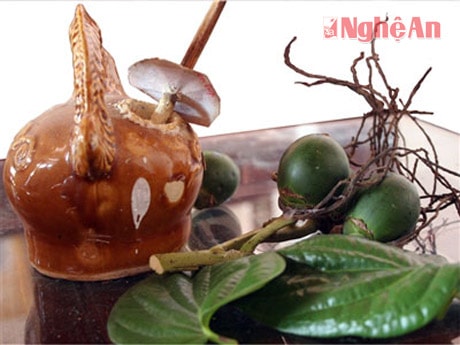 |
A betel quid consists of four ingredients, each with a different flavor: betel nut (sweet), betel leaf (spicy), root (bitter), and lime (hot). The tall betel nut tree symbolizes the sky (yang). The lime, a stone, symbolizes the earth (yin). The betel vine, growing from the earth and intertwining with the betel nut tree, symbolizes intermediary. A betel quid consists of a piece of betel nut, a betel leaf coated with lime, and a piece of astringent bark (a piece of root). Chewing betel with betel nut offers the sweetness of the betel nut, the spiciness of the betel leaf, the astringent heat of the lime, and the earthy taste of the root... all of which create a stimulating effect, freshening the breath and reddening the lips. Preparing betel nut requires a sharp knife, carefully peeling the bark, and only discarding about 1/3 of the bottom bark. Then, the betel quid is cut lengthwise into 5 or 6 equal parts, and the green outer layer is removed before chewing. To prepare betel quid shaped like a phoenix wing, one folds the betel leaf in half lengthwise, then makes a slightly slanted cut on both sides of the leaf, from the middle towards the stem, but without cutting it completely through. The middle section of the leaf is trimmed to make it straight, like when preparing betel quid for everyday use. A little lime is applied to the center, then it is rolled up; a hole is then punched in the middle of the rolled betel quid, and the stem is secured. The two curved strips of leaf, cut close to the stem at the beginning, are not rolled up and curl upwards, resembling the wings of a phoenix. The art of preparing betel quid enhances the value of feminine skill and dexterity. The image of the rolled betel quid, whether plump or round, measured or graceful, reflects the skill of the woman. Through the taste of the betel quid when chewed—whether it's bland, mild, or salty from the lime, subtly fragrant or intensely spicy from cinnamon or star anise—one can somewhat discern the character of its owner: careless or careful, clumsy or skillful, simple or elaborate, calm or passionate.
The custom of offering betel in our country shows that betel nuts are an indispensable means in daily social interactions. Because "a betel quid is the beginning of a conversation," "the start of receiving guests," so as soon as people meet, after a few greetings, they immediately offer betel nuts to eat before discussing anything else.
If you have betel leaves, take them out.
First, it's about entertaining a friend, then it's about ourselves.
- In the old days, nobody knew each other.
It was only because of cigarettes and betel nuts that we became acquainted.
In the context of love and marriage, the custom of offering betel leaves has been thoroughly exploited by ordinary people. Because betel leaves and areca nuts are also wedding gifts, the images, colors, and flavors of betel leaves, areca nuts, lime, etc., always evoke in young men and women associations with love stories and destined couples.
- Go into the garden to pick young betel nuts.
He finds you charming and wants to marry you.
- Chalk is whiter than lime; lime is stronger than chalk.
He ended up here because he loved her.
Today, although betel leaves and areca nuts remain a beautiful custom in marriage proposals, reflecting traditional cultural identity, few people chew betel anymore. Young men and women today know little about betel and areca nuts. Rows of areca trees and lush betel gardens have gradually disappeared from villages. The custom of offering betel has also become unfamiliar. The custom of chewing betel only exists in rural areas, associated with the image of elderly men and women in the countryside. Nevertheless, betel and areca nuts still endure during festivals, Tet (Lunar New Year), and other celebrations. The custom of chewing betel has become a traditional cultural identity of the Vietnamese people, expressing loyalty, unity, and respect.
Duy Ngoc