

The Turkish trumpet
(Baonghean) - From readily available materials, the Tho ethnic people have created their traditional horn. For generations, its sound has become an indispensable part of community life: the horn's sound celebrating a baby's first birthday, calling friends, celebrating a new house, enjoying village festivals, and bidding farewell to the deceased...
During my journey to learn about the trumpet, I met Mr. Truong Van Loi in Mo village, Van Loi commune (Quy Hop district), a remote area, who was once praised by the press as the "trumpet god." Indeed, through his "performances," the trumpet produced enchanting sounds. Sometimes contemplative, like the soul of the mountains and rivers, sometimes melodious, like forest birds calling to their mates... that trumpet sound has accompanied him to many rural areas. And now, at the age of 78, he remains faithful to the trumpet, preserving for his descendants the folk melodies that have been passed down through generations.
Mo Village is one of the cradles of the Tho ethnic group in western Nghe An province, so its folk songs, music, and dances are incredibly rich. This precious heritage was instilled in Mr. Loi from his childhood. He told me that he knew how to play the horn when he was over 10 years old. Back then, he would constantly follow his older siblings to spring outings and accompany the elders to religious ceremonies, and he was captivated by the sound of the horn without even realizing it. At 18, he left his family to work as a laborer at the Nghe An Forestry branch in Con Cuong, always carrying his traditional horn in his cloth bag. After several job changes, even when he joined a geological survey team traveling throughout the northern mountainous provinces, the horn remained his inseparable companion. Whenever he missed his homeland, or had free time, the sound of the horn would rise, giving strength to this son far from home who always felt a deep longing for his roots...
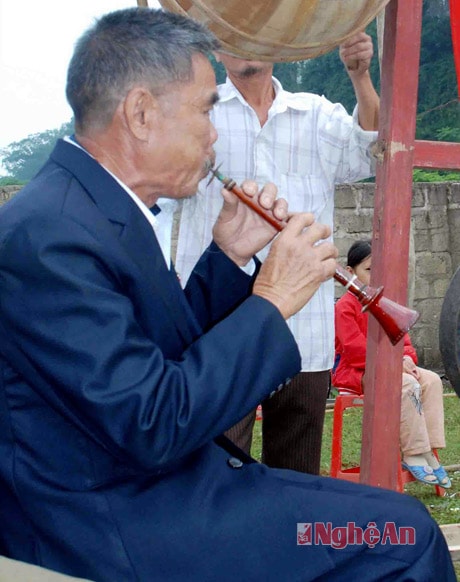 |
| Artisan Truong Song Huong and his traditional trumpet. |
Crossing the precarious bamboo bridge over the Dinh River, I sought out artisan Truong Song Huong, a son of Dua village (a village inhabited entirely by the Tho ethnic group), in Son Tien hamlet, Tho Hop commune (Quy Hop district). Artisan Truong Song Huong is proficient in playing 13 musical instruments, from horns, zithers, two-stringed fiddles, flutes, pipes, bowed string instruments, to mandolins and violins... Having learned and experimented with making horns on his own, when he talks about the horns of his people, he speaks with passion; our conversation naturally led from the making of horns to the "rules" of playing them.
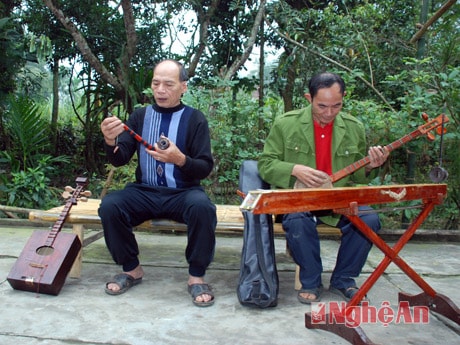 |
| The Thọ Hợp Commune Cultural Club is practicing. |
Making a trumpet isn't as complicated as making some other musical instruments, but that doesn't mean it's easy either! The entire trumpet is only about 25 cm long and consists of three main, detachable parts: the mouthpiece, the body, and the bell. A very important detail of the mouthpiece and the entire trumpet is the reed. The reed can be considered the soul of the trumpet; it's only about the size of three grains of rice arranged vertically, but without it, or if it's not made correctly, no matter how beautiful the trumpet is or how long the player's breath is, it won't produce any sound. Many people mistakenly think the reed is made of brass, but that's not the case. Previously, people made reeds from cardamom leaves, but now they've creatively made them from... plastic drinking straws, a very cheap and readily available material.
The middle part of the horn is the body, made of hollowed-out wood, with a diameter of about 3 cm at its widest point. The body must have seven holes for vibrato, and the spacing between these holes must adhere to traditional family secrets; only then will the horn produce the correct pitch. The end of the horn is the bell, made of wood with a diameter of about 10 cm.
The trumpet is an indispensable part of community life and spiritual rituals, and the "rules" for playing it are therefore divided into two types: joyful and mournful. Joyful trumpet tunes are often used during Tet (Vietnamese New Year), housewarming parties, village festivals, etc., such as the "Ken Xai" and "Ken Long Ba" tunes. The "Ken Xai" has a low, melodious tempo (level 1); the "Ken Long Ba" has a more rapid tempo (level 2), harmonizing with drums to provide a backdrop for people to dance. Mourning trumpet tunes are often used in funerals and include the "Ken Rung," "Ken Dieu," "Ken Dang," "Ken Truy," "Ken Khac Dui," and "Ken Lay." The "Ken Lay" is used during the funeral rites, the "Ken Rung" is played during the coffin placement ceremony, and the other four tunes are played alternately while dancing around the coffin...
Despite being deeply rooted in the community for generations, the Thổ ethnic group's horn is at risk of being played less frequently amidst the vibrant pace of the market economy and the rise of modern music trends. It's disheartening to see that the number of people who know how to play the horn within the Thổ community is currently very small, mostly elderly; the number of young people who can play the correct melodies can be counted on the fingers of one hand. According to Mr. Truong Thanh Hai, a cultural officer in Nghia Xuan commune (Quy Hop district), the entire commune currently has only about 8 people who know how to play the horn, all of whom are elderly. The situation is not much better in communes with large Thổ ethnic populations such as Tho Hop, Tam Hop, Van Loi, Ha Son, etc.
Knowing how to play the trumpet is essential for making a good trumpet, because the entire process of hollowing out the inner chamber, drilling holes in the body, and crafting the reeds requires careful sound testing and adjustment. Therefore, while few people know how to play the trumpet, even fewer know how to craft one. To make a traditional trumpet, even skilled craftsmen like artisan Truong Song Huong need three days. In the entire Tho Hop - Tam Hop region, he is the only one who knows how to make trumpets. He has tried many times to pass on his skills to younger generations, but after a few days, his apprentices always drop out. This is partly because crafting the reeds and hollowing out the body requires meticulous work, and partly because of the financial worries, as the time from learning to crafting a satisfactory trumpet can easily take a year; moreover, the trumpets made are mainly for personal use, and very few people actually buy them.
How to prevent the secrets of traditional horn-making from being lost, so that the sound of the horn will forever remain with the Tho ethnic people, is a heartfelt concern for many of us as we approached and researched to write these lines!
Cao Duy Thai