
Con Cuong: Effective economic models
(Baonghean) - When the peach blossoms begin to bloom, it's also the time when the ethnic minorities in Con Cuong are bustling with excitement to welcome the spring. The wish for a prosperous Tet holiday is within reach for many people as more and more effective economic development models that generate high incomes are emerging.
(Baonghean) - When the peach blossoms begin to bloom, it's also the time when the ethnic minorities in Con Cuong are bustling with excitement to welcome the spring. The wish for a prosperous Tet holiday is within reach for many people as more and more effective economic development models that generate high incomes are emerging.
We visited the integrated farm of Mr. Quang Van Dinh's family in Thuy Khe village, Chi Khe commune, while he was tending to his herd of black pigs. He said: "Previously, raising black pigs mainly involved utilizing leftover food from the family and improving daily meals. In recent years, black pork has become popular in the market, so we have boldly invested in raising black pigs to serve the Tet market. The investment cost is about over 20 million VND for building pens and fencing the breeding area. The family raises two sows to ensure a supply of 40-50 piglets per year."
We feed our pigs agricultural by-products such as corn bran, rice bran, wild bananas, sweet potato leaves, etc., instead of using industrial feed, thus saving on input costs. Black pigs grow slowly, reaching 15-20 kg in 4-5 months before being sold, but the price is double that of regular pork. On average, each pig fetches 1.4-1.6 million VND. My family has 40 black pigs for the Tet holiday market, and we've already sold 20, earning nearly 60 million VND in total. After deducting expenses, we have a profit of 40 million VND in 6 months.” Recognizing the effectiveness of the black pig farming model, many groups of households raising black pigs have emerged in Chi Khe, with nearly 100 households in various villages raising black pigs on a small to medium scale, supporting each other with farming experience… Through black pig farming, many households have risen out of poverty, and some have even become wealthy.
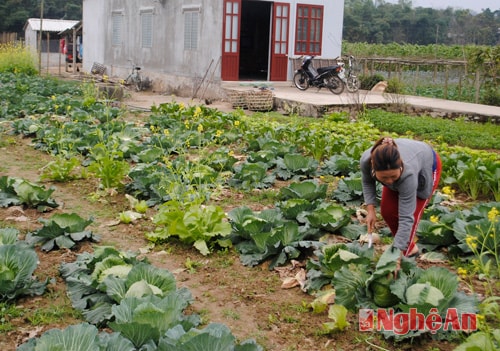 |
| Harvesting vegetables in Quyet Tien village, Chi Khe commune (Con Cuong district). |
The people of Chi Khe also make good use of the land for effective goat farming, such as Mr. Nguyen Xuan Vi's household in Lien Dinh village, which raises over 40 goats and over 400 free-range chickens. It is known that all of these goats and chickens have already been "ordered" by customers for the Lunar New Year. At an average price of 140,000 VND/kg, each animal costs between 2.5 and 2.8 million VND. After deducting expenses, the profit from raising 40 goats for 6 months is over 100 million VND.
In Quyet Tien village (Chi Khe district), along National Highway 7, a 17-hectare concentrated vegetable farming area has been established to meet the demand for fresh vegetables during Tet (Lunar New Year) for all three districts of Anh Son, Con Cuong, and Tuong Duong. Currently, the villagers are harvesting vegetables, and traders are actively buying them. Thanks to the vegetables, families have extra money to cover expenses during Tet. It is known that out of over 120 households in Quyet Tien village, more than 100 specialize in vegetable farming. Currently, the villagers are producing vegetables according to VietGAP standards, with a variety of vegetables such as kohlrabi, tomatoes, cabbage, and herbs… achieving an income of over 150 million VND/hectare/year.
In the spring sunshine, we visited the tea-growing area of Yen Khe commune, where the vast green of the tea hills interspersed with the red of the tiled roofs created a peaceful scene in the buffer zone of Pu Mat National Park. As Tet (Lunar New Year) approached, the tea hills were bustling with harvesting activity. Visiting the tea plantation of Ms. Tran Thi Ly in Trung Chinh village, Yen Khe, we saw her and her husband and neighbors working together to harvest the winter tea crop. She shared: "Tea is the main crop for our family. Each year, we earn over 30 million VND from tea. During the Tet month alone, we harvest tea buds to supply the Bai Phu Tea Enterprise, earning 4-6 million VND to cover our expenses for Tet." Mr. Nguyen Van Quy added: "All our Tet expenses depend on the money from tea. Our family cultivates 7 sao (approximately 0.7 hectares) of tea, and this Tet month we're harvesting about 5 million VND. That's a very precious amount for us." It is known that in Trung Chinh, out of nearly 100 households, 100% are engaged in tea cultivation. Thanks to a focus on intensive farming, tea yields have steadily increased, from only 12-14 tons/ha/year previously to 20-22 tons/ha/year now.
Tea cultivation is increasingly asserting its important role in the restructuring of rural agriculture in the highlands, helping people alleviate poverty, preventing soil erosion, and serving as a sustainable farming model on sloping land. Currently, Yen Khe commune has over 120 hectares of tea, with each hectare generating an income of 50-60 million VND per year. The entire Con Cuong district has over 350 hectares of tea, and the local authorities regularly organize training and guidance for people on tea cultivation and harvesting techniques. Purchasing units provide the best possible conditions for product procurement.
Amidst the bustling Tet atmosphere throughout the villages, Ms. Vi Thi Ha in Xieng village, Mon Son commune, is diligently weaving brocade fabrics with many colorful patterns. Ms. Ha said: “From the beginning of the year until now, brocade fabrics have been difficult to sell, so we have been producing at a slow pace. With orders coming in during the Tet season, the women in the brocade weaving group of the Mon Son Handicraft Cooperative have been working tirelessly day and night for over two weeks to meet delivery deadlines and earn money for Tet.” The Mon Son Handicraft Cooperative currently has over 60 members participating in brocade weaving. Although the salary is not high because it depends on orders, this is a work they do during their free time between farming seasons, providing an income of 2.5-3 million VND per person per month (during the Tet season), which helps them prepare for Tet. Ms. Ha Thi Hang, head of the Mon Son Handicraft Cooperative, shared with us: "The cooperative is always exploring and researching new designs to diversify products and improve product quality in order to secure more orders and create stable year-round income for the members."
Mr. Vi Van Binh, Chairman of the Con Cuong District Farmers' Association, added: In 2013, Con Cuong district developed over 30 economic development models focusing on crops, livestock, and small-scale handicrafts… The investment capital was approximately over 1.2 billion VND, mainly from integrated funding from Program 135, the New Rural Development Program, and Project VE 08. Local authorities mobilized villagers to participate in training and technology transfer, and many households have become aware of the importance of poverty alleviation, knowing how to reclaim and expand their orchards and hillsides for production development. Therefore, many production models have been successful and widely adopted by households, such as the black pig farming model which has spread to many households in Chi Khe, Bong Khe, Binh Chuan, and Do Phuc communes. Intensive tea cultivation and orange farming models have also been implemented in Yen Khe and Bong Khe. The success of these models will serve as a stepping stone for Con Cuong to further expand its tea cultivation area to over 500 hectares, and its orange cultivation area to over 150 hectares in Yen Khe and Bong Khe communes, as well as to widely replicate the black pig farming models.
Text and photos:Van Truong