
The officials are determined, and the people are in agreement.
(Baonghean) - Trung Son is a commune located in the low-lying area of Do Luong district. Due to its topography, which includes alluvial plains, frequently flooded areas, and terraced, infertile land, the commune's cultivated land has many different soil types. Therefore, those assigned good land tend to want to keep it permanently, while those assigned poor land are unwilling to accept it. This is also the reason why Trung Son has not been included by Do Luong district as a pilot commune for implementing Directive No. 08-CT/TU of the Provincial Party Committee on land consolidation and exchange, as well as a model commune for building new rural areas.
(Baonghean) - Trung Son is a commune located in the low-lying area of Do Luong district. Due to its topography, which includes alluvial plains, frequently flooded areas, and terraced, infertile land, the commune's cultivated land has many different soil types. Therefore, those assigned good land tend to want to keep it permanently, while those assigned poor land are unwilling to accept it. This is also the reason why Trung Son has not been included by Do Luong district as a pilot commune for implementing Directive No. 08-CT/TU of the Provincial Party Committee on land consolidation and exchange, as well as a model commune for building new rural areas.
However, recognizing this as a correct and popular policy, the commune leaders were determined to implement it successfully. After receiving the directives from the province and district, the Party Committee of Trung Son commune held a meeting and issued a resolution on land consolidation and exchange, then assigned the People's Council and People's Committee of the commune to develop an action program and plans for implementation. However, during the discussion and development of the plan, a problem arose: should the conversion unit be at the hamlet level or the commune level? Based on previous experience in directing land exchange, local leaders realized that if the conversion unit was at the hamlet level and households were encouraged to exchange land among themselves, it would be difficult to succeed and would not address the root of the problem.
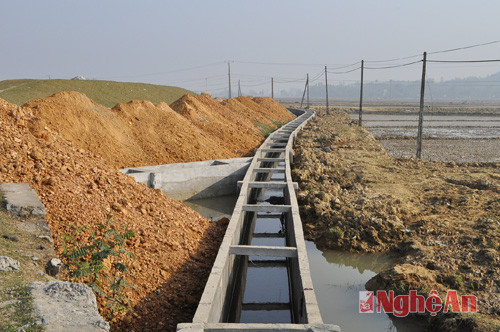 |
| The irrigation canals serving the three low-lying communes of Da, Trung, and Thuan Son are currently being upgraded. |
Based on that understanding, after discussion and consultation with the people, the Party Committee of the commune decided to use the entire commune as the unit for land conversion. Accordingly, all land would be reclaimed and reallocated to the people in a "convenient farming, convenient living" manner, meaning that fields near a hamlet would first be allocated to the people of that hamlet for cultivation, and only if there was surplus land would it be allocated to a closer hamlet. In addition, the commune determined that stable, fertile production land would be included in the long-term land allocation plan for the people according to Decree 64/CP; while barren, infertile land lacking irrigation would be included in the 5% land allocation to balance the needs of some hamlets and people who require land for production under contract.
Based on the commune's resolution, each Party committee and hamlet committee continued to hold meetings to develop a land conversion plan for their respective hamlets. The process of developing the conversion plan and conducting the land inventory encountered many problems. Therefore, for several months, residents often witnessed meetings of the commune's Party Standing Committee with Party committees and hamlet officials lasting from early evening, sometimes until 1 or 2 a.m., to discuss and calculate the most suitable land allocation plan for each hamlet.
Not only did they participate in discussions and meetings, but some key officials and Party members in the commune and hamlets, such as Comrade Le Xuan Toan, Head of the Commune Police, and Nguyen Huu Thanh, Head of Hamlet 4, also set an example by taking on low-grade land near their families to invest in renovating and redesigning it for the villagers to follow.
Witnessing the responsibility and diligence of the commune leaders, the fairness and objectivity of the village committee, and the exemplary conduct of officials and Party members, the people, who were initially skeptical, have now fully agreed with the commune's land consolidation and exchange policy. Many households that previously had doubts about the quality of the land have now set aside their concerns and accepted the conversion. In addition to contributing funds for the conversion as stipulated by the commune and village, people in some villages with terraced farming land, such as villages 3, 4, and 7, have also contributed at least 1 million to a maximum of 17 million VND per household to level the fields, improve, and restore the land according to their farming model.
Mr. Hoang Van Binh, residing in Hamlet 4, Trung Son Commune, is one such household. With 6 plots of rice paddy land and 1 leased plot (approximately 12 sao), his family previously owned 17-18 plots. After the land consolidation under Directive 02 and the land redistribution under Decree 64, his family was left with only 4-5 plots. Now, with the government's policy of "land consolidation and exchange," he requested the commune to consolidate 7 plots of land into one in front of his house. The land in front of his house wasn't as good as the previous plots, so he had to invest nearly 17 million VND and spend almost a month leveling and redesigning the entire area to make it suitable.
Mr. Binh said: "Previously, my family's farmland was good and had higher yields, but because it was located in many different places, requiring a lot of travel and effort for maintenance, it wasn't very efficient. The current plot of land is near my house, so I understand the soil and irrigation conditions of this area well. Therefore, I boldly took it on to improve, protect, and care for it. In the higher areas, I will plant peanuts, beans, and vegetables; in the lower areas, I will grow rice during the main crop season and fish-rice farming during the summer-autumn season. I believe that if things go well, I will recoup my investment within a year. In the near future, I plan to work with several households in the village to find high-quality rice varieties suitable for the irrigation characteristics of our village."
After nearly a year of implementation, the land consolidation and exchange program in Trung Son has been completed. Because it wasn't designated as a pilot commune, the commune mobilized contributions from residents over two years to secure funding, averaging 250,000 VND per person. Upon completion, the commune invested approximately 1.2 billion VND, including over 600 million VND in construction, excavating over 74,000 cubic meters of earth for drainage canals, and building over 200 access roads to the fields. Unlike before, when each household owned 5-7 plots in various fields, now, out of a total of 1,230 households receiving land totaling 441 hectares, the average number of plots per household is only 1.7. Specifically, 500 households own 1 plot (40%), 400 households own 2 plots (33%), and 330 households own 3 plots (27%).
Mr. Doan Van Linh, Vice Chairman of the Commune People's Committee, said: After some initial difficulties, Directive No. 08 of the Provincial Party Committee's Standing Committee successfully addressed the people's desire for "convenient farming and settlement," allowing them to invest long-term in agricultural land with peace of mind. Furthermore, recognizing this as a favorable condition for replanning the irrigation and transportation system, the commune mobilized each household to donate 25 square meters of land to expand and upgrade roads to sufficient width for motorized vehicles to transport goods in production. After the land conversion, thanks to dredged canals and culverts, some hamlets did not experience flooding during the recent rainy season. People in the floodplain area, after land conversion, have made significant investments and introduced machinery for corn cultivation, resulting in the commune's 8 hectares of winter corn developing very well this year and promising a high harvest…
Notably, although not selected as a pilot area, thanks to determination and effort, Trung Son was one of the first two communes in Do Luong (along with Thuan Son commune) to complete land consolidation and reallocation early. This success was achieved thanks to the concerted efforts of the Party Committee, government, and people of Trung Son, who were determined to create favorable conditions for the rapid progress of new rural development in the area.
Text and photos:Nguyen Hai