

Actively cover the rice seedlings with plastic sheeting.
(Baonghean) - Spring crop production often faces severe cold weather, so in recent years people have focused on protecting rice seedlings from the cold by covering them with plastic sheeting to ensure warmth for safe seedling development and a reliable supply of seedlings for transplanting.
Carefully covering the edges of the plastic sheeting around the four rows of newly planted rice seedlings, Ms. Nguyen Thi Huong from Hamlet 8, Nam Trung Commune (Nam Dan District) happily said: “This year the weather is so cold, my family had to carefully cover the seedlings with plastic sheeting. It only cost a little extra to buy the plastic, because if we didn't cover them, the severe cold would kill the seedlings, costing us more money for seeds and delaying the planting schedule. My family cultivates 5 sao (approximately 0.5 hectares) of rice in the spring season. We've just started planting seedlings for long-duration varieties like AC5, glutinous rice varieties 87 and 97, while hybrid rice varieties will be sown around January 10th. To ensure enough seedlings for all 5 sao of rice, my family bought 5 kg of plastic sheeting to cover the entire area where the seedlings are planted. In addition, we've applied phosphorus fertilizer and wood ash to keep the soil warm.”
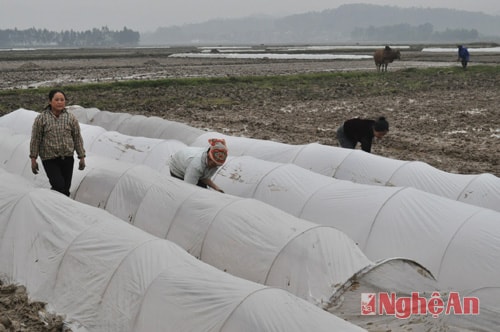 |
| People in Nam Trung commune (Nam Dan district) are covering rice seedlings with plastic sheeting to protect them from the cold. |
In addition, Mrs. Nguyen Thi Hanh's household in Hamlet 3, Nam Trung Commune, is also covering her early spring rice seedlings with plastic sheeting. With 7.5 sao (approximately 0.75 hectares) of land for spring planting, Mrs. Hanh has purchased nearly 7 kg of plastic sheeting to cover the entire area. For spring planting, her family annually implements measures to protect the seedlings from the cold, ensuring a consistent supply of seeds, healthy seedlings, and well-developed rice plants for high yields.
For the 2014 spring crop, Nam Trung commune planned to plant 323.6 hectares of rice, 70 hectares of peanuts, 30 hectares of corn, and about 20 hectares of other crops. Of this, 30 hectares were planted with the long-growing X23 pure rice variety, so farmers started sowing seedlings on December 8, 2013, and covered them 100% with plastic sheeting. 43 hectares of Tra 2, glutinous rice varieties 87 and 97, and pure rice varieties AC5 and BC15 were sown on December 20, also covered 100% with plastic sheeting. For the 200 hectares of hybrid rice, sowing will take place between January 12-14. Mr. Pham Van Phuong, Head of the Agriculture Committee of Nam Trung commune, said: "Every year, the people of Nam Trung proactively protect their seedlings from the cold because they consider it a way to ensure their family's benefit. In recent years, farmers have been very自觉 (self-aware) in covering seedlings with plastic sheeting when sowing spring seedlings." To date, the entire commune has received 1.8 tons of plastic sheeting (subsidized by the province and district), and in addition, people have purchased an extra 600 kg of plastic sheeting, ensuring enough plastic sheeting to protect the entire rice seedling area from the cold. Besides covering with plastic sheeting, local people are increasing the application of phosphorus fertilizer and wood ash, maintaining water in the fields, and keeping the seedlings warm to ensure the quality of the seed source. To date, the early rice seedlings are over 20 days old, and despite the severe cold, they are developing normally. The people have complete confidence in these traditional cold protection measures. The commune is strengthening inspections and providing timely guidance to the people. If the severe cold persists, the people will be instructed to take timely corrective measures, ensuring that the seedlings cover the entire production area in all cases.
Further north in Do Luong district, although planting hasn't begun yet, local farmers have already prepared supplies to protect their seedlings from the cold. Due to the seasonal conditions this year, all rice seedlings are sown during the period of mild to severe cold, so the people have decided to cover them 100% with plastic sheeting. Severe cold weather often affects seed germination and seedling growth; covering seedlings with plastic sheeting not only helps proactively protect them from the cold but also offers other benefits such as preventing pests that transmit diseases like yellow dwarf, leaf curl, and black stripe dwarf; and shortening the seedling stage, with seedlings reaching 3 leaves after only 15-16 days.
Ms. Dao Thi Son's family in Hamlet 1, Nhan Son Commune (Do Luong District) is skillfully using bamboo poles to make supports for their rice seedlings. Ms. Son carefully reminds her husband to securely fasten the edges of the plastic sheeting to the edges of the seedling beds, creating a completely sealed enclosure that won't be blown open by the wind. Ms. Son's family cultivates 4 sao (approximately 0.4 hectares) of spring rice, including 2 sao in the Hoc Cho area where seedlings were sown on December 31st. After a week, they will open the plastic sheeting at both ends to allow the seedlings to acclimate to the environment. Ms. Son's husband shared: "In 2008, there was a model of covering seedlings with plastic sheeting in the commune. Seeing that the seedlings grew quickly and safely, everyone in the commune has followed suit, using plastic sheeting to protect spring seedlings from the cold, ensuring good quality seedlings for transplanting and healthy rice plant growth."
In cold weather, rice seedlings without plastic sheeting are very susceptible to freezing. Even if the seedlings remain stable, it takes over 30 days before they can be transplanted. Furthermore, the long growth period means older seedlings must be transplanted densely, which wastes seeds and increases the risk of pests and diseases, resulting in low rice yields. In contrast, seedlings covered with plastic sheeting can be transplanted in just 15-20 days, and the young seedlings, when planted sparsely, save seeds and yield higher productivity. "Every year, my family does a good job of protecting the seedlings from the cold and planting sparsely, so the yield of our hybrid rice crop in the spring always averages 4.5 quintals per sao (approximately 1000 square meters), and we rarely have to spray pesticides." Mr. Dang Huu Tu, from Hamlet 4, Thuan Son Commune (Do Luong District), proudly shared that he carefully stores his frame for covering the seedlings and uses it every spring. For the past 5-6 years, his family has consistently covered the seedlings with plastic sheeting, ensuring their safe growth even in severe cold weather.
Mr. Phan Ba Binh, Chairman of Thuan Son Agricultural Cooperative, said: In the spring of 2014, Thuan Son commune cultivated 154 hectares of rice, 40 hectares of peanuts, and 85 hectares of corn. The entire rice area was covered with plastic sheeting. To date, the cooperative has supplied 1.2 tons of plastic sheeting for rice seedlings to each household, and nearly 4 tons of plastic sheeting for peanuts, ensuring 100% coverage of the peanut crop. Farmers in Thuan Son commune have a relatively high level of intensive farming expertise, regularly applying scientific and technical advancements to production. Covering seedlings with plastic sheeting to protect against cold has been a practice for many years. Similarly, peanuts grown under plastic sheeting thrive, resulting in higher tillering and fruit production. This ensures adequate moisture, allowing the seedling-forming rays to come into contact with the soil, leading to more tuber formation and approximately 10% higher yields compared to peanuts grown without plastic sheeting.
In the spring of 2014, Do Luong district had a total rice planting area of 7,500 hectares. To serve this area, approximately 170 hectares of rice seedlings needed to be covered. The district prepared and supplied the communes with 27 tons of plastic sheeting for covering the seedlings. Given the complex weather conditions, including prolonged severe cold, the Do Luong District People's Committee directed the communes to develop plans to cover the seedlings to be sown using plastic sheeting to protect them from the cold, proactively prevent and control yellow dwarf and twisted dwarf diseases, and adhere to the district's planting schedule. Any unit that fails to follow the procedure and results in seedlings dying from the cold will hold the commune's People's Committee chairman accountable to the District People's Committee.
Quynh Lan