

Opportunities to get rich from raising Dong Tao chickens.
(Baonghean) - I had always been fascinated by the Dong Tao chickens depicted in Dong Ho folk paintings, and through the media, I knew that this was a precious breed that scientists had diligently researched to preserve its genetic resources. However, I had never seen one with my own eyes. Recently, on a spring day in the Year of the Horse, I visited two war veterans in Vinh City and saw some Dong Tao chickens. I suddenly wondered why the agricultural extension sector hadn't investigated and replicated this model...
Two veterans raise Dong Tao chickens.
Veterans in Vinh City who raise Dong Tao chickens include Lieutenant Colonel Nguyen Sy Lap (Xuan Trung block, Hung Dung ward) and Colonel Nguyen Ba Dan (Mau Don hamlet, Hung Loc commune).
Mr. Nguyen Sy Lap's story of raising Dong Tao chickens is quite unique. Previously, he and his wife raised black chickens and bantam chickens. One day, his daughter and son-in-law from Hanoi came to visit. While touring his farm, the son-in-law laughed and said, "You'll only get a few dozen clean eggs for the grandchildren; the profit probably won't be much..." Hearing his son-in-law's comment, Mr. Lap replied, "I raise these for enjoyment in my old age, not for profit." Seeing his father-in-law's slight offense, the son-in-law said, "Well, you've already invested your time and effort. Let me see if there's a suitable breed I can bring back..." A short time later, the son-in-law called and said, "Dad, come to Hanoi to visit us for a few days, and then I'll ask my roommate to take you to Khoai Chau, Hung Yen to see how they raise Dong Tao chickens." Hearing this, Mr. Lap searched for information about this breed on Google and immediately took a bus to Hanoi. "Wow. You can't imagine how I felt seeing people raise Dong Tao chickens with my own eyes. They are the king of chickens. No wonder they're called 'chickens fit for a king.' Some are raised for 5-7 years, weighing 7-8 kg, and costing tens of millions of dong. Just look at their legs—they're truly terrifying, easily weighing 1 kg, with shiny, layered scales like pangolin scales..."
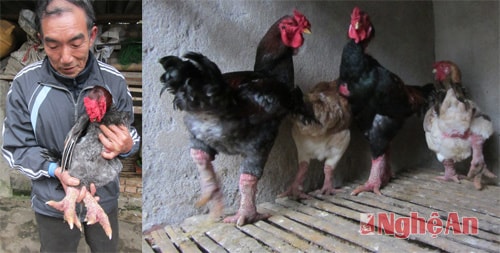 |
| Mr. Lap with his Dong Tao rooster weighing over 4kg. |
He became fascinated with and determined to raise Dong Tao chickens from then on. He saved up enough money to buy 12 chickens, including 5 roosters and 7 hens, weighing between 0.5 and 1 kg each, at a price of 350,000 VND per chicken. At the same time, he meticulously researched and recorded information on how to raise them, from disease prevention and control to how to care for them. Thanks to good care, Mr. Lap's Dong Tao chickens grew incredibly fast. After nearly 9 months, they weighed between 3.5 and 4.4 kg. Each chicken was large, majestic, with reddish-brown skin and sturdy legs. The roosters had two basic feather colors: black and plum, with large, rough, scaly legs, thick feet, and four splayed, well-proportioned toes. Their combs were also very distinctive: short, compact, and strong, reddish-purple combs. The hens had completely different feather colors from the roosters. Its feathers are pale yellow, tinged with milky white, with yellow and dark brown feathers on the neck and wings. The rest is exactly like a rooster, from its red skin and wrinkled comb to its sturdy, strong legs.
Mr. Lap recounted that after four months, the hens started laying eggs, with each hen producing 7-8 eggs per month. Determined to increase the number of chicks to make his trip to Hung Yen worthwhile, he was overjoyed every time a hen laid an egg. His first attempt at hatching was a struggle due to lack of experience. Dong Tao chicken eggs have thicker shells than regular chicken eggs, and the hatchery owner, unaware of this, set an unsuitable temperature. The shells didn't crack, and all the chicks suffocated inside. Learning from this experience, the second time he divided the eggs in half: one half sent to the hatchery, and the other half kept at home for his own hens to incubate. This time, he was quite successful. From 30 eggs, he got 18 Dong Tao chicks with off-white feathers, weighing 38-40 grams each.
He said, "It turns out that using native chickens for incubation is better. The hatching rate is much higher than in incubators..." To date, after 9 months, Mr. Lap has a total flock of nearly 70 Dong Tao chickens. When asked if it's profitable, he replied, "I haven't calculated it yet, so I can't say. Going to my friend's house would be clearer. Colonel Dan's house in Mau Don hamlet is like a livestock farm. Along with Dong Tao chickens, Mr. Dan also raises porcupines, pheasants, French pigeons, Peking chickens, native chickens... Regarding Dong Tao chickens, he said he's been raising them for about five years. Initially, he even traveled to Khoai Chau, Hung Yen to buy the chicks. The economic benefits are definitely there. Dong Tao chicken meat is delicious, sweet, with a thick, plump, reddish-pink breast, and muscular thighs with intertwined muscles that are smooth and not tough. The price of commercial chicken used to be 600-700 thousand dong/kg. Currently, it's around 350 thousand dong/kg, but there's hardly any to sell. During Tet (Vietnamese New Year), when customers buy chickens as gifts, some roosters weighing 9 kg can fetch prices as high as 32 million VND...
Opening the path to wealth
The economic aspect is clear, but is raising them very complicated? According to Mr. Lap, Dong Tao chickens are very gentle, not destructive or prone to jumping around like native chickens. They have small crops, eat little, and therefore produce little waste. They only like to eat grains like corn, rice, and some types of vegetables like water spinach and amaranth..., and absolutely do not eat industrial feed, so raising them is not too difficult. However, breeding them is quite a laborious process. Mr. Dan said that raising Dong Tao chickens was somewhat complicated at first. For example, when he and his wife first brought home chicks, almost all of them died. "It was because we lacked experience. After researching, we learned that chickens moved to a new environment get sick, and we had to take good care of them with medicine to raise them successfully," Mr. Dan recounted. Mr. Dan's family has also bred and expanded their flock, even crossbreeding Dong Tao chickens with other breeds. He said: "F1 and F2 hybrid Dong Tao chickens produce meat that tastes much better than native chickens." My breeding stock is getting too old, so I'm trying to persuade Mr. Lap to leave behind a few purebred animals so we can continue breeding.
When asked about breeding Dong Tao chickens, Mr. Lap explained that the entire process, from incubation to raising chicks, is very elaborate. Dong Tao chicks are unusual. Their downy feathers fall off after a few days, making way for new ones. Furthermore, they have less feathers than native chickens, making them extremely sensitive to cold weather. The coop must be well-ventilated but also warm enough; otherwise, the chicks will die immediately. Mr. Lap and his wife covered the entire backyard with a roof to protect against rain, and built small coops, about 1 square meter each, high and dry, sealed on three sides, with ventilation only on the south side. Each coop has a 100W light bulb. Another piece of advice from Mr. Lap is: "You have to know how to prevent disease, from administering nasal drops, oral medication, and injections according to proper procedures. At the same time, you have to listen to the weather forecast. When it's freezing cold, I even use a 200W light bulb to warm the chicks all day long..."
I searched on Google for information about Dong Tao chickens. Currently, raising Dong Tao chickens is not only prevalent in Khoai Chau, Hung Yen, but has spread to many areas nationwide. From Hai Duong, Bac Ninh, and Vinh Yen to southern provinces like Khanh Hoa and Dong Nai, and even Ho Chi Minh City. Many families have become wealthy thanks to raising Dong Tao chickens. However, Nghe An province is not on that list. Upon inquiring with Mr. Nguyen Sy Lap and Mr. Nguyen Ba Dan, I learned that some families in Nghe An are starting to raise Dong Tao chickens, but on a small scale, mainly for family consumption or as pets. "It's the same for us; raising Dong Tao chickens is a hobby for the elderly, a form of exercise suitable for our abilities..." Mr. Lap explained. However, based on what I've heard and seen, Dong Tao chickens are indeed a valuable breed and could be a suitable business opportunity for farming families. Through their farming practices, it's clear that Dong Tao chickens can thrive in Nghe An province if properly cared for. Furthermore, the province has abundant grains like corn and rice to feed the chickens. Why doesn't the Agricultural Extension Department investigate and introduce another breed to farmers for household economic development?
Text and photos:Nhat Lan